The Spanish Origin of International Law: Francisco de Vitoria and his law of nations
Book information
Description
Study of Vitoria by a leading figure in twentieth-century international law. Originally published: Oxford: Clarendon Press, 1934. 19a, 288, [6], clviii pp. Francisco de Vitoria [c.1483-1546] was a founder of international law. Scott holds that Vitoria's doctrines, popularized in his important Reflectiones, De Indis Noviter Inventis and De Jure Belli (the text of these are included in the appendix), are in fact the first works to address the law of nations, which was to become the international law of Christendom and the world at large. Vitoria held that pagans were entitled to freedom and property, declared slavery to be unsound and upheld the rights of Indians. He also questioned the legitimacy of Spain's recent conquest of the New World. This was the source of his thesis that the community of nations transcends Christendom. One of the greatest figures in modern international law, James Brown Scott [1866-1943] was the guiding force behind the American Society of International Law, and was editor-in-chief of the American Journal of International Law. He played a key role in several important diplomatic conferences and was secretary of the Carnegie Endowment for International Peace. His books include The American Institute of International Law: Its Declaration of the Rights and Duties of Nations (1916), The Catholic Conception of International Law (1934) and Law, The State and the International Community (1939).
Similar books

Law, the State, and the International Community. Volume One. a Commentary on the Development of Legal, Political, and International Ideals
2019 · PDF

Two cheers for anarchism : six easy pieces on autonomy, dignity, and meaningful work and play
2012 · PDF
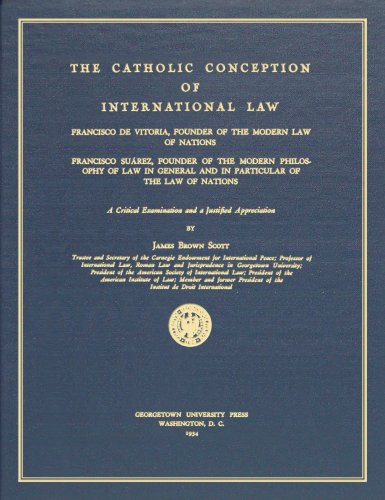
The Catholic Conception of International Law
2007 · PDF

MySQL® Notes for Professionals book
2018 · PDF

MrExcel 2022: Boosting Excel
2022 · PDF

MrExcel 2022: Boosting Excel
2022 · PDF

Session C11: Ancient Cultural Landscapes in South Europe – their Ecological Setting and Evolution, Session C22: Gardeners from South America, Session S04: Agro-Pastoralism and Early Metallurgy Sessions, Session WS29: The Idea of Enclosure in Recent Iberian Prehistory, Session C88: Rhytmes et causalites des dynamiques de l'anthropisation en Europe entre 6500 ET 500 BC: Hypotheses socio-culturelles et/ou climatiques: Proceedings of the XV UISPP World Congress (Lisbon 4-9 September 2006) / Actes du XV Congrès Mondial (Lisbonne 4-9 Septembre 2006) Vol.36
2010 · PDF

THE BRITISH ARMY IN INDIA: ITS PRESERVATION BY AN APPROPRIATE CLOTHING, HOUSING, LOCATING, RECREATIVE EMPLOYMENT, AND HOPEFUL ENCOURAGEMENT OF THE TROOPS. with AN APPENDIX ON INDIA : THE CLIMATE OP ITS HILLS ; THE DEVELOPMENT OF ITS RESODRCBS, INDUSTRY, AND ARTS ; THE ADMINISTRATION OF JUSTICE ; THE BLACK ACT ; THE PROGRESS OF CHRISTIANITY ; THE TRAFFIC IN OPIUM ; THE VALUE OF INDIA ; PERMANENT CAUSES OF DISAFFECTION, AND OF THE RECENT REBELLION ; THE TRADITIONARY POLICY; MISGOVERNMENT BY NATIVE RULERS ; ANNEXATIONS OF THEIR TERRITORY, ETC.
1858 · PDF