Deep Learning with TensorFlow: Explore neural networks and build intelligent systems with Python, 2nd Edition
Book information
Description
Delve into neural networks, implement deep learning algorithms, and explore layers of data abstraction with the help of this comprehensive TensorFlow guide Key Features Learn how to implement advanced techniques in deep learning with Google's brainchild, TensorFlow Explore deep neural networks and layers of data abstraction with the help of this comprehensive guide Real-world contextualization through some deep learning problems concerning research and application Book Description Deep learning is the step that comes after machine learning, and has more advanced implementations. Machine learning is not just for academics anymore, but is becoming a mainstream practice through wide adoption, and deep learning has taken the front seat. As a data scientist, if you want to explore data abstraction layers, this book will be your guide. This book shows how this can be exploited in the real world with complex raw data and has been fully updated to the latest version of TensorFlow 1.x. Throughout the book, you'll learn how to implement deep learning algorithms for machine learning systems and integrate them into your product offerings, including search, image recognition, and language processing. Additionally, you'll learn how to analyze and improve the performance of deep learning models. This can be done by comparing algorithms against benchmarks, along with machine intelligence, to learn from the information and determine ideal behaviors within a specific context. After finishing the book, you will be familiar with machine learning techniques, in particular the use of TensorFlow for deep learning, and will be ready to apply your knowledge to research or commercial projects. What you will learn Learn about machine learning landscapes along with the historical development and progress of deep learning Learn about deep machine intelligence and GPU computing with the latest TensorFlow 1.x Access public datasets and utilize them using TensorFlow to load, process, and transform data Use TensorFlow on real-world datasets, including images, text, and more Learn how to evaluate the performance of your deep learning models Using deep learning for scalable object detection and mobile computing Train machines quickly to learn from data by exploring reinforcement learning techniques Explore active areas of deep learning research and applications Who This Book Is For The book is intended for a general audience of people interested in machine learning and machine intelligence. A rudimentary level of programming in one language is assumed, as is a basic familiarity with computer science techniques and technologies, including a basic awareness of computer hardware and algorithms. Some competence in mathematics is needed to the level of elementary linear algebra and calculus. Cover Copyright Packt Upsell Contributors Table of Contents Preface Chapter 1: Getting Started with Deep Learning A soft introduction to machine learning Supervised learning Unbalanced data Unsupervised learning Reinforcement learning What is deep learning? Artificial neural networks The biological neurons The artificial neuron How does an ANN learn? ANNs and the backpropagation algorithm Weight optimization Stochastic gradient descent Neural network architectures Deep Neural Networks (DNNs) Multilayer perceptron Deep Belief Networks (DBNs) Convolutional Neural Networks (CNNs) AutoEncoders Recurrent Neural Networks (RNNs) Emergent architectures Deep learning frameworks Summary Chapter 2: A First Look at TensorFlow A general overview of TensorFlow What's new in TensorFlow v1.6? Nvidia GPU support optimized Introducing TensorFlow Lite Eager execution Optimized Accelerated Linear Algebra (XLA) Installing and configuring TensorFlow TensorFlow computational graph TensorFlow code structure Eager execution with TensorFlow Data model in TensorFlow Tensor Rank and shape Data type Variables Fetches Feeds and placeholders Visualizing computations through TensorBoard How does TensorBoard work? Linear regression and beyond Linear regression revisited for a real dataset Summary Chapter 3: Feed-Forward Neural Networks with TensorFlow Feed-forward neural networks (FFNNs) Feed-forward and backpropagation Weights and biases Activation functions Using sigmoid Using tanh Using ReLU Using softmax Implementing a feed-forward neural network Exploring the MNIST dataset Softmax classifier Implementing a multilayer perceptron (MLP) Training an MLP Using MLPs Dataset description Preprocessing A TensorFlow implementation of MLP for client-subscription assessment Deep Belief Networks (DBNs) Restricted Boltzmann Machines (RBMs) Construction of a simple DBN Unsupervised pre-training Supervised fine-tuning Implementing a DBN with TensorFlow for client-subscription assessment Tuning hyperparameters and advanced FFNNs Tuning FFNN hyperparameters Number of hidden layers Number of neurons per hidden layer Weight and biases initialization Selecting the most suitable optimizer GridSearch and randomized search for hyperparameters tuning Regularization Dropout optimization Summary Chapter 4: Convolutional Neural Networks Main concepts of CNNs CNNs in action LeNet5 Implementing a LeNet-5 step by step AlexNet Transfer learning Pretrained AlexNet Dataset preparation Fine-tuning implementation VGG Artistic style learning with VGG-19 Input images Content extractor and loss Style extractor and loss Merger and total loss Training Inception-v3 Exploring Inception with TensorFlow Emotion recognition with CNNs Testing the model on your own image Source code Summary Chapter 5: Optimizing TensorFlow Autoencoders How does an autoencoder work? Implementing autoencoders with TensorFlow Improving autoencoder robustness Implementing a denoising autoencoder Implementing a convolutional autoencoder Encoder Decoder Fraud analytics with autoencoders Description of the dataset Problem description Exploratory data analysis Training, validation, and testing set preparation Normalization Autoencoder as an unsupervised feature learning algorithm Evaluating the model Summary Chapter 6: Recurrent Neural Networks Working principles of RNNs Implementing basic RNNs in TensorFlow RNN and the long-term dependency problem Bi-directional RNNs RNN and the gradient vanishing-exploding problem LSTM networks GRU cell Implementing an RNN for spam prediction Data description and preprocessing Developing a predictive model for time series data Description of the dataset Pre-processing and exploratory analysis LSTM predictive model Model evaluation An LSTM predictive model for sentiment analysis Network design LSTM model training Visualizing through TensorBoard LSTM model evaluation Human activity recognition using LSTM model Dataset description Workflow of the LSTM model for HAR Implementing an LSTM model for HAR Summary Chapter 7: Heterogeneous and Distributed Computing GPGPU computing The GPGPU history The CUDA architecture The GPU programming model The TensorFlow GPU setup Update TensorFlow GPU representation Using a GPU GPU memory management Assigning a single GPU on a multi-GPU system The source code for GPU with soft placement Using multiple GPUs Distributed computing Model parallelism Data parallelism The distributed TensorFlow setup Summary Chapter 8: Advanced TensorFlow Programming tf.estimator Estimators Graph actions Parsing resources Flower predictions TFLearn Installation Titanic survival predictor PrettyTensor Chaining layers Normal mode Sequential mode Branch and join Digit classifier Keras Keras programming models Sequential model Functional API Summary Chapter 9: Recommendation Systems Using Factorization Machines Recommendation systems Collaborative filtering approaches Content-based filtering approaches Hybrid recommender systems Model-based collaborative filtering Movie recommendation using collaborative filtering The utility matrix Description of the dataset Ratings data Movies data Users data Exploratory analysis of the MovieLens dataset Implementing a movie RE Training the model with the available ratings Inferencing the saved model Generating the user-item table Clustering similar movies Movie rating prediction by users Finding top k movies Predicting top k similar movies Computing user-user similarity Evaluating the recommender system Factorization machines for recommendation systems Factorization machines Cold-start problem and collaborative-filtering approaches Problem definition and formulation Dataset description Workflow of the implementation Preprocessing Training the FM model Improved factorization machines Neural factorization machines Dataset description Using NFM for the movie recommendation Summary Chapter 10: Reinforcement Learning The RL problem OpenAI Gym OpenAI environments The env class Installing and running OpenAI Gym The Q-Learning algorithm The FrozenLake environment Deep Q-learning Deep Q neural networks The Cart-Pole problem Deep Q-Network for the Cart-Pole problem The Experience Replay method Exploitation and exploration The Deep Q-Learning training algorithm Summary Other Books You May Enjoy Leave a review – let other readers know what you think Index
Similar books

Deep Learning with TensorFlow
2018 · EPUB

Deep Learning with TensorFlow
2018 · EPUB
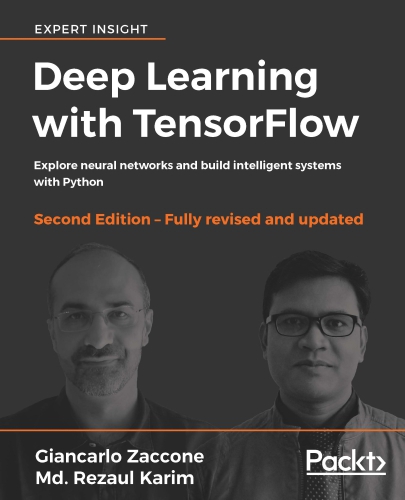
Deep Learning with TensorFlow
2018 · EPUB

Deep Learning with TensorFlow: Explore neural networks with Python. Code
2017 · ZIP

Deep Learning with TensorFlow: Explore neural networks with Python
2017 · EPUB

Deep Learning with TensorFlow
2018 · EPUB

Deep Learning with TensorFlow: Explore neural networks with Python
2017 · PDF

Hands-on Deep Learning for Iot
2019 · PDF