Cogent science in context: the science wars, argumentation theory, and Habermas
Book information
Description
Recent years have seen a series of intense, increasingly acrimonious debates over the status and legitimacy of the natural sciences. These "science wars" take place in the public arena--with current battles over evolution and global warming--and in academia, where assumptions about scientific objectivity have been called into question. Given these hostilities, what makes a scientific claim merit our consideration? In Cogent Science in Context, William Rehg examines what makes scientific arguments cogent--that is, strong and convincing--and how we should assess that cogency. Drawing on the tools of argumentation theory, Rehg proposes a multidimensional, context-sensitive framework both for understanding the cogency of scientific arguments and for conducting cooperative interdisciplinary assessments of the cogency of actual scientific arguments. Rehg closely examines J?rgen Habermas's argumentation theory and its implications for understanding cogency, applying it to a case from high-energy physics. A series of problems, however, beset Habermas's approach. In response, Rehg outlines his own "critical contextualist" approach, which uses argumentation-theory categories in a new and more context-sensitive way inspired by ethnography of science.
Similar books

Insight and Solidarity: The Discourse Ethics of Jürgen Habermas
2023 · PDF
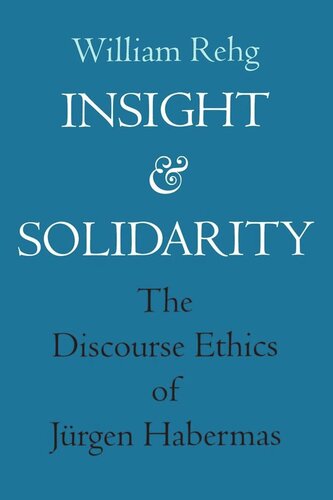
Insight and Solidarity: The Discourse Ethics of Jürgen Habermas
2023 · PDF

Insight and Solidarity: The Discourse Ethics of Jurgen Habermas
1997 · PDF

Insight and Solidarity: The Discourse Ethics of Jürgen Habermas (Philosophy, Social Theory, and the Rule of Law)
1997 · PDF

Deliberative Democracy: Essays on Reason and Politics
1997 · PDF

Pluralism and the Pragmatic Turn: The Transformation of Critical Theory, Essays in Honor of Thomas McCarthy
2001 · PDF

MySQL® Notes for Professionals book
2018 · PDF

MrExcel 2022: Boosting Excel
2022 · PDF