Why Europe Grew Rich and Asia Did Not: Global Economic Divergence, 1600–1850
Book information
Description
Why Europe Grew Rich and Asia Did Not provides a striking new answer to the classic question of why Europe industrialized from the late eighteenth century and Asia did not. Drawing significantly from the case of India, Prasannan Parthasarathi shows that in the seventeenth and eighteenth centuries, the advanced regions of Europe and Asia were more alike than different, both characterized by sophisticated and growing economies. Their subsequent divergence can be attributed to different competitive and ecological pressures that in turn produced varied state policies and economic outcomes. This account breaks with conventional views, which hold that divergence occurred because Europe possessed superior markets, rationality, science, or institutions. It offers instead a groundbreaking rereading of global economic development that ranges from India, Japan and China to Britain, France, and the Ottoman Empire and from the textile and coal industries to the roles of science, technology, and the state. [email protected]@9677835A6EEE0659C59278B48DC1E429 (1) Outline placeholder [email protected]@8402879160CEDFE1C6A519954CC569F5 Outline placeholder abbreviations Outline placeholder introduction Outline placeholder Chapter 1: Introduction On European difference Parallels in Eurasia From anachronism to context On regions and comparisons Anote on sources The plan of the book [email protected]@E806AAD8E13E627FBCF1EAEBBC955BDA Outline placeholder Part 1: Setting the stage: Europe and Asia before divergence india-and-the-global-economy-16001800 Outline placeholder Chapter 2: India and the global economy, 1600-1800 Introduction The global trade in cotton textiles The appeal of Indian cottons Aesthetics and fashion Quality The question of price Low Indian wages&e_x003F; Bullion in the global economy Conclusion political-institutions-and-economic-life Outline placeholder Chapter 3: Political institutions and economic life Introduction The state Property, markets and commercial life Caste and commerce Property rights and agriculture Demography and ecology Max Weber and individual and social rationality Conclusion [email protected]@7AAB2BABB5F15A27ADAD20017DF226E2 Outline placeholder Part 2: The divergence of Britain the-european-response-to-indian-cottons Outline placeholder Chapter 4: The European response to Indian cottons Introduction Imitation of Indian cottons: calico printing The West African trade Innovation in British cotton spinning Histories of the British cotton industry More eighteenth&e_x2010;century voices Smithian political economy and the British cotton industry Conclusion state-and-market-britain-france-and-the-ottoman-empire Outline placeholder Chapter 5: State and market: Britain, France and the Ottoman Empire Introduction Indian cottons in the Ottoman Empire Egypt Anatolia Ottoman imitations of Indian cloth State policy and textile manufacturing: the British case Economic philosophy and state policy: the Ottoman Empire The Atlantic market French cottons: state policy and the Atlantic trade Conclusion from-cotton-to-coal Outline placeholder Chapter 6: From cotton to coal Introduction The cotton revolution The cotton revolution and energy Ecological change in Eurasia Why Britain&e_x003F; The British state and iron The state and coal in China The state and forests in the Yangzi and Japan Whither India&e_x003F; [email protected]@71F61A24756A53F6BD1DD7D1051C7D0D Outline placeholder Part 3: The Indian path science-and-technology-in-india-16001800 Outline placeholder Chapter 7: Science and technology in India, 1600-1800 Introduction From European to global science Science in India Scientific activity in India Technological change in the Indian subcontinent Regimes of useful knowledge Conclusion: the mindful hand modern-industry-in-early-nineteenthcentury-india Outline placeholder Chapter 8: Modern industry in early nineteenth-century India Introduction The debate on the nineteenth&e_x2010;century Indian economy New industrial techniques in the Indian subcontinent Cotton spinning Steam engines Coal mining Shipbuilding Iron working Industrialization in early nineteenth&e_x2010;century India State and economy in nineteenth&e_x2010;century Europe The state and trade policy State support for technological capability State enterprises State and economy in nineteenth&e_x2010;century India Conclusion conclusion Outline placeholder Chapter 9: Conclusion notes-to-the-text Outline placeholder 1 2 3 4 5 6 7 8 9 Primary sources Manuscript Archives of the Royal Society of Arts Bolton Central Library, Bolton British Library, London Asia, Pacific and Africa Collections Department of Manuscripts John Rylands Library, Manchester Manchester Central Library bibliography Outline placeholder National Archives of the United Kingdom: Public Record Office, Kew Printed Secondary works Unpublished [email protected]@40CB59A6CE127CCADC6C101C4BDEFCD1 Outline placeholder
Similar books
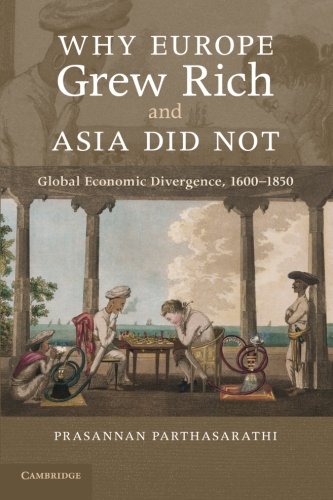
Why Europe Grew Rich and Asia Did Not: Global Economic Divergence, 1600-1850
2011 · PDF

The Transition to a Colonial Economy: Weavers, Merchants and Kings in South India, 1720-1800
2001 · PDF

MySQL® Notes for Professionals book
2018 · PDF

MrExcel 2022: Boosting Excel
2022 · PDF

MrExcel 2022: Boosting Excel
2022 · PDF

Session C11: Ancient Cultural Landscapes in South Europe – their Ecological Setting and Evolution, Session C22: Gardeners from South America, Session S04: Agro-Pastoralism and Early Metallurgy Sessions, Session WS29: The Idea of Enclosure in Recent Iberian Prehistory, Session C88: Rhytmes et causalites des dynamiques de l'anthropisation en Europe entre 6500 ET 500 BC: Hypotheses socio-culturelles et/ou climatiques: Proceedings of the XV UISPP World Congress (Lisbon 4-9 September 2006) / Actes du XV Congrès Mondial (Lisbonne 4-9 Septembre 2006) Vol.36
2010 · PDF

THE BRITISH ARMY IN INDIA: ITS PRESERVATION BY AN APPROPRIATE CLOTHING, HOUSING, LOCATING, RECREATIVE EMPLOYMENT, AND HOPEFUL ENCOURAGEMENT OF THE TROOPS. with AN APPENDIX ON INDIA : THE CLIMATE OP ITS HILLS ; THE DEVELOPMENT OF ITS RESODRCBS, INDUSTRY, AND ARTS ; THE ADMINISTRATION OF JUSTICE ; THE BLACK ACT ; THE PROGRESS OF CHRISTIANITY ; THE TRAFFIC IN OPIUM ; THE VALUE OF INDIA ; PERMANENT CAUSES OF DISAFFECTION, AND OF THE RECENT REBELLION ; THE TRADITIONARY POLICY; MISGOVERNMENT BY NATIVE RULERS ; ANNEXATIONS OF THEIR TERRITORY, ETC.
1858 · PDF

Idries Shah 27 Books Collection : A Perfumed Scorpion, A Veiled Gazelle, Caravan of Dreams, Darkest England, Destination Mecca, Evenings with Idries Shah, Knowing How to Know, Learning How to Learn, Letters and Lectures of Idries Shah, Neglected aspects of Sufi study, Observations, Oriental Magic, Reflections, Seeker after Truth, Special Illumination, Special Problems in the study of Sufi ideas, Sufi thought and action, Tales of the Dervishes, The Dermis Probe, The Elephant in the Dark, The Englishman Handbook, Idries Shah Antology, The Magic Monastery, The natives are restless, wisdom of the Idiots PDF.
2022 · PDF