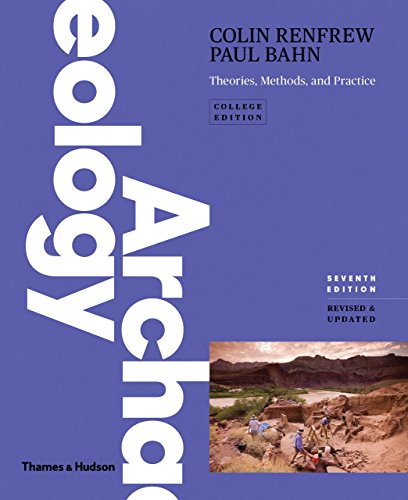
Archaeology: Theories, Methods, and Practice
Book information
Description
Cover Archaeology Contents Preface Introduction: The Nature and Aims of Archaeology Part I The Framework of Archaeology 1 The Searchers: The History of Archaeology The Speculative Phase The Beginnings of Modern Archaeology Classification and Consolidation A Turning Point in Archaeology World Archaeology Summary Further Reading 2 What Is Left? The Variety of the Evidence Types of Archaeological Evidence Formation Processes Cultural Formation Processes—How People Have Affected What Survivesin the Archaeological Record Natural Formation Processes—How Nature Affects What Survives in the Archaeological Record The Archaeological Record and Context Summary Further Reading 3 Where? Survey and Excavation of Sites and Features Discovering Archaeological Sites and Features Assessing the Layout of Sites and Features Excavation Summary Further Reading 4 When? Dating Methods and Chronology Relative Dating Stratigraphy Typology Linguistic Dating Climate Change and Chronology Absolute Dating Calendars and Historical Chronologies Dendrochronology andAnnual Cycles Radioactive Clocks Other Absolute Dating Methods Genetic Dating Chronological Correlations World Chronology Summary Further Reading Part II Discovering the Variety of Human Experience 5 How Were Societies Organized? Social Archaeology Scale of the Society Investigating Hierarchies Collective Works and Communal Action Heterarchies Economic Specialization Centralized Societies Settlements and Territories Further Sources of Information for Social Organization The Archaeology of the Individual and of Identity Summary Further Reading 6 What was the Environment?Environmental Archaeology Investigating Environments on a Global Scale Studying the Landscape: Geoarchaeology Reconstructing the Plant Environment Reconstructing the Animal Environment Reconstructing the Human Environment Summary Further Reading 7 What Did They Eat? Subsistence and Diet Information from Plant Remains Information from Animal Remains Evidence of Animal-Resource Exploitation Assessing Diet from Human Remains Summary Further Reading 8 How Did They Make and Use Tools? Technology and Material Culture Unaltered Materials: Stone Other Unaltered Materials Synthetic Materials Archaeometallurgy Summary Further Reading 9 What Contact Did They Have?Trade and Exchange The Study of Interaction Finding the Sources of Traded Goods: Characterization The Study of Distribution The Study of Production The Study of Consumption Exchange and Interaction: The Complete System Summary Further Reading 10 What Did They Think? Cognition, Art, and Religion The Evolution of Human Symbolizing Faculties How Symbols Were Used Writing Establishing Place: The Location of Memory Measuring the World Planning: Maps for The Future Symbols of Organization and Power Symbols for the "OtherWorld": The Archaeology of Religion Depiction: Art and Representation Music and Cognition Mind and Material Engagement Summary Further Reading 11 Who Were They? What Were They Like? The Bioarchaeology of People Identifying Physical Attributes Assessing Human Abilities Disease, Deformity, and Death Assessing Nutrition Population Studies Diversity and Evolution Identity and Personhood Summary Further Reading 12 Why Did Things Change Explanation in Archaeology The Form of Explanation: General or Particular Migrationist and Diffusionist Explanations The Processual Approach Applications of Processual Archaeology Attempts at Explanation: One Cause or Several? Postprocessual or Interpretive Explanation Cognitive Archaeology The Individual, Agency, and Material Engagement Summary Further Reading Part III The World of Archaeology 13 Archaeology in Action: Five Case Studies Oaxaca: The Origins and Rise of the Zapotec State The Calusa of Florida: A Complex Hunter-Gatherer Society Research Among Hunter-Gatherers: Upper Mangrove Creek, Australia Khok Phanom Di: Rice Farming in Southeast Asia York and the Public Presentation of Archaeology Further Reading 14 Whose Past? Archaeology and the Public The Meaning of the Past: The Archaeology of Identity Archaeological Ethics Community Archaeology Popular Archaeology Versus Pseudoarchaeology Who Owns the Past? The Responsibility of Collectors and Museums Summary Further Reading 15 The Future of the Past: How to Manage the Heritage? The Destruction of the Past The Response: Survey, Conservation, and Mitigation Heritage Management, Display, and Tourism Who Interprets and Presents the Past? The Past for All People and All Peoples What Use Is the Past? Summary Further Reading Glossary Notes Bibliography Useful Websites Acknowledgments Illustration credits Index
Similar books

Archaeology: Theories, Methods and Practice
2020 · PDF

Archaeology Essentials: Theories, Methods, and Practice
2018 · PDF

Archaeology Essentials: Theories, Methods, and Practice
2018 · PDF

Archaeology: Theories, Methods and Practice
2016 · PDF
Archaeology: Theories, Methods, and Practice
2016 · PDF

Archaeology: Theories, Methods, and Practice: Theories, Methods, and Practice)
2012 · PDF

Archaeology: The Key Concepts (Routledge Key Guides)
2004 · PDF

Cave Art: A Guide to the Decorated Ice Age Caves of Europe
2024 · PDF