Global Business
Book information
Description
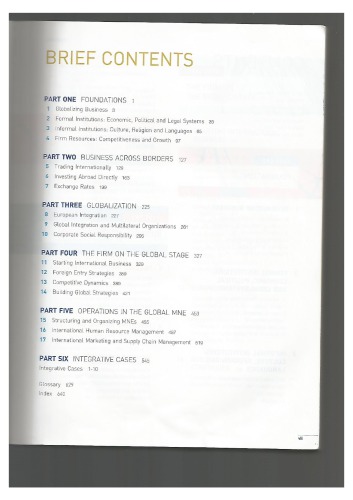
Discover what determines success and failure in firms around the globe with the comprehensive, strategic approach to international business topics in GLOBAL BUSINESS, 2E by renowned international instructor, author, and consultant Mike Peng. This first truly global, global business book integrates both an institutional-based view and resource-based view throughout every chapter for an unparalleled continuity to the learning process. The book?s inviting, conversational style weaves the latest global developments and examples in every chapter, including the impact of the 2008-2009 global economic crisis. A wealth of actual business cases from Mike Peng and other respected international experts, video cases, and unique global debate sections teach you to view business through the eyes of a true world citizen. You gain the perspective you need to become a savvy, effective manager within today's global business landscape. Cover Page Title Page Copyright Page Dedication Page BRIEF CONTENTS CONTENTS PREFACE ABOUT THE AUTHOR Part 1: Laying Foundations Chapter 1: Globalizing Business What Is Global Business? Why Study Global Business? A Unified Framework What Is Globalization? Global Business and Globalization at a Crossroads Organization of the Book Chapter 2: Understanding Formal Institutions: Politics, Laws, and Economics Understanding Institutions What Do Institutions Do? An Institution-Based View of Global Business Political Systems Legal Systems Economic Systems Debates and Extensions Management Savvy Chapter 3: Emphasizing Informal Institutions: Cultures, Ethics, and Norms Where Do Informal Institutions Come From? Culture Cultural Differences Ethics Norms and Ethical Challenges Debates and Extensions Management Savvy Chapter 4: Leveraging Resources and Capabilities Understanding Resources and Capabilities Resources, Capabilities, and the Value Chain: In-House versus Outsourcing Analyzing Resources and Capabilities with a VRIO Framework Debates and Extensions Management Savvy Part 1: PengAtlas 1.1: Developed Economies and Emerging Economies 1.2: The Group of 20 (G-20) 1.3: Political Freedom around the World 1.4: Religious Heritages of the World Part 1: Integrative Cases 1.1: The Chinese Menu (for Development) 1.2: Fighting Counterfeit Motion Pictures 1.3: Brazil’s Embraer: From State-Owned Enterprise to Global Leader 1.4: Shakti: Unilever Collaborates with Women Entrepreneurs in Rural India Part 2: Acquiring Tools Chapter 5: Trading Internationally Why Do Nations Trade? Theories of International Trade Realities of International Trade Debates and Extensions Management Savvy Chapter 6: Investing Abroad Directly Understanding the FDI Vocabulary Why Do Firms Become MNEs by Engaging in FDI? Ownership Advantages Location Advantages Internalization Advantages Realities of FDI How MNEs and Host Governments Bargain Debates and Extensions Management Savvy Chapter 7: Dealing with Foreign Exchange What Determines Foreign Exchange Rates? Evolution of the International Monetary System Strategic Responses to Foreign Exchange Movements Debates and Extensions Management Savvy Chapter 8: Capitalizing on Global and Regional Integration Global Economic Integration Organizing World Trade Regional Economic Integration Regional Economic Integration in Europe Regional Economic Integration in the Americas Regional Economic Integration in the Asia Pacific Regional Economic Integration in Africa Debates and Extensions Management Savvy Part 2: PengAtlas 2.1: Top Ten Merchandise Importers and Exporters 2.2: Top Ten Service Importers and Exporters 2.3: Top Ten Economies for FDI Inflows and Outflows 2.4: The European Union 2.5: Regional Integration in South America 2.6: Regional Integration in the Asia Pacific Part 2: Integrative Cases 2.1: Iceland’s Financial Crisis 2.2: Soybeans in China 2.3: DP World 2.4: Competing in China’s Automobile Industry Part 3: Strategizing around the Globe Chapter 9: Growing and Internationalizing the Entrepreneurial Firm Entrepreneurship and Entrepreneurial Firms Institutions, Resources, and Entrepreneurship Growing the Entrepreneurial Firm Internationalizing the Entrepreneurial Firm Debates and Extensions Management Savvy Chapter 10: Entering Foreign Markets Overcoming the Liability of Foreignness Where to Enter? When to Enter? How to Enter? Debates and Extensions Management Savvy Chapter 11: Managing Global Competitive Dynamics Competition, Cooperation, and Collusion Institutions Governing Domestic and International Competition Resources and Capabilities Influencing Competitive Dynamics Attack, Counterattack, and Signaling Local Firms versus Multinational Enterprises Debates and Extensions Management Savvy Chapter 12: Making Alliances and Acquisitions Work Defining Alliances and Acquisitions Institutions, Resources, Alliances, and Acquisitions Formation of Alliances Evolution and Dissolution of Alliances Performance of Alliances Motives for Acquisitions Performance of Acquisitions Debates and Extensions Management Savvy Chapter 13: Strategizing, Structuring, and Learning around the World Multinational Strategies and Structures How Institutions and Resources Affect Multinational Strategies, Structures, and Learning Worldwide Learning, Innovation, and Knowledge Management Debates and Extensions Management Savvy Part 3: PengAtlas 3.1: Ease of Doing Business: Top Ten and Bottom Ten 3.2: Top Reformers in 2008–2009 3.3: Rotterdam—Centrally Located in the EU 3.4: Top Ten and Bottom Ten Countries by Per Capita Income Part 3: Integrative Cases 3.1: Private Military Companies 3.2: Huawei’s Internationalization 3.3: Hong Kong’s Ocean Park: Learning to Live with Disneyland 3.4: DHL Bangladesh Part 4: Building Functional Excellence Chapter 14: Competing on Marketing and Supply Chain Management Three of the Four Marketing Ps From Distribution Channel to Supply Chain Management Three As of Supply Chain Management How Insititutions and Resources Affect Marketing and Supply Chain Management Debates and Extensions Management Savvy Chapter 15: Managing Human Resources Globally Staffing Training and Development Compensation and Performance Appraisal Labor Relations Institutions, Resources, and Human Resource Management Debates and Extensions Management Savvy Chapter 16: Financing and Governing the Corporation Globally Financing Decisions Owners Managers Board of Directors Governance Mechanisms as a Package A Global Perspective on Corporate Governance Institutions, Resources, and Corporate Finance and Governance Debates and Extensions Management Savvy Chapter 17: Managing Corporate Social Responsibility Globally A Stakeholder View of the Firm Institutions, Resources, and Corporate Social Responsibility Debates and Extensions Management Savvy Part 4: PengAtlas 4.1: Major Shipping and Transportation Routes 4.2: Busiest Airports 4.3: Countries with the Largest Labor Forces 4.4: Countries with the Highest Unemployment Rates 4.5: Top 20 Countries in CO2 Emissions (in MIO Tonnes) Part 4: Integrative Cases 4.1: Mary Kay in China 4.2: Baosteel Europe 4.3: Socially Responsible to Whom? The Case of the US Ethanol Industry Glossary Name Index A B C D E F G H I J K L M N O P Q R S T U V W X Y Z Organization Index A B C D E F G H I J K L M N O P Q R S T U V W X Y Z Subject Index A B C D E F G H I J K L M N O P Q R S T U V W Y
Similar books

Global Strategy
2021 · PDF

Global Business 4th
2015 · PDF

Global strategy
2022 · PDF

Negocios globales (2a. ed.).
2012 · PDF
International business
2011 · PDF

Global Business
2013 · PDF

Global Business
2008 · PDF
Global Business
2010 · PDF