Achievement Relocked: Loss Aversion and Game Design
Book information
Description
How game designers can use the psychological phenomenon of loss aversion to shape player experience. Getting something makes you feel good, and losing something makes you feel bad. But losing something makes you feel worse than getting the same thing makes you feel good. So finding $10 is a thrill; losing $10 is a tragedy. On an "intensity of feeling" scale, loss is more intense than gain. This is the core psychological concept of loss aversion, and in this book game creator Geoffrey Engelstein explains, with examples from both tabletop and video games, how it can be a tool in game design. Loss aversion is a profound aspect of human psychology, and directly relevant to game design; it is a tool the game designer can use to elicit particular emotions in players. Engelstein connects the psychology of loss aversion to a range of phenomena related to games, exploring, for example, the endowment effect--why, when an object is ours, it gains value over an equivalent object that is not ours--as seen in the Weighted Companion Cube in the game Portal; the framing of gains and losses to manipulate player emotions; Deal or No Deal's use of the utility theory; and regret and competence as motivations, seen in the context of legacy games. Finally, Engelstein examines the approach to Loss Aversion in three games by Uwe Rosenberg, charting the designer's increasing mastery. Cover Contents On Thinking Playfully Preface Introduction 1. Loss Aversion Losing Levels Tracking Casino Games The Rest of the Book 2. Endowment Effect Weighted Companion Cube Robinson Crusoe and First Martians Permadeath 3. Framing Disease Offsets and Isolation Framing in Board Games 4. Utility Theory Deal or No Deal Path Dependence Endowment Effect Push-Your-Luck Games The Ten-Times Game 5. Endowed Progress Car Wash Experiment Hearthstone Ranked Play Chess Rankings Liquor Store Experiment The Settlers of Catan Experience in RPGs 6. Regret and Competence Legacy Games Regret Game Regret as a Game Design Tool Regret and Endowed Progress Competence Attack/Defend Example: Who Chooses First? Video Games versus Board Games 7. Putting It All Together The Agricola Series Conclusion Notes Introduction 1. Loss Aversion 2. Endowment Effect 3. Framing 4. Utility Theory 5. Endowed Progress 6. Regret and Competence 7. Putting It All Together Index
Similar books

GameTek
2019 · EPUB

Achievement Relocked: Loss Aversion and Game Design
EPUB
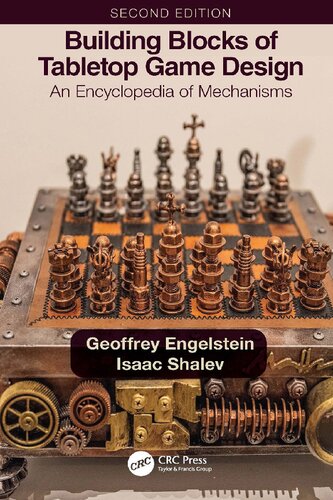
Building Blocks of Tabletop Game Design. An Encyclopedia of Mechanisms
2022 · PDF

Building Blocks of Tabletop Game Design: An Encyclopedia of Mechanisms
2022 · PDF

Building Blocks of Tabletop Game Design: An Encyclopedia of Mechanisms
2022 · PDF

Game Production: Prototyping and Producing Your Board Game
2020 · PDF

Achievement Relocked: Loss Aversion and Game Design
2020 · EPUB

MySQL® Notes for Professionals book
2018 · PDF