Heating with Wolves, Cooling with Cacti: Thermo-bio-architectural Framework (ThBA)
Book information
Description
This book describes the detailed process behind the development of a comprehensive thermo-bio-architectural framework (the ThBA). This framework systematically connects the thermal performance requirements of a building to relevant solutions found in the natural world. This is the first time that architecture has been connected to biology in this manner. The book provides an in-depth understanding of thermoregulatory strategies in animals and plants and links these to equivalent solutions in architectural design. The inclusion of this fundamental knowledge, along with the systematic process of accessing it, should open up new avenues for the generation of energy efficient and sustainable buildings. Cover Title Page Copyright Page Preface Table of Contents 1. Building Energy Use and Climate Change 1.1 Climate change 1.2 Sustainability and climate change 1.2.1 Ecologically Sustainable Design (ESD) 1.3 Biomimicry 2. Thermal Issues and Building Design 2.1 Design and climate 2.1.1 Cold winters, cool summers 2.1.2 Hot summers, cold winters 2.1.3 Hot, wet climates 2.1.4 Traditional building 2.2 Modern buildings 2.2.1 Passive solar design 2.2.2 Active solar design 2.2.3 Passive and active comparisons 2.3 Zero energy buildings 3. Biomimicry and Its Approaches to Energy-Efficient Building Design 3.1 Architecture and nature: an unending dialogue 3.1.1 Design inspired by nature: its origins and background 3.1.2 Biomimicry in architecture 3.1.3 Biomimicry and innovative solutions for building design 4. Linking Biology and Buildings 4.1 The search for a link between biomimetic design and building energy efficiency 4.2 Extraction of useful data 4.2.1 Animals and insects 4.2.2 Plants 4.2.3 Human beings 4.2.4 Other relevant examples 4.3 A systematic way of accessing natural examples of thermoregulation 4.3.1 BioGen (a biomimetic framework for design concept generation) 4.4 Assessment 4.4.1 The examples of biomimetic design 4.4.2 Badarnah’s approach to biomimetic design 4.4.3 The next step 5. Developing a Structure for the ThBA 5.1 Environmental adaptation: a leap forward for energy efficiency 5.2 Literature review 5.2.1 Step 1: basics of bio-heat transfer 5.2.2 Step 2: classification measures of biological thermal regulation strategies 5.2.3 Step 3: thermal physiology of heat regulation in nature 5.2.4 Similar patterns of thermoregulation in organisms and buildings 5.2.5 Endothermy and ectothermy as a means of classification 6. Thermoregulation in Nature 6.1 Introduction 6.2 Controlling heat: passive methods of thermal adaptation in animals 6.2.1 Generating heat 6.2.2 Controlling heat gain 6.2.3 Controlling heat loss 6.3 Controlling heat: active methods of thermal adaptation in animals 6.3.1 Generating heat 6.3.2 Controlling heat gain 6.3.3 Controlling heat loss 6.4 Controlling heat: thermal adaptation in plants 6.4.1 Generating heat 6.4.2 Controlling heat gain 6.4.3 Controlling heat loss 6.5 Generating the ThBA 7. Parallels in Building Design 7.1 Introduction 7.2 Passive methods of thermal regulation in buildings 7.2.1 Generating heat 7.2.2 Controlling heat gain 7.2.3 Controlling heat loss 7.3 Active methods of thermal regulation in buildings 7.3.1 Generating heat 7.3.2 Controlling heat gain 7.3.3 Controlling heat loss 7.4 Active and passive methods of thermal regulation in buildings (Plants) 7.4.1 Generating heat 7.4.2 Controlling heat gain 7.4.3 Controlling heat loss 7.5 The hierarchical structure of the first draft of the ThBA 7.6 Biology to architecture transfer 7.7 The complementary aspects of thermoregulation 7.7.1 Systems in organisms 7.7.2 Interconnection of systems 7.7.3 HVAC in buildings and circulatory and respiratory systems in organisms 8. Testing the ThBA 8.1 Introduction 8.2 Focus group 8.3 Identification of thermal issues 8.4 Building A in Dunedin (using the ThBA Version 01, Test 01): the need to redesign the ThBA 8.4.1 The process of redesigning the ThBA Version 01 8.5 Building A in Dunedin (using the ThBA Version 04, Test 01) 8.5.1 Inappropriate solutions 8.5.2 Appropriate solutions 8.6 Building A in Auckland (using the ThBA version 04, Test 02) 8.6.1 Action one: decreasing heat gain 8.6.2 Action two: avoiding heat gain and action three: increasing heat loss 8.7 Architects know biomimicry by instinct 8.7.1 Controlling conductive and convective heat gain through temperature gradient 8.7.2 Controlling convective and conductive heat loss through temperature gradient 8.7.3 Controlling solar heat gain through transmission and absorption 8.7.4 Controlling solar heat gain through surface area 8.7.5 Controlling evaporation through surface area 8.7.6 Controlling evaporation through air flow 8.7.7 Controlling conductive and convective heat gain through surface area 8.7.8 Controlling convective and conductive heat loss and heat gain through heat transfer coefficient 9. Developing a Framework for Bio-Inspired Energy-Efficient Building Design 9.1 Introduction 9.2 The usefulness of the ThBA 9.2.1 Possible links revealed by the ThBA 9.3 Does nature hold the answer? 9.3.1 Trade-offs 9.3.2 Unknown nature 9.4 Waiting for new technology 9.5 What was learned from developing the ThBA Index
Similar books

Collapsing Gracefully: Making a Built Environment that is Fit for the Future
2021 · PDF

The Environmental Impact of Cities: Death by Democracy and Capitalism
2022 · PDF

Materials for a Healthy, Ecological and Sustainable Built Environment: Principles for Evaluation
2017 · PDF

Materials for a Healthy, Ecological and Sustainable Built Environment: Principles for Evaluation
2017 · PDF
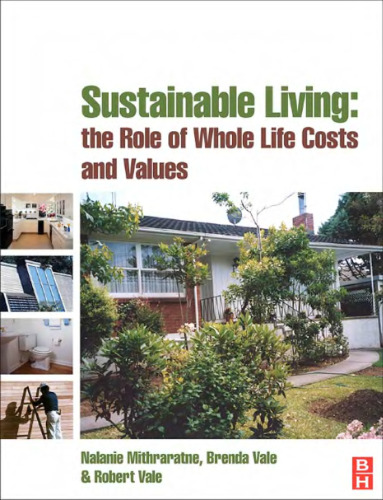
Sustainable Living: the Role of Whole Life Costs and Values
2007 · DJVU

Time to Eat the Dog? The Real Guide to Sustainable Living
2009 · PDF

Prefabs: The history of the UK Temporary Housing Programme (Studies in History, Planning and the Environment Series)
1995 · PDF

Sustainable Living: the Role of Whole Life Costs and Values
2007 · PDF