Social media, mobilisation and protest slogans in Moscow and beyond
Book information
Description
Article published in the «Digital Icons: Studies in Russian, Eurasian and Central European New Media» — 2012 —No 7 — p. 213-225.The claim that the internet, and social media in particular, have changed the face of civic action, has at least two components that need to be distinguished. One claim is that social media have made it easier to mobilise people; the other is that they create more publicity for the movements. These claims are of course interrelated: internet users who learn about a protest movement through social media, i.e. from personal acquaintances or through other trusted sources, are more likely to join it than those who only see official media representations of the movement, which will probably be negative, selective, or indeed non-existent. Conversely, those who are already taking active part in a movement may feel emboldened by the very fact of having relatively free online media at their disposal, allowing them to reach large numbers of people beyond those physically present.
Similar books

Либеральный архипелаг. Теория разнообразия и свободы

Явление разделенных этнонациональных групп: политологический анализ

Власть в России: Элиты и институты

Рабочий класс Украины: вчера и сегодня. По материалам социологических исследований
2014 · PDF

Ребусы на тему Социология политики
DOCX
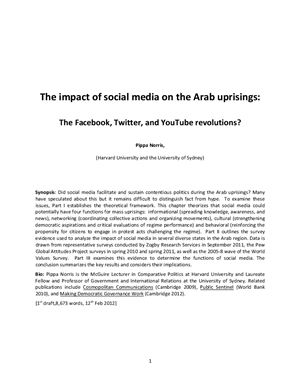
The impact of social media on the Arab uprisings: The Facebook, Twitter, and YouTube revolutions?
Принципы и следствия современной войны: взгляд социолога

Русская власть (теоретико-социологические проблемы)
DJVU