Survival Analysis
Book information
Description
Survival analysis generally deals with analysis of data arising from clinical trials. Censoring, truncation, and missing data create analytical challenges and the statistical methods and inference require novel and different approaches for analysis. Statistical properties, essentially asymptotic ones, of the estimators and tests are aptly handled in the counting process framework which is drawn from the larger arm of stochastic calculus. With explosion of data generation during the past two decades, survival data has also enlarged assuming a gigantic size. Most statistical methods developed before the millennium were based on a linear approach even in the face of complex nature of survival data. Nonparametric nonlinear methods are best envisaged in the Machine Learning school. This book attempts to cover all these aspects in a concise way. Survival Analysisoffers an integrated blend of statistical methods and machine learning useful in analysis of survival data. The purpose of the offering is to give an exposure to the machine learning trends for lifetime data analysis. Features: Classical survival analysis techniques for estimating statistical functional and hypotheses testingRegression methods covering the popular Cox relative risk regression model, Aalen’s additive hazards model, etc.Information criteria to facilitate model selection including Akaike, Bayes, and FocusedPenalized methodsSurvival trees and ensemble techniques of bagging, boosting, and random survival forestsA brief exposure of neural networks for survival dataR program illustration throughout the book Cover Half Title Title Page Copyright Page Dedication Contents Preface Author Bios Symbol Description Acronyms I. Classical Survival Analysis 1. Lifetime Data and Concepts 1.1. Introduction 1.2. Survival Datasets 1.2.1. Lifetimes of Sheep 1.2.2. Mayo Clinic Primary Biliary Cirrhosis Study 1.2.3. Chronic Granulotomous Disease Study 1.2.4. Bone Marrow Transplant Data for Leukemia 1.2.5. Heart Transplant Monitoring Data 1.2.6. Netherlands Cancer Institute Seventy Gene Signature 1.3. Basic Survival Analysis Concepts 1.3.1. Survival Function 1.3.2. Hazard Rate and Cumulative Hazard Function 1.4. Statistical Inference for Survival Data 1.5. Machine Learning Inception 1.6. Roadmap 2. Core Concepts 2.1. Introduction 2.2. Lifetime Distributions 2.2.1. Univariate Lifetime Distributions 2.2.2. Multivariate Lifetime Distributions 2.3. Generalized Lifetime Distributions 2.4. Censoring in Lifetime Studies 2.5. Handling Missing Data with EM Algorithm 2.6. Counting Process Approach to Survival Analysis 2.7. Multi-state Models 2.8. Exercises 2.9. Mas Lejos Temas 3. Inference—Estimation 3.1. Introduction 3.2. Nonparametric Estimation 3.2.1. Nelson-Aalen Estimator 3.2.2. Kaplan-Meier Estimator 3.2.3. Mean and Median Survival Times 3.3. Smoothing the Hazard Rate 3.4. Estimation in Nonhomogeneous Markov Processes 3.5. Exercises 3.6. Mas Lejos Temas 4. Inference—Statistical Tests 4.1. Introduction 4.2. Parametric Tests 4.3. One-sample Nonparametric Tests 4.4. k-sample Nonparametric Tests 4.5. Exercises 4.6. Mas Lejos Temas 5. Regression Models 5.1. Introduction 5.2. Linear Regression Methods 5.2.1. Koul-Susarla-van Ryzin Estimator 5.2.2. Miller's Estimator 5.2.3. Buckley-James Estimator 5.3. Relative Risk (Cox) Model 5.4. Residual Analysis for the Cox Proportional Hazards Regression Model 5.5. Parametric Regression Models 5.6. Exercises 5.7. Mas Lejos Temas 6. Further Topics in Regression Models 6.1. Introduction 6.2. Aalen's Additive Regression Model 6.3. Regression Based on Pseudo-observations 6.4. Modeling with Time-Dependent Covariates 6.5. Exercises 6.6. Mas Lejos Temas 7. Model Selection 7.1. Introduction 7.2. Model Selection with AIC and BIC 7.3. FIC Selection 7.4. Penalization with the Proportional Hazards Model 7.5. Penalization with Aalen's Semiparametric Hazards Model 7.6. Exercises 7.7. Mas Lejos Temas II. Machine Learning Methods Why Machine Learning? 8. Survival Trees 8.1. Introduction 8.2. Machine Learning Terminologies 8.3. Decision Trees and Node Split Functions 8.4. Survival Tree 8.5. Prediction and Variable Importance 8.6. Understanding Different Facets of Survival Tree 8.7. Exercises 8.8. Mas Lejos Temas 9. Ensemble Survival Analysis 9.1. Introduction 9.2. Principle of Ensemble Learning 9.3. Bagging Survival Trees 9.4. Random Survival Forests 9.5. Boosting Algorithm 9.5.1. Gradient Boosting Algorithm 9.5.2. Boosting the Cox PH Model 9.6. Exercises 9.7. Mas Lejos Temas 10. Neural Network Survival Analysis 10.1. Introduction 10.2. Neural Network Architecture 10.3. Activation Function 10.4. Perceptron Model 10.4.1. Perceptron Learning Algorithm 10.5. Multi-layer Neural Network 10.5.1. Backpropagation Algorithm 10.6. Neural Networks for Survival Analysis 10.7. Exercises 10.8. Mas Lejos Temas 11. Complementary Machine Learning Techniques Bibliography Index
Similar books

Survival Analysis
2022 · RAR

Practical Data Science Cookbook: Data pre-processing, analysis and visualization using R and Python
2017 · PDF

Practical Data Science Cookbook: Data pre-processing, analysis and visualization using R and Python. Code
2017 · ZIP
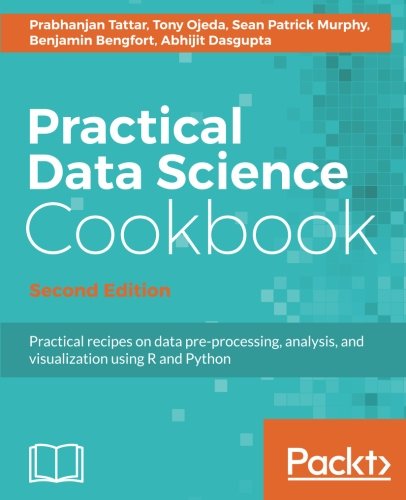
Practical Data Science Cookbook: Data pre-processing, analysis and visualization using R and Python
2017 · EPUB

MySQL® Notes for Professionals book
2018 · PDF

MrExcel 2022: Boosting Excel
2022 · PDF

MrExcel 2022: Boosting Excel
2022 · PDF

Session C11: Ancient Cultural Landscapes in South Europe – their Ecological Setting and Evolution, Session C22: Gardeners from South America, Session S04: Agro-Pastoralism and Early Metallurgy Sessions, Session WS29: The Idea of Enclosure in Recent Iberian Prehistory, Session C88: Rhytmes et causalites des dynamiques de l'anthropisation en Europe entre 6500 ET 500 BC: Hypotheses socio-culturelles et/ou climatiques: Proceedings of the XV UISPP World Congress (Lisbon 4-9 September 2006) / Actes du XV Congrès Mondial (Lisbonne 4-9 Septembre 2006) Vol.36
2010 · PDF