Restricted Generosity in the New Testament
Book information
Description
The importance of material generosity in early Christianity has been firmly established in New Testament research. Given this consensus, Timothy J. Murray examines the New Testament texts for evidence of when, how and why the early Christians restricted their generosity. Having also examined the restricted generosity of comparable social structures (Jewish groups, Greco-Roman associations and the Hellenistic oikos), the author argues that the self-conception of the early Christians as members of a fictive-family was the most significant influence on their practices of material generosity and its restrictions, in which they drew heavily from existing cultural ideals regarding family reciprocity and support. Additionally, the author argues (against the majority view) that evidence for organised poor-care in Jewish groups is meagre and non-existent with regard to Greco-Roman associations. Cover Titel Preface Table of Content List of Abbreviations 1. Introduction: Restricted Generosity in the New Testament in its Academic Context 1.1. The development of New Testament ethics 1.2. Wealth ethics in New Testament ethics 1.3. New Testament wealth ethics 1.3.1. ‘Ethic’ or ‘ethics’ of the New Testament 1.3.2. The appropriate object of study: the ethics of the texts and the ethos of the community 1.3.3. Ruben Zimmermann’s “implicit ethics” 1.4. The argument and contributions of this study Part I: Restricted Generosity in Comparable First-Century Social Structures 2. An Introduction to Comparable Social Structures 2.1. Which social structures should the early church be compared with? 2.1.1. Why not the philosophical schools and the mystery religions? 3. Restricted Generosity in the Roman Household 3.1. The early church and the oikos 3.2. The oikos and generosity in early Hellenistic literature 3.3. Restricted generosity in the Roman oikos 3.3.1. Pietas in the Roman oikos 3.3.2. Restrictions on generosity in the Roman family 3.3.3. Excursus – the relevance of the law to the first Christians 3.3.4. Summary 3.3.5. Qualifying considerations: the Roman family in the wider empire 3.3.6. Qualifying considerations: the Roman family and Jewish families 4. Restricted Generosity in Greco-Roman Associations 4.1. Introduction 4.1.1. Definition 4.1.2. The validity of using associations as a comparative model 4.1.3. What groups are included in ‘associations’? 4.1.4. Jewish groups 4.1.5. Evidence 4.2. Association finances – an overview 4.2.1. Sources of income 4.2.2. Uses of money 4.3. Restrictions on use of money 4.3.1. The wishes of a benefactor 4.3.2. Breaking association rules 4.3.3. The solvency of an association 4.4. Care of members in associations? 4.4.1. Evidence that associations cared for their “poor” members 4.4.2. Arguments against care of members in associations 4.5. Summary 5. Care of the Poor in First-Century Jewish Groups? 5.1. Introduction 5.2. Evidence commonly adduced for poor-care in first century Jewish groups 5.2.1. Literary sources 5.2.2. Non-literary 5.3. Evidence rarely adduced for poor-care in first century Jewish groups 5.3.1. Papyri 5.3.2. Roman literature: Jewish beggars and the προσευχή 5.3.3. The Qumran community and the Essenes 5.4. Dead ends and loud silences 5.4.1. Philo 5.4.2. Other sources 5.5. Summary Part II: Restricted Generosity in the New Testament 6. Fictive Kinship and Social Reality in the New Testament 6.1. Implications of oikos language in the whole New Testament: The church-as-family as a redefinition of oikos 6.2. Specific texts possibly linking the church-as-oikos with economic issues 6.2.1. Mark 10.28–31 6.2.2. Matthew 25.31–46 6.2.3. Romans 12.9–13 6.2.4. Hebrews 13.1–6 6.2.5. Galatians 6.10 6.2.6. 1 John 3.17 6.2.7. 1 Thessalonians 4.9–12 and 1 Timothy 5.3–16 6.2.8. Indicative references 6.3. Excursus - evidence outside the New Testament 6.4. Summary 6.5. Implications: fictive-kinship and material solidarity as restricted generosity 7. Restricted Generosity in the Thessalonian Correspondence 7.1. The authenticity of, and relationship between, 1 and 2 Thessalonians 7.2. The problem in Thessalonica 7.2.1. Eschatological beliefs 7.2.2. Social dynamics 7.2.3. Missional privilege 7.2.4. None of the above 7.3. Implicit ethics in the Thessalonian correspondence 7.3.1. 1 Thessalonians 4.9–12 7.3.2. 1 Thessalonians 5.12–15 7.3.3. 2 Thessalonians 3.6–16 7.3.4. Summary 7.4. The Thessalonian problem – what can be said? 7.4.1. Eschatological beliefs 7.4.2. Social dynamics 7.4.3. Missional privilege 7.4.4. The ‘problem’ as the simple abuse of φιλαδελφία 7.5. Summary 8. Restricted Generosity in 1 Timothy 5.3–16 8.1. Current interpretive options 8.1.1. An order of widows 8.1.2. A benefit register 8.1.3. Harmonisation 8.2. Methodological issues 8.3. Implicit ethics in 1 Timothy 5.3–16 8.3.1. Linguistic form 8.3.2. Norms and values 8.3.3. The text 8.3.4. Excursus - B. Winter’s thesis concerning “New Women” 8.4. Summative discussions 8.4.1. The structure of 1 Timothy 5.3–16 8.4.2. Benefit register or a widows’ order 8.4.3. The problem and its solution 8.5. Summary 9. Summary and Conclusions Appendix: A survey of metaphorical oikos language in the New Testament Bibliography Index of Ancient Sources Index of Modern Authors Index of Subjects
Similar books
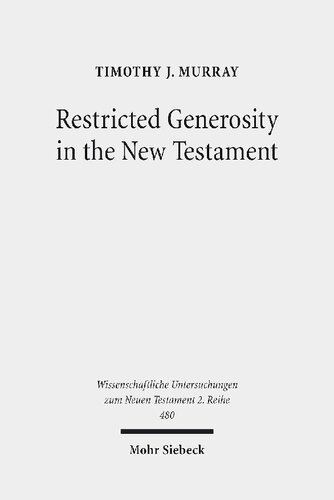
Restricted Generosity in the New Testament
2019 · PDF

MySQL® Notes for Professionals book
2018 · PDF

MrExcel 2022: Boosting Excel
2022 · PDF

MrExcel 2022: Boosting Excel
2022 · PDF

Session C11: Ancient Cultural Landscapes in South Europe – their Ecological Setting and Evolution, Session C22: Gardeners from South America, Session S04: Agro-Pastoralism and Early Metallurgy Sessions, Session WS29: The Idea of Enclosure in Recent Iberian Prehistory, Session C88: Rhytmes et causalites des dynamiques de l'anthropisation en Europe entre 6500 ET 500 BC: Hypotheses socio-culturelles et/ou climatiques: Proceedings of the XV UISPP World Congress (Lisbon 4-9 September 2006) / Actes du XV Congrès Mondial (Lisbonne 4-9 Septembre 2006) Vol.36
2010 · PDF

THE BRITISH ARMY IN INDIA: ITS PRESERVATION BY AN APPROPRIATE CLOTHING, HOUSING, LOCATING, RECREATIVE EMPLOYMENT, AND HOPEFUL ENCOURAGEMENT OF THE TROOPS. with AN APPENDIX ON INDIA : THE CLIMATE OP ITS HILLS ; THE DEVELOPMENT OF ITS RESODRCBS, INDUSTRY, AND ARTS ; THE ADMINISTRATION OF JUSTICE ; THE BLACK ACT ; THE PROGRESS OF CHRISTIANITY ; THE TRAFFIC IN OPIUM ; THE VALUE OF INDIA ; PERMANENT CAUSES OF DISAFFECTION, AND OF THE RECENT REBELLION ; THE TRADITIONARY POLICY; MISGOVERNMENT BY NATIVE RULERS ; ANNEXATIONS OF THEIR TERRITORY, ETC.
1858 · PDF

Idries Shah 27 Books Collection : A Perfumed Scorpion, A Veiled Gazelle, Caravan of Dreams, Darkest England, Destination Mecca, Evenings with Idries Shah, Knowing How to Know, Learning How to Learn, Letters and Lectures of Idries Shah, Neglected aspects of Sufi study, Observations, Oriental Magic, Reflections, Seeker after Truth, Special Illumination, Special Problems in the study of Sufi ideas, Sufi thought and action, Tales of the Dervishes, The Dermis Probe, The Elephant in the Dark, The Englishman Handbook, Idries Shah Antology, The Magic Monastery, The natives are restless, wisdom of the Idiots PDF.
2022 · PDF

The travels of Capts. Lewis and Clarke from St. Louis, by way of the Missouri and Columbia rivers, to the Pacific ocean; performed in the years 1804, 1805 & 1806, by order of the government of the United States. Containing delineations of the manners, customs, religion, &c. of the Indians, comp. from various authentic sources, and original documents, and a summary of the Statistical view of the Indian nations, from the official communication of Meriwether Lewis. Illustrated with a map of the country, inhabited by the western tribes of Indians
1809 · PDF