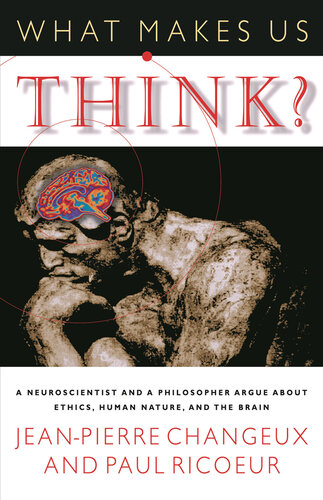
What Makes Us Think? A Neuroscientist and a Philosopher Argue about Ethics, Human Nature, and the Brain
Book information
Description
Will understanding our brains help us to know our minds? Or is there an unbridgeable distance between the work of neuroscience and the workings of human consciousness? In a remarkable exchange between neuroscientist Jean-Pierre Changeux and philosopher Paul Ricoeur, this book explores the vexed territory between these divergent approaches--and comes to a deeper, more complex perspective on human nature. Ranging across diverse traditions, from phrenology to PET scans and from Spinoza to Charles Taylor, What Makes Us Think? revolves around a central issue: the relation between the facts (or "what is") of science and the prescriptions (or "what ought to be") of ethics. Changeux and Ricoeur ask: Will neuroscientific knowledge influence our moral conduct? Is a naturally based ethics possible? Pursuing these questions, they attack key topics at the intersection of philosophy and neuroscience: What are the relations between brain states and psychological experience? Between language and truth? Memory and culture? Behavior and action? What is a mental representation? How does a sign relate to what it signifies? How might subjective experience be constructed rather than discovered? And can biological or cultural evolution be considered progressive? Throughout, Changeux and Ricoeur provide unprecedented insight into what neuroscience can--and cannot--tell us about the nature of human experience. Changeux and Ricoeur bring an unusual depth of engagement and breadth of knowledge to each other's subject. In doing so, they make two often hostile disciplines speak to one another in surprising and instructive ways--and speak with all the subtlety and passion of conversation at its very best. Cover Page Half-title Page Title Page Copyright Page Contents Translator’s Note Prelude 1. A Necessary Encounter Knowledge and Wisdom Knowledge of the Brain and Self-Knowledge The Biological and the Normative 2. Body and Mind: In Search of a Common Discourse The Cartesian Ambiguity The Contribution of the Neurosciences Toward a Third Kind of Discourse? 3. The Neuronal Model and the Test of Experience The Simple and the Complex: Questions of Method The Human Brain: Complexity, Hierarchy, Spontaneity Mental Objects: Chimera or Link? Is a Neuronal Theory of Knowledge Possible? Understanding Better by Explaining More 4. Consciousness of Oneself and of Others Conscious Space The Question of Memory Comprehension of Oneself and of Others Mind or Matter? 5. The Origins of Morality Darwinian Evolution and Moral Norms The First Structures of Morality From Biological History to Cultural History: Valuing the Individual 6. Desire and Norms Natural Dispositions to Ethical Systems The Biological Bases of Rules of Conduct Passage to the Norm 7. Ethical Universality and Cultural Conflict The Natural Foundations of an Ethics of Debate Religion and Violence Paths of Tolerance The Scandal of Evil Toward an Ethics of Deliberation: The Example of Advisory Committees on Bioethics Art as Peacemaker Fugue Notes Index
Similar books
What Makes Us Think?: A Neuroscientist and a Philosopher Argue about Ethics, Human Nature, and the Brain
2002 · EPUB

Neden Nasıl Düşünürüz? Etik, İnsan Doğası ve Beyin Üzerine Bir Tartışma
2013 · PDF

La natura e la regola. Alle radici del pensiero
1999 · PDF

Zeit und Erzählung, Band 3: Die erzählte Zeit
1999 · PDF

Das Rätsel der Vergangenheit: Erinnern - Vergessen - Verzeihen
2004 · PDF

Lebendig bis in den Tod: Fragmente aus dem Nachlaß
2011 · PDF

Iubire si justitie
2009 · PDF

Cum sa intelegem Biblia
2002 · PDF