100 Go Mistakes and How to Avoid Them
Book information
Description
Spot errors in your Go code you didn’t even know you were making and boost your productivity by avoiding common mistakes and pitfalls. 100 Go Mistakes and How to Avoid Them shows you how to: • Dodge the most common mistakes made by Go developers • Structure and organize your Go application • Handle data and control structures efficiently • Deal with errors in an idiomatic manner • Improve your concurrency skills • Optimize your code • Make your application production-ready and improve testing quality 100 Go Mistakes and How to Avoid Them puts a spotlight on common errors in Go code you might not even know you’re making. You’ll explore key areas of the language such as concurrency, testing, data structures, and more—and learn how to avoid and fix mistakes in your own projects. As you go, you’ll navigate the tricky bits of handling JSON data and HTTP services, discover best practices for Go code organization, and learn how to use slices efficiently. About the technology Understanding mistakes is the best way to improve the quality of your code. This unique book examines 100 bugs and inefficiencies common to Go applications, along with tips and techniques to avoid making them in your own projects. About the book 100 Go Mistakes and How to Avoid Them shows you how to replace common programming problems in Go with idiomatic, expressive code. In it, you’ll explore dozens of interesting examples and case studies as you learn to spot mistakes that might appear in your own applications. Expert author Teiva Harsanyi organizes the error avoidance techniques into convenient categories, ranging from types and strings to concurrency and testing. What's inside • Identify and squash code-level bugs • Avoid problems with application structure and design • Perfect your data and control structures • Optimize your code by eliminating inefficiencies About the reader For developers proficient with Go programming and syntax. About the author Teiva Harsanyi is a senior software engineer at Docker with experience in various domains, including safety-critical industries like air traffic management. 100 Go Mistakes contents preface acknowledgments about this book Who should read this book How this book is organized: A roadmap About the code liveBook discussion forum about the author about the cover illustration 1 Go: Simple to learn but hard to master 1.1 Go outline 1.2 Simple doesn’t mean easy 1.3 100 Go mistakes 1.3.1 Bugs 1.3.2 Needless complexity 1.3.3 Weaker readability 1.3.4 Suboptimal or unidiomatic organization 1.3.5 Lack of API convenience 1.3.6 Under-optimized code 1.3.7 Lack of productivity Summary 2 Code and project organization 2.1 #1: Unintended variable shadowing 2.2 #2: Unnecessary nested code 2.3 #3: Misusing init functions 2.3.1 Concepts 2.3.2 When to use init functions 2.4 #4: Overusing getters and setters 2.5 #5: Interface pollution 2.5.1 Concepts 2.5.2 When to use interfaces 2.5.3 Interface pollution 2.6 #6: Interface on the producer side 2.7 #7: Returning interfaces 2.8 #8: any says nothing 2.9 #9: Being confused about when to use generics 2.9.1 Concepts 2.9.2 Common uses and misuses 2.10 #10: Not being aware of the possible problems with type embedding 2.11 #11: Not using the functional options pattern 2.11.1 Config struct 2.11.2 Builder pattern 2.11.3 Functional options pattern 2.12 #12: Project misorganization 2.12.1 Project structure 2.12.2 Package organization 2.13 #13: Creating utility packages 2.14 #14: Ignoring package name collisions 2.15 #15: Missing code documentation 2.16 #16: Not using linters Summary 3 Data types 3.1 #17: Creating confusion with octal literals 3.2 #18: Neglecting integer overflows 3.2.1 Concepts 3.2.2 Detecting integer overflow when incrementing 3.2.3 Detecting integer overflows during addition 3.2.4 Detecting an integer overflow during multiplication 3.3 #19: Not understanding floating points 3.4 #20: Not understanding slice length and capacity 3.5 #21: Inefficient slice initialization 3.6 #22: Being confused about nil vs. empty slices 3.7 #23: Not properly checking if a slice is empty 3.8 #24: Not making slice copies correctly 3.9 #25: Unexpected side effects using slice append 3.10 #26: Slices and memory leaks 3.10.1 Leaking capacity 3.10.2 Slice and pointers 3.11 #27: Inefficient map initialization 3.11.1 Concepts 3.11.2 Initialization 3.12 #28: Maps and memory leaks 3.13 #29: Comparing values incorrectly Summary 4 Control structures 4.1 #30: Ignoring the fact that elements are copied in range loops 4.1.1 Concepts 4.1.2 Value copy 4.2 #31: Ignoring how arguments are evaluated in range loops 4.2.1 Channels 4.2.2 Array 4.3 #32: Ignoring the impact of using pointer elements in range loops 4.4 #33: Making wrong assumptions during map iterations 4.4.1 Ordering 4.4.2 Map insert during iteration 4.5 #34: Ignoring how the break statement works 4.6 #35: Using defer inside a loop Summary 5 Strings 5.1 #36: Not understanding the concept of a rune 5.2 #37: Inaccurate string iteration 5.3 #38: Misusing trim functions 5.4 #39: Under-optimized string concatenation 5.5 #40: Useless string conversions 5.6 #41: Substrings and memory leaks Summary 6 Functions and methods 6.1 #42: Not knowing which type of receiver to use 6.2 #43: Never using named result parameters 6.3 #44: Unintended side effects with named result parameters 6.4 #45: Returning a nil receiver 6.5 #46: Using a filename as a function input 6.6 #47: Ignoring how defer arguments and receivers are evaluated 6.6.1 Argument evaluation 6.6.2 Pointer and value receivers Summary 7 Error management 7.1 #48: Panicking 7.2 #49: Ignoring when to wrap an error 7.3 #50: Checking an error type inaccurately 7.4 #51: Checking an error value inaccurately 7.5 #52: Handling an error twice 7.6 #53: Not handling an error 7.7 #54: Not handling defer errors Summary 8 Concurrency: Foundations 8.1 #55: Mixing up concurrency and parallelism 8.2 #56: Thinking concurrency is always faster 8.2.1 Go scheduling 8.2.2 Parallel merge sort 8.3 #57: Being puzzled about when to use channels or mutexes 8.4 #58: Not understanding race problems 8.4.1 Data races vs. race conditions 8.4.2 The Go memory model 8.5 #59: Not understanding the concurrency impacts of a workload type 8.6 #60: Misunderstanding Go contexts 8.6.1 Deadline 8.6.2 Cancellation signals 8.6.3 Context values 8.6.4 Catching a context cancellation Summary 9 Concurrency: Practice 9.1 #61: Propagating an inappropriate context 9.2 #62: Starting a goroutine without knowing when to stop it 9.3 #63: Not being careful with goroutines and loop variables 9.4 #64: Expecting deterministic behavior using select and channels 9.5 #65: Not using notification channels 9.6 #66: Not using nil channels 9.7 #67: Being puzzled about channel size 9.8 #68: Forgetting about possible side effects with string formatting 9.8.1 etcd data race 9.8.2 Deadlock 9.9 #69: Creating data races with append 9.10 #70: Using mutexes inaccurately with slices and maps 9.11 #71: Misusing sync.WaitGroup 9.12 #72: Forgetting about sync.Cond 9.13 #73: Not using errgroup 9.14 #74: Copying a sync type Summary 10 The standard library 10.1 #75: Providing a wrong time duration 10.2 #76: time.After and memory leaks 10.3 #77: Common JSON-handling mistakes 10.3.1 Unexpected behavior due to type embedding 10.3.2 JSON and the monotonic clock 10.3.3 Map of any 10.4 #78: Common SQL mistakes 10.4.1 Forgetting that sql.Open doesn’t necessarily establish connections to a database 10.4.2 Forgetting about connections pooling 10.4.3 Not using prepared statements 10.4.4 Mishandling null values 10.4.5 Not handling row iteration errors 10.5 #79: Not closing transient resources 10.5.1 HTTP body 10.5.2 sql.Rows 10.5.3 os.File 10.6 #80: Forgetting the return statement after replying to an HTTP request 10.7 #81: Using the default HTTP client and server 10.7.1 HTTP client 10.7.2 HTTP server Summary 11 Testing 11.1 #82: Not categorizing tests 11.1.1 Build tags 11.1.2 Environment variables 11.1.3 Short mode 11.2 #83: Not enabling the -race flag 11.3 #84: Not using test execution modes 11.3.1 The parallel flag 11.3.2 The -shuffle flag 11.4 #85: Not using table-driven tests 11.5 #86: Sleeping in unit tests 11.6 #87: Not dealing with the time API efficiently 11.7 #88: Not using testing utility packages 11.7.1 The httptest package 11.7.2 The iotest package 11.8 #89: Writing inaccurate benchmarks 11.8.1 Not resetting or pausing the timer 11.8.2 Making wrong assumptions about micro-benchmarks 11.8.3 Not being careful about compiler optimizations 11.8.4 Being fooled by the observer effect 11.9 #90: Not exploring all the Go testing features 11.9.1 Code coverage 11.9.2 Testing from a different package 11.9.3 Utility functions 11.9.4 Setup and teardown Summary 12 Optimizations 12.1 #91: Not understanding CPU caches 12.1.1 CPU architecture 12.1.2 Cache line 12.1.3 Slice of structs vs. struct of slices 12.1.4 Predictability 12.1.5 Cache placement policy 12.2 #92: Writing concurrent code that leads to false sharing 12.3 #93: Not taking into account instruction-level parallelism 12.4 #94: Not being aware of data alignment 12.5 #95: Not understanding stack vs. heap 12.5.1 Stack vs. heap 12.5.2 Escape analysis 12.6 #96: Not knowing how to reduce allocations 12.6.1 API changes 12.6.2 Compiler optimizations 12.6.3 sync.Pool 12.7 #97: Not relying on inlining 12.8 #98: Not using Go diagnostics tooling 12.8.1 Profiling 12.8.2 Execution tracer 12.9 #99: Not understanding how the GC works 12.9.1 Concepts 12.9.2 Examples 12.10 #100: Not understanding the impacts of running Go in Docker and Kubernetes Summary Final words index A B C D E F G H I J L M N O P R S T U V W 100 Go Mistakes - back
Similar books

100 ошибок Go и как их избежать
2024 · PDF

100 Go Mistakes and How to Avoid Them
2022 · PDF
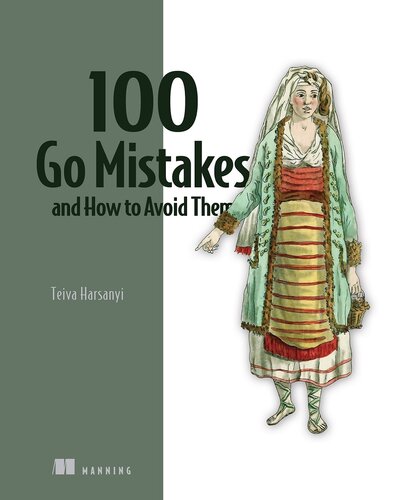
100 Go Mistakes and How to Avoid Them
2022 · MOBI

100 Go Mistakes and How to Avoid Them
2022 · EPUB

MySQL® Notes for Professionals book
2018 · PDF

MrExcel 2022: Boosting Excel
2022 · PDF

MrExcel 2022: Boosting Excel
2022 · PDF

Session C11: Ancient Cultural Landscapes in South Europe – their Ecological Setting and Evolution, Session C22: Gardeners from South America, Session S04: Agro-Pastoralism and Early Metallurgy Sessions, Session WS29: The Idea of Enclosure in Recent Iberian Prehistory, Session C88: Rhytmes et causalites des dynamiques de l'anthropisation en Europe entre 6500 ET 500 BC: Hypotheses socio-culturelles et/ou climatiques: Proceedings of the XV UISPP World Congress (Lisbon 4-9 September 2006) / Actes du XV Congrès Mondial (Lisbonne 4-9 Septembre 2006) Vol.36
2010 · PDF