Spaniards in the Holocaust: Mauthausen, Horror on the Danube
Book information
Description
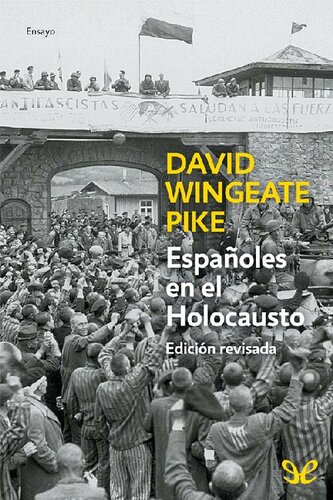
El presente libro describe la experiencia del gran contingente español confinado en uno de los más terribles campos de concentración nazis, el complejo de Mauthausen, que se extendía por territorio austríaco. Entre los cientos de miles de prisioneros enviados a este campo situado a orillas del Danubio, los siete mil españoles que llegaron allí eran republicanos que habían luchado en la guerra civil y que habían encontrado refugio en territorio francés. Tras la invasión de Francia en 1940 fueron arrestados por las tropas alemanas y deportados a campos de concentración como el de Mauthausen. Su historia sirve en parte para presentarnos un microcosmos de la experiencia colectiva, pero es al mismo tiempo una experiencia única: ningún otro grupo nacional logró colocar a sus miembros en los puestos clave de la administración de las SS, y ningún otro colectivo logró ocultar y salvar los documentos básicos de su paso por el campo. Y por encima de todo, ningún otro grupo nacional salió de una experiencia tan terrible con la reputación tan alta como la que tuvieron los españoles entre los otros presos. Book Cover Half-Title Title Copyright Dedication Contents List of plates Preface Acknowledgements Abbreviations, acronyms, and portmanteau words Comparative ranks Part I The SS archipelago 1 Captives in the Channel Islands 2 Deported to the Stalags 3 The Spaniards and the KZ universe 4 Classification and stratification 5 Opposing programmes 6 Everyday life in the KZ 7 Oranienburg, Buchenwald and Mauthausen compared 8 The survival of the evidence Part II Mauthausen, Category Three 1 The arrival 2 The outer circle 3 The inner circle 4 The first Spanish contingents 5 International friction and the brothel 6 The Spaniards as seen by others 7 The paradox of entertainment 8 The Revier, antechamber of death 9 The quarry and the 186 steps 10 Local Kommandos 11 The Nebenlager 12 Schloss Hartheim and the mobile gas chamber 13 Escape and the SS response Part III Survival 1 The nucleus of a resistance 2 A Spaniard enters the Central Administration Office 3 A Spaniard enters the photo lab 4 Franco’s consulate in Vienna 5 A marriage at Auschwitz 6 Holy Night 7 A visit to Melk 8 An international committee forms 9 Atrocities against Allied prisoners 10 The Resistance forms a military branch 11 Reds and Blues replace the Greens and Blacks 12 Incidents in the photo lab 13 The Soviet break-out from the Death Block 14 Mauthausen as the terminus of evacuation 15 Growing fears of a general massacre 16 The evacuation of the last Nebenlager 17 The photos and the Poschacher boys 18 The departure of the SS Part IV Liberation 1 The Soviet assault from the east 2 The American assault from the west 3 The liberation of Gusen and Mauthausen 4 The night of 5–6 May 5 The return of the Americans to Mauthausen 6 Ebensee 7 The American–Soviet link-up 8 The final German surrender 9 Punishment and impunity for the SS criminals Epilogue Notes Annex I Guide to rank abbreviations Annex II Annex III Annex IV Annex V Annex VI Annex VII Annex VIII Bibliography 1 Primary sources A Archives and documents 1 Archives 2 Documents B Interviews C Video Films 2 Secondary sources Index
Similar books
Españoles en el Holocausto
2000 · EPUB

Españoles en el Holocausto
2000 · EPUB

Franco and the Axis Stigma
2008 · PDF

Franco and the Axis Stigma
2008 · PDF

MySQL® Notes for Professionals book
2018 · PDF

MrExcel 2022: Boosting Excel
2022 · PDF

MrExcel 2022: Boosting Excel
2022 · PDF

Session C11: Ancient Cultural Landscapes in South Europe – their Ecological Setting and Evolution, Session C22: Gardeners from South America, Session S04: Agro-Pastoralism and Early Metallurgy Sessions, Session WS29: The Idea of Enclosure in Recent Iberian Prehistory, Session C88: Rhytmes et causalites des dynamiques de l'anthropisation en Europe entre 6500 ET 500 BC: Hypotheses socio-culturelles et/ou climatiques: Proceedings of the XV UISPP World Congress (Lisbon 4-9 September 2006) / Actes du XV Congrès Mondial (Lisbonne 4-9 Septembre 2006) Vol.36
2010 · PDF