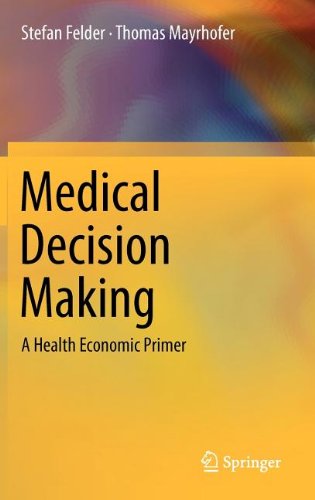
Medical Decision Making: A Health Economic Primer
Book information
Description
Preface to the Third Edition Preface to the Second Edition Preface to the First Edition Contents List of Figures List of Tables List of Boxes 1 Introduction 1.1 Outline 1.2 Notes References 2 Basic Tools in Medical Decision Making 2.1 Prevalence, Incidence and Risk 2.2 Discriminatory Power and Predictive Values 2.3 Probability, Odds and the Likelihood Ratio 2.4 Continuous Test Outcomes and Cut-off Values 2.5 Notes 2.6 Exercises References 3 Basic Tools in Economics: Preferences, Expected Utility, Risk Aversion and Prudence 3.1 Preferences and Utility 3.2 Decisions Under Uncertainty: Menu of Actions, States of Nature and Consequences 3.3 The Elementary Utility Function and the Expected Utility Rule 3.4 The Axiom of Independence and the Expected Utility Rule 3.5 The QALY Concept 3.6 Risk Aversion 3.7 Prudence 3.8 Medical Decision Making: An Economic Perspective 3.9 Non-Expected Utility Theories 3.10 Notes 3.11 Exercises References 4 Treatment Decisions 4.1 The Treatment Decision under Diagnostic Risk 4.1.1 The Treatment Threshold 4.1.2 The Protective Effect of Treatment 4.1.3 Risk Aversion and the Treatment Decision 4.1.4 Preventive Treatment 4.1.5 Choosing Between Several Treatments 4.2 The Treatment Decision Under Therapeutic Risk 4.2.1 The Treatment Success Probability Threshold 4.2.2 Including the Protective Effect of Treatment 4.2.3 The Role of Risk Aversion 4.2.4 Choosing Between Several Treatments 4.3 The Treatment Decision under Diagnostic and Therapeutic Risk 4.4 Notes 4.5 Exercises References 5 Test and Treatment Decisions 5.1 The Value of Information of a Diagnostic Test 5.1.1 The Perfect Test 5.1.2 The Imperfect Test 5.1.3 Decision Curve Analysis 5.1.4 Threshold Analysis with Several Treatment Options 5.1.5 Threshold Analysis with a Genetic Test 5.2 Risk Attitude and the Test and Test-Treatment Thresholds 5.2.1 The Perfect Test 5.2.2 The Imperfect Test 5.3 Testing Under the Therapeutic Risk 5.4 The Test and Test-Treatment Thresholds when both the Diagnostic and the Therapeutic Risk are Present 5.5 Potential Harm from a Test 5.6 Notes 5.7 Exercises References 6 Prudence and Medical Decision Making 6.1 Prudence and the Treatment Threshold 6.2 Prudence and the Test and Treatment Decisions 6.2.1 The Perfect Test 6.2.2 The Imperfect Test 6.3 Prudence and Protection 6.4 Prudence and Prevention 6.5 Prudence and the Therapeutic Risk 6.6 Notes 6.7 Exercises References 7 Optimal Strategy for Multiple Diagnostic Tests 7.1 Choosing among Two Tests 7.2 Combining Two Tests 7.3 Test and Test-Treatment Thresholds for Composite Tests 7.4 The Optimal Sequence of and Potential Harm from Testing 7.5 Parallel or Sequential Testing? 7.6 Notes 7.7 Exercises References 8 The Optimal Cutoff of a Diagnostic Test 8.1 Endogenous Test Characteristics 8.2 The Optimal Cut-Off 8.3 Test and Test-Treatment Thresholds and the Optimal Cut-Off 8.4 Multiple Tests with Endogenous Sensitivity and Specificity: Triple Test and Amniocentesis 8.4.1 The ROC Curve of the Triple Test 8.4.2 The Value of Information and Optimal Use of the Triple Test with Amniocentesis 8.4.3 Deciding on the Test Outcome 8.5 Notes 8.6 Exercises References 9 The Total Value of Information of a Test 9.1 Exogenous Test Characteristics 9.1.1 Performance as a Function of the Prior Probability of Disease 9.1.2 Overall Performance 9.1.3 A Social Perspective 9.2 Endogenous Test Characteristics 9.2.1 Performance as a Function of the Prior Probability of Disease 9.2.2 Overall Performance 9.3 Application to Prenatal Diagnostics 9.3.1 Age-Specific Performance 9.3.2 Overall Performance 9.4 Notes 9.5 Exercises References 10 The Economics of Medical Decision Making 10.1 Welfarism and Non-Welfarism 10.1.1 The QALY Approach 10.1.2 The Welfarist Approach 10.2 The Diagnostic Risk 10.2.1 The Treatment Decision 10.2.2 Risk Aversion and the Treatment Decision 10.2.3 Prudence and the Treatment Decision 10.2.4 Treatment and Testing 10.2.5 Treatment and Composite Testing 10.3 The Therapeutic Risk 10.3.1 Risk Aversion and the Treatment Decision 10.4 Treatment Decision with Both Risks 10.5 The Effect of Income, Health and Death on the Treatment Decision 10.6 Notes 10.7 Exercises References 11 Valuing Health and Life 11.1 Treatment and Health 11.2 Treatment and Survival 11.3 The Value of Health and Life 11.4 Optimal Allocation of Health Across Individuals 11.4.1 The Health Model 11.4.2 The Health-Survival Model 11.4.3 The QALY Model 11.5 Conclusion 11.6 Appendix 11.7 Notes 11.8 Exercises References 12 Revealed Preference in Medical Decisions 12.1 The Diagnostic Risk 12.1.1 The Pauker–Kassirer Model 12.1.2 Adding the Test Option 12.1.3 The Protective Effect of Treatment 12.1.4 Revealing a Lower Bound on the Value of Life 12.2 The Therapeutic Risk 12.2.1 The Eeckhoudt Model 12.2.2 The Protective Effect of Treatment 12.3 Regulation and Revealed Preferences 12.3.1 Prenatal Diagnostics 12.3.2 PSA Test 12.3.3 Primary Prevention of Atherosclerotic Cardiovascular Disease 12.3.4 Ventral Hernia Repairs: Laparoscopic or Open? 12.4 Notes 12.5 Exercises References 13 Imperfect Agency and Non-expected Utility Models 13.1 Imperfect Physician Agency 13.2 Non-expected Utility Theories Under Risk 13.3 Non-expected Utility Theories Under Uncertainty 13.4 Conclusion 13.5 Notes 13.6 Exercises References References Index
Similar books

Medical Decision Making: A Health Economic Primer
2017 · PDF

Medical Decision Making. A Health Economic Primer
2017 · PDF
Medical Decision Making: A Health Economic Primer
2011 · PDF

MySQL® Notes for Professionals book
2018 · PDF

MrExcel 2022: Boosting Excel
2022 · PDF

MrExcel 2022: Boosting Excel
2022 · PDF

Session C11: Ancient Cultural Landscapes in South Europe – their Ecological Setting and Evolution, Session C22: Gardeners from South America, Session S04: Agro-Pastoralism and Early Metallurgy Sessions, Session WS29: The Idea of Enclosure in Recent Iberian Prehistory, Session C88: Rhytmes et causalites des dynamiques de l'anthropisation en Europe entre 6500 ET 500 BC: Hypotheses socio-culturelles et/ou climatiques: Proceedings of the XV UISPP World Congress (Lisbon 4-9 September 2006) / Actes du XV Congrès Mondial (Lisbonne 4-9 Septembre 2006) Vol.36
2010 · PDF

THE BRITISH ARMY IN INDIA: ITS PRESERVATION BY AN APPROPRIATE CLOTHING, HOUSING, LOCATING, RECREATIVE EMPLOYMENT, AND HOPEFUL ENCOURAGEMENT OF THE TROOPS. with AN APPENDIX ON INDIA : THE CLIMATE OP ITS HILLS ; THE DEVELOPMENT OF ITS RESODRCBS, INDUSTRY, AND ARTS ; THE ADMINISTRATION OF JUSTICE ; THE BLACK ACT ; THE PROGRESS OF CHRISTIANITY ; THE TRAFFIC IN OPIUM ; THE VALUE OF INDIA ; PERMANENT CAUSES OF DISAFFECTION, AND OF THE RECENT REBELLION ; THE TRADITIONARY POLICY; MISGOVERNMENT BY NATIVE RULERS ; ANNEXATIONS OF THEIR TERRITORY, ETC.
1858 · PDF