Freud's Free Clinics: Psychoanalysis & Social Justice, 1918-1938
Book information
Description
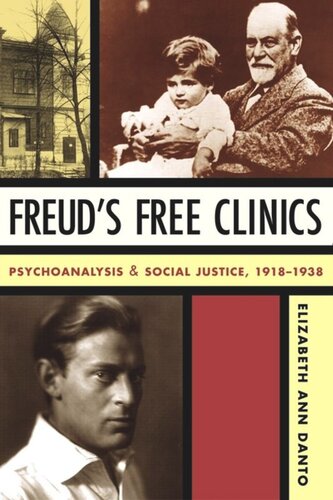
Today many view Sigmund Freud as an elitist whose psychoanalytic treatment was reserved for the intellectually and financially advantaged. However, in this new work Elizabeth Ann Danto presents a strikingly different picture of Freud and the early psychoanalytic movement. Danto recovers the neglected history of Freud and other analysts' intense social activism and their commitment to treating the poor and working classes.Danto's narrative begins in the years following the end of World War I and the fall of the Habsburg Empire. Joining with the social democratic and artistic movements that were sweeping across Central and Western Europe, analysts such as Freud, Wilhelm Reich, Erik Erikson, Karen Horney, Erich Fromm, and Helene Deutsch envisioned a new role for psychoanalysis. These psychoanalysts saw themselves as brokers of social change and viewed psychoanalysis as a challenge to conventional political and social traditions. Between 1920 and 1938 and in ten different cities, they created outpatient centers that provided free mental health care. They believed that psychoanalysis would share in the transformation of civil society and that these new outpatient centers would help restore people to their inherently good and productive selves.Drawing on oral histories and new archival material, Danto offers vivid portraits of the movement's central figures and their beliefs. She explores the successes, failures, and challenges faced by free institutes such as the Berlin Poliklinik, the Vienna Ambulatorium, and Alfred Adler's child-guidance clinics. She also describes the efforts of Wilhelm Reich's Sex-Pol, a fusion of psychoanalysis and left-wing politics, which provided free counseling and sex education and aimed to end public repression of private sexuality.In addition to situating the efforts of psychoanalysts in the political and cultural contexts of Weimar Germany and Red Vienna, Danto also discusses the important treatments and methods developed during this period, including child analysis, short-term therapy, crisis intervention, task-centered treatment, active therapy, and clinical case presentations. Her work illuminates the importance of the social environment and the idea of community to the theory and practice of psychoanalysis. (8/10/05)
Similar books
Freud's Free Clinics: Psychoanalysis and Social Justice, 1918–1938
2005 · PDF

As clínicas públicas de Freud: Psicanálise e justiça social (Estudos)
2019 · EPUB

Psicoanálisis y justicia social (MENTE,SALUD,SOCIEDAD)
2018 · EPUB

MySQL® Notes for Professionals book
2018 · PDF

MrExcel 2022: Boosting Excel
2022 · PDF

MrExcel 2022: Boosting Excel
2022 · PDF

Session C11: Ancient Cultural Landscapes in South Europe – their Ecological Setting and Evolution, Session C22: Gardeners from South America, Session S04: Agro-Pastoralism and Early Metallurgy Sessions, Session WS29: The Idea of Enclosure in Recent Iberian Prehistory, Session C88: Rhytmes et causalites des dynamiques de l'anthropisation en Europe entre 6500 ET 500 BC: Hypotheses socio-culturelles et/ou climatiques: Proceedings of the XV UISPP World Congress (Lisbon 4-9 September 2006) / Actes du XV Congrès Mondial (Lisbonne 4-9 Septembre 2006) Vol.36
2010 · PDF

THE BRITISH ARMY IN INDIA: ITS PRESERVATION BY AN APPROPRIATE CLOTHING, HOUSING, LOCATING, RECREATIVE EMPLOYMENT, AND HOPEFUL ENCOURAGEMENT OF THE TROOPS. with AN APPENDIX ON INDIA : THE CLIMATE OP ITS HILLS ; THE DEVELOPMENT OF ITS RESODRCBS, INDUSTRY, AND ARTS ; THE ADMINISTRATION OF JUSTICE ; THE BLACK ACT ; THE PROGRESS OF CHRISTIANITY ; THE TRAFFIC IN OPIUM ; THE VALUE OF INDIA ; PERMANENT CAUSES OF DISAFFECTION, AND OF THE RECENT REBELLION ; THE TRADITIONARY POLICY; MISGOVERNMENT BY NATIVE RULERS ; ANNEXATIONS OF THEIR TERRITORY, ETC.
1858 · PDF