Doing and Being: An Interpretation of Aristotle's Metaphysics Theta (Oxford Aristotle Studies Series)
Book information
Description
Doing and Being confronts the problem of how to understand two central concepts of Aristotle's philosophy: energeia and dunamis. While these terms seem ambiguous between actuality/potentiality and activity/capacity, Aristotle did not intend them to be so. Through a careful and detailed reading of Metaphysics Theta, Beere argues that we can solve the problem by rejecting both "actuality" and "activity" as translations of energeia, and by working out an analogical conception of energeia. This approach enables Beere to discern a hitherto unnoticed connection between Plato's Sophist and Aristotle's Metaphysics Theta, and to give satisfying interpretations of the major claims that Aristotle makes in Metaphysics Theta, the claim that energeia is prior in being to capacity (Theta 8) and the claim that any eternal principle must be perfectly good (Theta 9).
Similar books
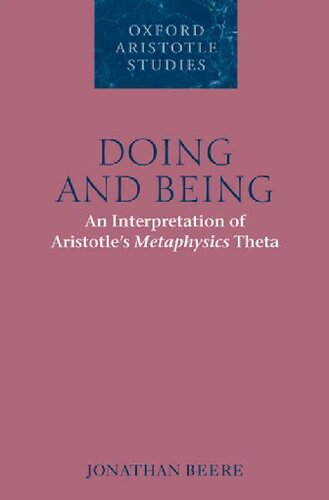
Doing and Being: An Interpretation of Aristotle's Metaphysics Theta (Oxford Aristotle Studies Series)
2009 · PDF

Doing and Being: An Interpretation of Aristotle's Metaphysics Theta (Oxford Aristotle Studies Series)
2009 · EPUB

Doing and Being: An Interpretation of Aristotle's Metaphysics Theta (Oxford Aristotle Studies Series)
2010 · EPUB

Doing and Being: An Interpretation of Aristotle's Metaphysics Theta
2010 · PDF

MySQL® Notes for Professionals book
2018 · PDF

MrExcel 2022: Boosting Excel
2022 · PDF

MrExcel 2022: Boosting Excel
2022 · PDF

Session C11: Ancient Cultural Landscapes in South Europe – their Ecological Setting and Evolution, Session C22: Gardeners from South America, Session S04: Agro-Pastoralism and Early Metallurgy Sessions, Session WS29: The Idea of Enclosure in Recent Iberian Prehistory, Session C88: Rhytmes et causalites des dynamiques de l'anthropisation en Europe entre 6500 ET 500 BC: Hypotheses socio-culturelles et/ou climatiques: Proceedings of the XV UISPP World Congress (Lisbon 4-9 September 2006) / Actes du XV Congrès Mondial (Lisbonne 4-9 Septembre 2006) Vol.36
2010 · PDF