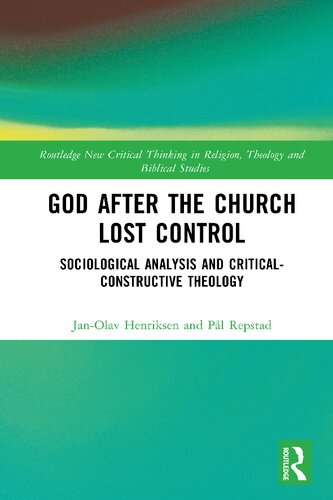
God After the Church Lost Control (Routledge New Critical Thinking in Religion, Theology and Biblical Studies)
Book information
Description
This book combines insights from sociology of religion and theology to consider the fundamental changes that have taken place in how people think about God in contemporary Western society. It can be said that God has become irrelevant for many people, often as a result of well-grounded ethical critique of churches. Here the authors argue for the necessity of rethinking God-talk in a pluralist and changing context and for thinking critically about hegemonic ways of speaking about God from a moral and experiential perspective, not only from the point of view of abstract theology. Drawing on empirical material from a Norwegian setting, the book advocates a critical-constructive theology with a notion of God that takes human experience and social change seriously. It depicts a God who is an enabler of moral maturity rather than an authoritarian moral instructor, a God who is on the side of the marginalized and poor, and a challenge to unjust hierarchies.
Similar books
God After the Church Lost Control: Sociological Analysis and Critical-Constructive Theology
2022 · PDF

Theological Anthropology in the Anthropocene: Reconsidering Human Agency and its Limits
2022 · PDF

Climate change and the Symbol Deficit in the Christian Tradition: Expanding Gendered Sources
2022 · PDF

Christianity as Distinct Practices: A Complicated Relationship
2019 · PDF

Modern Sociologists on Society and Religion
2021 · EPUB

The Reconstruction of Religion: Lessing, Kierkegaard, and Nietzsche
2015 · PDF

Religious Pluralism and Pragmatist Theology
2019 · PDF

An Introduction to the Sociology of Religion: Classical and Contemporary Perspectives
2006 · PDF