Control of Interactive Robotic Interfaces: A Port-Hamiltonian Approach
Book information
Description
This monograph deals with energy based control of interactive robotic interfaces and the port-Hamiltonian framework is exploited both for modeling and controlling interactive robotic interfaces. Using the port-Hamiltonian framework, it is possible to identify the energetic properties that have to be controlled in order to achieve a desired interactive behavior and it is possible to build a port-Hamiltonian controller that properly regulates the robotic interface by shaping its energetic properties. Thanks to its generality, the port-Hamiltonian formalism allows to model and control also complex interactive robotic interfaces in a very natural way. In this book, a port-Hamiltonian approach for regulating the interaction between a robot and a local environment, a virtual environment (i.e. haptic interfaces) and a remote environment (i.e. bilateral telemanipulation systems) is developed.
Similar books

Control of Interactive Robotic Interfaces: A Port-Hamiltonian Approach
2007 · DJVU

Modeling and IPC Control of Interactive Mechanical Systems - A Coordinate-Free Approach
2001 · PDF
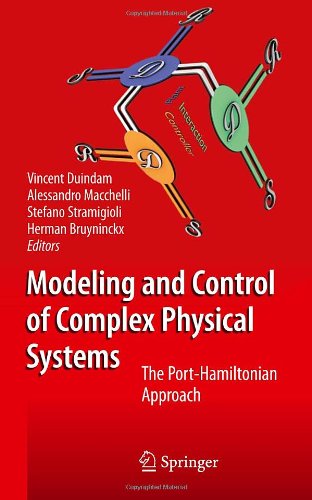
Modeling and Control of Complex Physical Systems: The Port-Hamiltonian Approach
2009 · PDF

Modeling and control of complex physical systems: The Port-Hamiltonian approach
2009 · PDF

MySQL® Notes for Professionals book
2018 · PDF

MrExcel 2022: Boosting Excel
2022 · PDF

MrExcel 2022: Boosting Excel
2022 · PDF

Session C11: Ancient Cultural Landscapes in South Europe – their Ecological Setting and Evolution, Session C22: Gardeners from South America, Session S04: Agro-Pastoralism and Early Metallurgy Sessions, Session WS29: The Idea of Enclosure in Recent Iberian Prehistory, Session C88: Rhytmes et causalites des dynamiques de l'anthropisation en Europe entre 6500 ET 500 BC: Hypotheses socio-culturelles et/ou climatiques: Proceedings of the XV UISPP World Congress (Lisbon 4-9 September 2006) / Actes du XV Congrès Mondial (Lisbonne 4-9 Septembre 2006) Vol.36
2010 · PDF