The Great Migration of the Chemurchek People from France to the Altai in the Early 3rd Millenium BCE
Book information
Description
International Journal of Eurasian Studies. — 2011. — Vol. 1 (11). — P. 1-58."In this paper we attempt to present elements of Chemurchek culture which have no other analogies except those in the Neolithic of France: in the mounds’ construction these were overlapping perimetral cairns, burial corridors with dry stone side-walls, the specific style of stone statues, and the peculiar shapes of vessels. Evidently the fact that all these elements of culture had been transferred over 6,500 kilometers to the Mongolian Altai can only be explained by migration.The results of the presented research can throw light on the problem of the origins of the Tokharians because the Tokharian-speaking people moved from the West to the heart of Asia in this period (according to glotto-chronological data) and the Tokharian language belongs precisely to the western Indo-European languages. If it was a migration of Proto-Tokharians we have possibilities of recognizing territories of inhabitancy of other Old Western Indo-European dialects: the Proto-Tokharian language had the closest connections with Proto-Germanic and Proto-Italian. These dialects should have been spread in the vicinity of the territory of the Proto-Tokharians, as we established here-namely in the vicinity of southern France."
Similar books
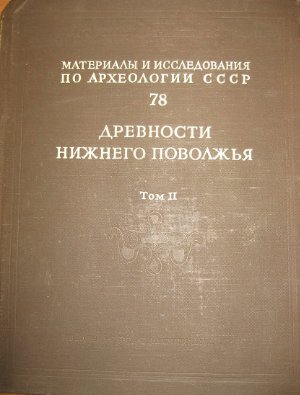
Материалы и исследования по археологии СССР №78. Крупнов Е.И., Смирнов К.Ф. (отв. ред.) Древности Нижнего Поволжья (Итоги работ Сталинградской археологической экспедиции). Том II
DJVU

Усово Озеро. Поселение срубной культуры на Северском Донце

О серпах, колодцах и земледелии бронзового века

К вопросу об использовании металлических серпов и серповидных орудий в степных (скотоводческих) культурах эпохи поздней бронзы Восточной Европы

Технико-технологический анализ керамики Покровского поселения эпохи бронзы

Самарский II курганный могильник - новый некрополь ямной культуры в Башкирском Зауралье

Самарский II курганный могильник ямной культуры в Башкирском Зауралье
