Textbook on The Law of Evidence
Book information
Description
Function of the law of evidence.-The Law of Evidence may be defined as a system of rules for ascertaining controverted questions of fact in judicial inquiries. It bears the same relation to a judicial investigation as logic to reasoning. The object of every judicial proceeding is the enforcement of some right or liability which invariably depends upon certain facts. The substantive law, whether it be statute law or common law, merely defines what facts go to constitute a right or liability. Before a tribunal can pronounce as to the existence of a right or liability, it must ascertain the facts which, according to the rule of Substantive Law applicable to the case, are the necessary constituents of that right or liability. This duty of ascertaining the facts which are the essential elements of a right of liability is the primary, and perhaps the most difficult, function of a tribunal. The inquiry into these facts is regulated by a set of rules and principles which go by the name of "Law of Evidence". The first task of a Judge being to ascertain facts, the rules by which the inquiry before him is regulated should not, in their fundamentals, differ from those by which any other seeker after truth regulates his inquiries. The Physicist who ascertains the properties of matter or the Historian who is concerned with finding what happened in the past is as much a seeker after truth as the Judge who is concerned 1. Short title, extent and commencement 2. Repeal of enactments. 3. Interpretation clause 4."May presume" "Shall presume" "Conclusive proof" 5. OF THE RELEVANCY OF FACTS
Similar books
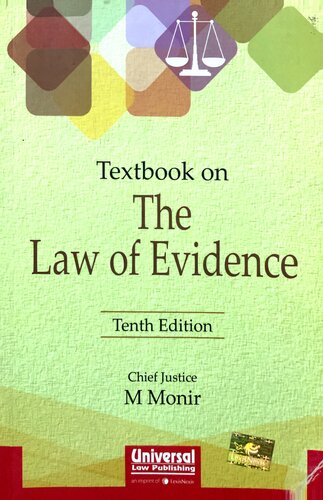
Textbook on The Law of Evidence

MySQL® Notes for Professionals book
2018 · PDF

MrExcel 2022: Boosting Excel
2022 · PDF

MrExcel 2022: Boosting Excel
2022 · PDF

Session C11: Ancient Cultural Landscapes in South Europe – their Ecological Setting and Evolution, Session C22: Gardeners from South America, Session S04: Agro-Pastoralism and Early Metallurgy Sessions, Session WS29: The Idea of Enclosure in Recent Iberian Prehistory, Session C88: Rhytmes et causalites des dynamiques de l'anthropisation en Europe entre 6500 ET 500 BC: Hypotheses socio-culturelles et/ou climatiques: Proceedings of the XV UISPP World Congress (Lisbon 4-9 September 2006) / Actes du XV Congrès Mondial (Lisbonne 4-9 Septembre 2006) Vol.36
2010 · PDF

THE BRITISH ARMY IN INDIA: ITS PRESERVATION BY AN APPROPRIATE CLOTHING, HOUSING, LOCATING, RECREATIVE EMPLOYMENT, AND HOPEFUL ENCOURAGEMENT OF THE TROOPS. with AN APPENDIX ON INDIA : THE CLIMATE OP ITS HILLS ; THE DEVELOPMENT OF ITS RESODRCBS, INDUSTRY, AND ARTS ; THE ADMINISTRATION OF JUSTICE ; THE BLACK ACT ; THE PROGRESS OF CHRISTIANITY ; THE TRAFFIC IN OPIUM ; THE VALUE OF INDIA ; PERMANENT CAUSES OF DISAFFECTION, AND OF THE RECENT REBELLION ; THE TRADITIONARY POLICY; MISGOVERNMENT BY NATIVE RULERS ; ANNEXATIONS OF THEIR TERRITORY, ETC.
1858 · PDF

Idries Shah 27 Books Collection : A Perfumed Scorpion, A Veiled Gazelle, Caravan of Dreams, Darkest England, Destination Mecca, Evenings with Idries Shah, Knowing How to Know, Learning How to Learn, Letters and Lectures of Idries Shah, Neglected aspects of Sufi study, Observations, Oriental Magic, Reflections, Seeker after Truth, Special Illumination, Special Problems in the study of Sufi ideas, Sufi thought and action, Tales of the Dervishes, The Dermis Probe, The Elephant in the Dark, The Englishman Handbook, Idries Shah Antology, The Magic Monastery, The natives are restless, wisdom of the Idiots PDF.
2022 · PDF

The travels of Capts. Lewis and Clarke from St. Louis, by way of the Missouri and Columbia rivers, to the Pacific ocean; performed in the years 1804, 1805 & 1806, by order of the government of the United States. Containing delineations of the manners, customs, religion, &c. of the Indians, comp. from various authentic sources, and original documents, and a summary of the Statistical view of the Indian nations, from the official communication of Meriwether Lewis. Illustrated with a map of the country, inhabited by the western tribes of Indians
1809 · PDF