A Companion to Hobbes (Blackwell Companions to Philosophy)
Book information
Description
Offers comprehensive treatment of Thomas Hobbes’s thought, providing readers with different ways of understanding Hobbes as a systematic philosopher As one of the founders of modern political philosophy, Thomas Hobbes is best known for his ideas regarding the nature of legitimate government and the necessity of society submitting to the absolute authority of sovereign power. Yet Hobbes produced a wide range of writings, from translations of texts by Homer and Thucydides, to interpretations of Biblical books, to works devoted to geometry, optics, morality, and religion. Hobbes viewed himself as presenting a unified method for theoretical and practical science—an interconnected system of philosophy that provides many entry points into his thought. A Companion to Hobbes is an expertly curated collection of essays offering close textual engagement with the thought of Thomas Hobbes in his major works while probing his ideas regarding natural philosophy, mathematics, human nature, civil philosophy, religion, and more. The Companion discusses the ways in which scholars have tried to understand the unity and diversity of Hobbes’s philosophical system and examines the reception of the different parts of Hobbes’s philosophy by thinkers such as René Descartes, Margaret Cavendish, David Hume, and Immanuel Kant. Presenting a diversity of fresh perspectives by both emerging and established scholars, this volume: Provides a comprehensive treatment of Hobbes’s thought in his works, including Elements of Law, Elements of Philosophy, and Leviathan Explores the connecting points between Hobbes’ metaphysics, epistemology, mathematics, natural philosophy, morality, and civil philosophy Offers readers strategies for understanding how the parts of Hobbes’s philosophical system fit together Examines Hobbes’s philosophy of mathematics and his attempts to understand geometrical objects and definitions Considers Hobbes’s philosophy in contexts such as the natural state of humans, gender relations, and materialist worldviews Challenges conceptions of Hobbes’s moral theory and his views about the rights of sovereigns Part of the acclaimed Blackwell Companions to Philosophy series, A Companion to Hobbes is an invaluable resource for scholars and advanced students of Early modern thought, particularly those from disciplines such as History of Philosophy, Political Philosophy, Intellectual History, History of Politics, Political Theory, and English.
Similar books

Eppur si muove: Doing History and Philosophy of Science with Peter Machamer: A Collection of Essays in Honor of Peter Machamer
2017 · PDF
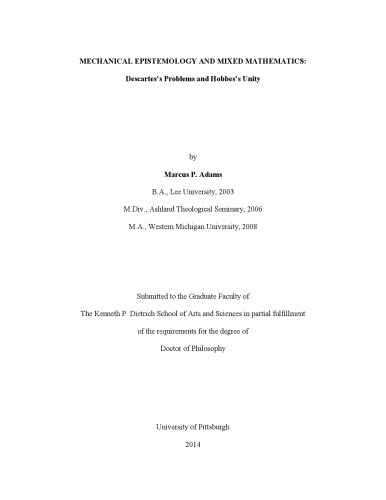
Mechanical Epistemology and Mixed Mathematics: Descartes’s Problems and Hobbes’s Unity
2014 · PDF

Whiskey and Philosophy: A Small Batch of Spirited Ideas (Epicurean)
2009 · PDF

MySQL® Notes for Professionals book
2018 · PDF

MrExcel 2022: Boosting Excel
2022 · PDF

MrExcel 2022: Boosting Excel
2022 · PDF

Session C11: Ancient Cultural Landscapes in South Europe – their Ecological Setting and Evolution, Session C22: Gardeners from South America, Session S04: Agro-Pastoralism and Early Metallurgy Sessions, Session WS29: The Idea of Enclosure in Recent Iberian Prehistory, Session C88: Rhytmes et causalites des dynamiques de l'anthropisation en Europe entre 6500 ET 500 BC: Hypotheses socio-culturelles et/ou climatiques: Proceedings of the XV UISPP World Congress (Lisbon 4-9 September 2006) / Actes du XV Congrès Mondial (Lisbonne 4-9 Septembre 2006) Vol.36
2010 · PDF

THE BRITISH ARMY IN INDIA: ITS PRESERVATION BY AN APPROPRIATE CLOTHING, HOUSING, LOCATING, RECREATIVE EMPLOYMENT, AND HOPEFUL ENCOURAGEMENT OF THE TROOPS. with AN APPENDIX ON INDIA : THE CLIMATE OP ITS HILLS ; THE DEVELOPMENT OF ITS RESODRCBS, INDUSTRY, AND ARTS ; THE ADMINISTRATION OF JUSTICE ; THE BLACK ACT ; THE PROGRESS OF CHRISTIANITY ; THE TRAFFIC IN OPIUM ; THE VALUE OF INDIA ; PERMANENT CAUSES OF DISAFFECTION, AND OF THE RECENT REBELLION ; THE TRADITIONARY POLICY; MISGOVERNMENT BY NATIVE RULERS ; ANNEXATIONS OF THEIR TERRITORY, ETC.
1858 · PDF