The Material of Poetry: Sketches for a Philosophical Poetics
Book information
Description
Poetry is philosophically interesting, writes Gerald L. Bruns, "when it is innovative not just in its practices, but, before everything else, in its poetics (that is, in its concepts or theories of itself)." In The Material of Poetry, Bruns considers the possibility that anything, under certain conditions, may be made to count as a poem. By spelling out such enabling conditions he gives us an engaging overview of some of the kinds of contemporary poetry that challenge our notions of what language is: sound poetry, visual or concrete poetry, and "found" poetry. Poetry's sense and meaning can hide in the spaces in which it is written and read, says Bruns, and so he urges us to become anthropologists, to go afield in poetry's social, historical, and cultural settings. From that perspective, Bruns draws on works by such varied poets as Gertrude Stein, Ezra Pound, Steve McCaffery, and Francis Ponge to argue for three seemingly competing points. First, poetry is made of language but is not a use of it. That is, poetry is made of words but not of what we use words to produce: concepts, narratives, expressions of feeling, and so on. Second, as the nine sound poems on the CD included with the book demonstrate, poetry is not necessarily made of words but is rooted in, and in fact already fully formed by, sounds the human body can produce. Finally, poetry belongs to the world alongside ordinary things; it cannot be confined to some aesthetic, neutral, or disengaged dimension of human culture. Poetry without frontiers, unmoored from expectations, and sometimes even written in imaginary languages: Bruns shows us why, for the sake of all poetry, we should embrace its anarchic, vitalizing ways. Contents CD Tracks Illustrations Foreword Acknowledgements Introduction: An Apology for Poetry 1. Poetry as an Event of Language: The Conceptual Achievement of Contemporary Poetics 2. The Transcendence of Words: A Short Defense of (Sound) Poetry 3. Poetic Materialism: The Poet's Redemption of Everyday Things Conclusion: On Poems of the Third Kind (a Thought Experiment) Notes Bibliography Index
Similar books
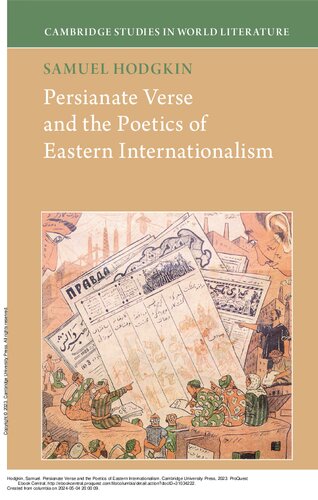
Persianate Verse and the Poetics of Eastern Internationalism
2023 · PDF

Seamus Heaney: A Collection of Critical Essays
1993 · PDF

Yeats and Modern Poetry
2013 · PDF

The Form of Love: Poetry’s Quarrel with Philosophy
2021 · EPUB

Seamus Heaney
2010 · PDF

Handbook of the English Novel of the Twentieth and Twenty-First Centuries
2017 · PDF

Poetry as Method: Reporting Research Through Verse
2009 · PDF
The Modern Poetic Sequence: The Genius of Modern Poetry
1983 · PDF