Whole Earth: Beyond the Entitlement of the Property Owner
Book information
Description
This book takes a radical approach to ecological economics, proposing a new paradigm based on earth systems science. This book questions the foundation of economics on individual private property, and proposes new forms of relationship to land and to the state. It questions the foundation of economics on the individual, and proposes new forms of regional ecological collectives, integrated at the global level. It critically examines the assumptions of economics and re-envisions it as more integrally related to society and ecology. The volume integrates insights from a variety of fields, including humanities, natural, and social science, placing human life in the setting of ecology. The chapters invoke a historical institutional methodology to examine the link between economic theories and economic institutions, understanding performativity and applying reflexivity, and the potential for the emergence of new visions and methods. The method draws upon literary studies, linguistic philosophy, as well as long term economic history. Providing an alternative view of the relationship of humans to the earth, this book is appropriate for students and researchers across a variety of disciplines including economics, history, ecology, and philosophy. Preface Acknowledgments Contents Part I: Basic Framework Chapter 1: Introduction: Beyond Reification: Envisioning the Earth 1 Summary of Project 2 Review of the Literature 3 Life Processes 4 Techniques of Reification 4.1 Property 4.2 Money 4.3 Ecosystems Services 4.4 Public/Private Divide 4.5 Modern Science 5 Governance Systems 6 Freedom and Recognition Bibliography Chapter 2: The Modern Institution of Science 1 History of Science 2 Dichotomies 3 Standpoint 4 Relations 4.1 History of Science 4.2 Feminist Critics of Science 4.3 Marxists 5 Modern Sciences 5.1 Co-evolution 5.2 Human Exceptionalism 5.3 Potential Bias to Science 5.4 Anthropocene 6 New Collective 7 The Limits of Modernity Appendix: Consideration of Other Topics and Issues Bibliography Chapter 3: History of Political Economy 1 Introduction 2 Evolution of Language 3 Co-evolution of Nature and Culture 4 Emergence of History, Political Economy, and Time 5 Separation of Natural from Social Science and Economics from History 5.1 Property 5.2 Corporation 5.3 Money, Finance, and Contradictions 6 Modernity and Capitalist Institutionalism 7 Varieties within Economics Discipline 8 Re-envisioning the Human Relation to Nature Bibliography Part II: Conceptual Development and Critique of Capitalism Chapter 4: “Fictitious Capital”: Money, the Symbol, and the State 1 Modernity and Reifying Abstractions 2 Review Literature Defining “Money” and “Capital” 3 Multiple Usages of “Capital” 4 “Capital” Is the Name of a Complex Evolving Social System 4.1 Definition of Capital 4.2 Logical Development 5 Institutional Definition of Capital 5.1 Consciousness, Roles, and Relations 5.2 Reification of Money 6 Institutional Shifts in Capital Markets 6.1 Merchant Capital 6.2 Central Banks 6.3 The Extension of Markets 6.4 Financial Markets 7 Case: Repo Hiccup of 2019 and 2020 7.1 Historical Context 7.2 Shadow Banking 7.3 Crisis Indicator 7.4 Vulnerabilities 8 Conclusions Appendix Central Bank Facilities in the Pandemic 2020 (Table 4.1) Bibliography Chapter 5: The Public Private Divide 1 Introduction 2 Public/Private Divide 3 Property and Governance 4 Divergent Institutions, Unified System 4.1 Public Finance 4.2 Property 4.3 From Commons to Factory and Household 4.4 Self/Social 4.5 Public Opinion/Private Interests 5 New Institutions 5.1 Public Goods 5.2 Private Parcel of Land/Global Ecology 5.3 Energy 5.4 Public Media 5.5 Time 5.6 Science 5.7 Church 5.8 Family 5.9 Corporations 6 Ambiguities, Reversals, and Contradictions of Public/Private Divide Bibliography Chapter 6: Abstraction and Reification 1 Historical Institutional Methodology 2 Long-Term Evolution of Institutions 3 Property 4 Gender 5 The Power of Money: Credit and Finance 6 Money and Credit 7 Information and Media Technology 8 Real Abstractions Bibliography Part III: Alternatives Chapter 7: Proletarianization and Commodification 1 Introduction 2 The Long Duréé: Human Relation to Land 3 Emergence of Capitalism 3.1 From Land to Property and Finance 3.2 Corporations and the Management of Financial Circuits 4 American Constitution and Protection of Property 4.1 Structure 4.2 Party Formation 5 Class Formation 6 Technology 7 Globalization Under Pax Americana 8 Financialization and Abstraction 9 Contemporary Global Politics Bibliography Chapter 8: Alternatives: Regional Ecological Communities 1 Introduction 2 Green Capitalism 2.1 Market-Based Solutions 2.2 Assessment of Market-Based Solutions 3 Values 4 Post-capitalism 4.1 Changing Human Sciences 4.2 Changing Human Settlement Patterns 4.3 Changing Culture 4.4 Changing Politics 4.5 Priority on Global Biogeochemical Cycles 4.6 Earth Monitoring System 4.7 Integration of Time and Geographic Scales 4.8 Ecological Credit 5 Different Narratives and Visions of the Future Bibliography Chapter 9: Conclusion and Further Reflections Appendix: Human Relation to the Earth Bibliography
Similar books
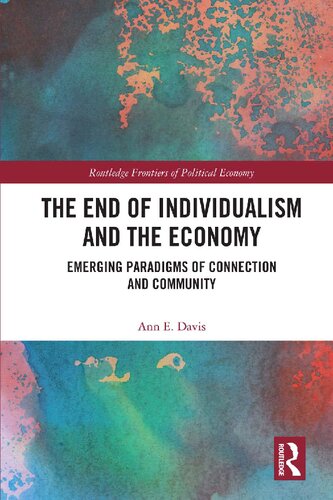
The End of Individualism and the Economy: Emerging Paradigms of Connection and Community
2020 · PDF

The Evolution of the Property Relation: Understanding Paradigms, Debates, and Prospects
2015 · PDF

The Evolution of the Property Relation: Understanding Paradigms, Debates, and Prospects
2015 · PDF

MySQL® Notes for Professionals book
2018 · PDF

MrExcel 2022: Boosting Excel
2022 · PDF

MrExcel 2022: Boosting Excel
2022 · PDF

Session C11: Ancient Cultural Landscapes in South Europe – their Ecological Setting and Evolution, Session C22: Gardeners from South America, Session S04: Agro-Pastoralism and Early Metallurgy Sessions, Session WS29: The Idea of Enclosure in Recent Iberian Prehistory, Session C88: Rhytmes et causalites des dynamiques de l'anthropisation en Europe entre 6500 ET 500 BC: Hypotheses socio-culturelles et/ou climatiques: Proceedings of the XV UISPP World Congress (Lisbon 4-9 September 2006) / Actes du XV Congrès Mondial (Lisbonne 4-9 Septembre 2006) Vol.36
2010 · PDF

THE BRITISH ARMY IN INDIA: ITS PRESERVATION BY AN APPROPRIATE CLOTHING, HOUSING, LOCATING, RECREATIVE EMPLOYMENT, AND HOPEFUL ENCOURAGEMENT OF THE TROOPS. with AN APPENDIX ON INDIA : THE CLIMATE OP ITS HILLS ; THE DEVELOPMENT OF ITS RESODRCBS, INDUSTRY, AND ARTS ; THE ADMINISTRATION OF JUSTICE ; THE BLACK ACT ; THE PROGRESS OF CHRISTIANITY ; THE TRAFFIC IN OPIUM ; THE VALUE OF INDIA ; PERMANENT CAUSES OF DISAFFECTION, AND OF THE RECENT REBELLION ; THE TRADITIONARY POLICY; MISGOVERNMENT BY NATIVE RULERS ; ANNEXATIONS OF THEIR TERRITORY, ETC.
1858 · PDF