Theory of African music, Volume 1
Book information
Description
Offers an account of the music of Africa. This book describes and examines xylophone playing in southern Uganda and harp music from the Central African Republic; compares multi-part singing from across the continent; and explores movement and sound in eastern Angola. It also includes a cognitive study of African rhythm and Yoruba chantefables. Gerhard Kubik is a cultural anthropologist, ethnomusicologist, and psychoanalyst. A professor of ethnology and African studies at the Universities of Vienna and Klagenfurt, he also teaches at Sigmund Freud University, Vienna. Professor Kubik is affiliated with the Oral Literature Research Programme, Chileka, Malawi, and is a permanent member of the Center for Black Music Research in Chicago as well as an honorary fellow of the Royal Anthropological Institute of Great Britain and Ireland. His recent books include 'Africa and the Blues' and 'Tusona—Luchazi Ideographs'. "Kubik's scholarship is deep and vast, and this collection of his writing has no parallel. He stands alone among Africanists for many reasons, which are amply demonstrated in these volumes." - Eric Charry, Wesleyan University" Theory of African Music VOLUME I Contents Preface to Volumes I and II Introduction I. Xylophone Playing in Southern Uganda II. Harp Music of the Azande and Related Peoples in the Central African Republic III. A Structural Examination of Multi-Part Singing in East, Central and Southern Africa Section 1: Homophonic Multi-Part Singing in Bantu Musical Cultures of East and Central Africa Section 2: Nsenga/Shona Harmonic Patterns and the San Heritage in Southern Africa IV. Composition Techniques in Kiganda Xylophone Music. With an Introduction into Some Kiganda Musical Concepts Section 1: The Amadinda Section 2: The Akadinda Section 3: Are Amadinda and Akadinda Pieces Structurally Related? Transcriptions V. Concepts About Movement and Sound in the Eastern Angolan Culture Area Section 1: Musical Enculturation Section 2: Patterns of Body Movement in Mbwela/Nkhangala Boys’ Initiation Section 3: Likembe Tunings and Musical Concepts of an Adolescent Kachokwe: Kufuna Kandonga Notes Bibliography Sound Examples on CD 1 Contents of Volume II
Similar books
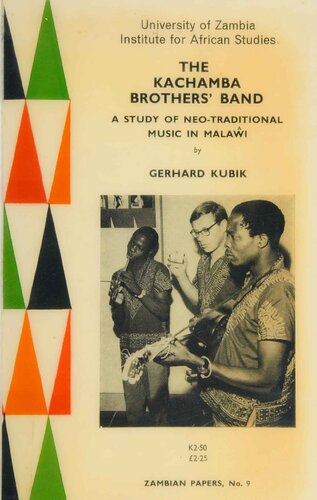
The Kachamba Brothers Band: A Study of Neo-Traditional Music in Malawi
1974 · PDF
Música tradicional e aculturada dos !Kung' de Angola
1970 · PDF

Theory of African Music, Volume II
2010 · PDF

Africa and the Blues
1999 · PDF

Jazz Transatlantic, Volume II: Jazz Derivatives and Developments in Twentieth-Century Africa
2017 · EPUB

Jazz Transatlantic, Volume I: The African Undercurrent in Twentieth-Century Jazz Culture
2017 · EPUB

Jazz Transatlantic, Volume I: The African Undercurrent in Twentieth-Century Jazz Culture
2017 · PDF

Africa and the Blues
2008 · MOBI