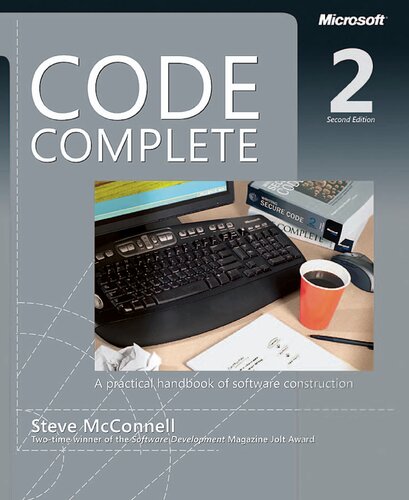
Code Complete: A Practical Handbook of Software Construction (with PDF outline)
Book information
Description
Cover......Page 1 Copyright......Page 0 Further Praise for Code Complete......Page 4 Contents at a Glance......Page 7 Table of Contents......Page 9 Who Should Read This Book?......Page 19 Where Else Can You Find This Information?......Page 20 Key Benefits of This Handbook......Page 21 Why This Handbook Was Written......Page 23 Author Note......Page 25 Acknowledgments......Page 27 Checklists......Page 29 Tables......Page 31 Figures......Page 33 Part I: Laying the Foundation......Page 38 1.1 What Is Software Construction?......Page 40 1.2 Why Is Software Construction Important?......Page 43 Key Points......Page 45 2.1 The Importance of Metaphors......Page 46 2.2 How to Use Software Metaphors......Page 48 2.3 Common Software Metaphors......Page 50 Additional Resources......Page 57 Key Points......Page 58 Chapter 3: Measure Twice, Cut Once: Upstream Prerequisites......Page 60 3.1 Importance of Prerequisites......Page 61 3.2 Determine the Kind of Software You’re Working On......Page 68 3.3 Problem-Definition Prerequisite......Page 73 3.4 Requirements Prerequisite......Page 75 3.5 Architecture Prerequisite......Page 80 3.6 Amount of Time to Spend on Upstream Prerequisites......Page 92 Additional Resources......Page 93 Key Points......Page 96 4.1 Choice of Programming Language......Page 98 4.3 Your Location on the Technology Wave......Page 103 4.4 Selection of Major Construction Practices......Page 106 Key Points......Page 107 Part II: Creating High-Quality Code......Page 108 Chapter 5: Design in Construction......Page 110 5.1 Design Challenges......Page 111 5.2 Key Design Concepts......Page 114 5.3 Design Building Blocks: Heuristics......Page 124 5.4 Design Practices......Page 147 5.5 Comments on Popular Methodologies......Page 155 Additional Resources......Page 156 Key Points......Page 160 Chapter 6: Working Classes......Page 162 6.1 Class Foundations: Abstract Data Types (ADTs)......Page 163 6.2 Good Class Interfaces......Page 170 6.3 Design and Implementation Issues......Page 180 6.4 Reasons to Create a Class......Page 189 6.6 Beyond Classes: Packages......Page 193 Additional Resources......Page 196 Key Points......Page 197 Chapter 7: High-Quality Routines......Page 198 7.1 Valid Reasons to Create a Routine......Page 201 7.2 Design at the Routine Level......Page 205 7.3 Good Routine Names......Page 208 7.4 How Long Can a Routine Be?......Page 210 7.5 How to Use Routine Parameters......Page 211 7.6 Special Considerations in the Use of Functions......Page 218 7.7 Macro Routines and Inline Routines......Page 219 Key Points......Page 223 Chapter 8: Defensive Programming......Page 224 8.1 Protecting Your Program from Invalid Inputs......Page 225 8.2 Assertions......Page 226 8.3 Error-Handling Techniques......Page 231 8.4 Exceptions......Page 235 8.5 Barricade Your Program to Contain the Damage Caused by Errors......Page 240 8.6 Debugging Aids......Page 242 8.7 Determining How Much Defensive Programming to Leave in Production Code......Page 246 8.8 Being Defensive About Defensive Programming......Page 247 Additional Resources......Page 249 Key Points......Page 250 Chapter 9: The Pseudocode Programming Process......Page 252 9.1 Summary of Steps in Building Classes and Routines......Page 253 9.2 Pseudocode for Pros......Page 255 9.3 Constructing Routines by Using the PPP......Page 257 9.4 Alternatives to the PPP......Page 269 Key Points......Page 271 Part III: Variables......Page 272 Chapter 10: General Issues in Using Variables......Page 274 10.1 Data Literacy......Page 275 10.2 Making Variable Declarations Easy......Page 276 10.3 Guidelines for Initializing Variables......Page 277 10.4 Scope......Page 281 10.5 Persistence......Page 288 10.6 Binding Time......Page 289 10.7 Relationship Between Data Types and Control Structures......Page 291 10.8 Using Each Variable for Exactly One Purpose......Page 292 Key Points......Page 295 11.1 Considerations in Choosing Good Names......Page 296 11.2 Naming Specific Types of Data......Page 301 11.3 The Power of Naming Conventions......Page 307 11.4 Informal Naming Conventions......Page 309 11.5 Standardized Prefixes......Page 316 11.6 Creating Short Names That Are Readable......Page 319 11.7 Kinds of Names to Avoid......Page 322 Key Points......Page 326 Chapter 12: Fundamental Data Types......Page 328 12.1 Numbers in General......Page 329 12.2 Integers......Page 330 12.3 Floating-Point Numbers......Page 332 12.4 Characters and Strings......Page 334 12.5 Boolean Variables......Page 338 12.6 Enumerated Types......Page 340 12.7 Named Constants......Page 344 12.8 Arrays......Page 347 12.9 Creating Your Own Types (Type Aliasing)......Page 348 Key Points......Page 355 13.1 Structures......Page 356 13.2 Pointers......Page 360 13.3 Global Data......Page 372 Additional Resources......Page 380 Key Points......Page 381 Part IV: Statements......Page 382 14.1 Statements That Must Be in a Specific Order......Page 384 14.2 Statements Whose Order Doesn’t Matter......Page 388 Key Points......Page 390 15.1 if Statements......Page 392 15.2 case Statements......Page 398 Key Points......Page 403 16.1 Selecting the Kind of Loop......Page 404 16.2 Controlling the Loop......Page 410 16.3 Creating Loops Easily—From the Inside Out......Page 422 16.4 Correspondence Between Loops and Arrays......Page 424 Key Points......Page 426 17.1 Multiple Returns from a Routine......Page 428 17.2 Recursion......Page 430 17.3 goto......Page 435 Additional Resources......Page 445 Key Points......Page 447 18.1 General Considerations in Using Table-Driven Methods......Page 448 18.2 Direct Access Tables......Page 450 18.3 Indexed Access Tables......Page 462 18.4 Stair-Step Access Tables......Page 463 18.5 Other Examples of Table Lookups......Page 466 Key Points......Page 467 19.1 Boolean Expressions......Page 468 19.2 Compound Statements (Blocks)......Page 480 19.3 Null Statements......Page 481 19.4 Taming Dangerously Deep Nesting......Page 482 19.5 A Programming Foundation: Structured Programming......Page 491 19.6 Control Structures and Complexity......Page 493 Key Points......Page 497 Part V: Code Improvements......Page 498 20.1 Characteristics of Software Quality......Page 500 20.2 Techniques for Improving Software Quality......Page 503 20.3 Relative Effectiveness of Quality Techniques......Page 506 20.4 When to Do Quality Assurance......Page 510 20.5 The General Principle of Software Quality......Page 511 Additional Resources......Page 513 Key Points......Page 514 Chapter 21: Collaborative Construction......Page 516 21.1 Overview of Collaborative Development Practices......Page 517 21.2 Pair Programming......Page 520 21.3 Formal Inspections......Page 522 21.4 Other Kinds of Collaborative Development Practices......Page 529 21.5 Comparison of Collaborative Construction Techniques......Page 532 Additional Resources......Page 533 Key Points......Page 534 Chapter 22: Developer Testing......Page 536 22.1 Role of Developer Testing in Software Quality......Page 537 22.2 Recommended Approach to Developer Testing......Page 540 22.3 Bag of Testing Tricks......Page 542 22.4 Typical Errors......Page 554 22.5 Test-Support Tools......Page 560 22.6 Improving Your Testing......Page 565 22.7 Keeping Test Records......Page 566 Additional Resources......Page 567 Key Points......Page 570 23.1 Overview of Debugging Issues......Page 572 23.2 Finding a Defect......Page 577 23.3 Fixing a Defect......Page 587 23.4 Psychological Considerations in Debugging......Page 591 23.5 Debugging Tools—Obvious and Not-So-Obvious......Page 593 Additional Resources......Page 598 Key Points......Page 599 Chapter 24: Refactoring......Page 600 24.1 Kinds of Software Evolution......Page 601 24.2 Introduction to Refactoring......Page 602 23.3 Specific Refactorings......Page 608 23.4 Refactoring Safely......Page 616 23.5 Refactoring Strategies......Page 619 Key Points......Page 622 Chapter 25: Code-Tuning Strategies......Page 624 25.1 Performance Overview......Page 625 25.2 Introduction to Code Tuning......Page 628 25.3 Kinds of Fat and Molasses......Page 634 25.4 Measurement......Page 640 25.5 Iteration......Page 642 Additional Resources......Page 643 Key Points......Page 645 Chapter 26: Code-Tuning Techniques......Page 646 26.1 Logic......Page 647 26.2 Loops......Page 653 26.3 Data Transformations......Page 661 26.4 Expressions......Page 667 26.5 Routines......Page 676 26.6 Recoding in a Low-Level Language......Page 677 26.7 The More Things Change, the More They Stay the Same......Page 680 Additional Resources......Page 681 Key Points......Page 682 Part VI: System Considerations......Page 684 Chapter 27: How Program Size Affects Construction......Page 686 27.1 Communication and Size......Page 687 27.3 Effect of Project Size on Errors......Page 688 27.4 Effect of Project Size on Productivity......Page 690 27.5 Effect of Project Size on Development Activities......Page 691 Additional Resources......Page 695 Key Points......Page 696 Chapter 28: Managing Construction......Page 698 28.1 Encouraging Good Coding......Page 699 28.2 Configuration Management......Page 701 28.3 Estimating a Construction Schedule......Page 708 28.4 Measurement......Page 714 28.5 Treating Programmers as People......Page 717 28.6 Managing Your Manager......Page 723 Additional Resources on Managing Construction......Page 724 Key Points......Page 725 29.1 Importance of the Integration Approach......Page 726 29.2 Integration Frequency—Phased or Incremental?......Page 728 29.3 Incremental Integration Strategies......Page 731 29.4 Daily Build and Smoke Test......Page 739 Additional Resources......Page 744 Key Points......Page 745 Chapter 30: Programming Tools......Page 746 30.2 Source-Code Tools......Page 747 30.3 Executable-Code Tools......Page 753 30.4 Tool-Oriented Environments......Page 757 30.5 Building Your Own Programming Tools......Page 758 30.6 Tool Fantasyland......Page 759 Additional Resources......Page 761 Key Points......Page 762 Part VII: Software Craftsmanship......Page 764 Chapter 31: Layout and Style......Page 766 31.1 Layout Fundamentals......Page 767 31.2 Layout Techniques......Page 773 31.3 Layout Styles......Page 775 31.4 Laying Out Control Structures......Page 782 31.5 Laying Out Individual Statements......Page 790 31.6 Laying Out Comments......Page 800 31.7 Laying Out Routines......Page 803 31.8 Laying Out Classes......Page 805 Additional Resources......Page 811 Key Points......Page 812 32.1 External Documentation......Page 814 32.2 Programming Style as Documentation......Page 815 32.3 To Comment or Not to Comment......Page 818 32.4 Keys to Effective Comments......Page 822 32.5 Commenting Techniques......Page 829 32.6 IEEE Standards......Page 850 Additional Resources......Page 852 Key Points......Page 854 Chapter 33: Personal Character......Page 856 33.1 Isn’t Personal Character Off the Topic?......Page 857 33.2 Intelligence and Humility......Page 858 33.3 Curiosity......Page 859 33.4 Intellectual Honesty......Page 863 33.5 Communication and Cooperation......Page 865 33.6 Creativity and Discipline......Page 866 33.8 Characteristics That Don’t Matter As Much As You Might Think......Page 867 3.9 Habits......Page 870 Additional Resources......Page 871 Key Points......Page 872 34.1 Conquer Complexity......Page 874 34.2 Pick Your Process......Page 876 34.3 Write Programs for People First, Computers Second......Page 878 34.4 Program into Your Language, Not in It......Page 880 34.5 Focus Your Attention with the Help of Conventions......Page 881 34.6 Program in Terms of the Problem Domain......Page 882 34.7 Watch for Falling Rocks......Page 885 34.8 Iterate, Repeatedly, Again and Again......Page 887 34.9 Thou Shalt Rend Software and Religion Asunder......Page 888 Key Points......Page 890 Chapter 35: Where to Find More Information......Page 892 35.1 Information About Software Construction......Page 893 35.2 Topics Beyond Construction......Page 894 35.3 Periodicals......Page 896 35.4 A Software Developer’s Reading Plan......Page 897 35.5 Joining a Professional Organization......Page 899 Bibliography......Page 900 Index......Page 922 About the Author......Page 952
Similar books

Kod doskonały. Jak tworzyć oprogramowanie pozbawione błędów. Wydanie II
2012 · EPUB

Kod doskonały. Jak tworzyć oprogramowanie pozbawione błędów. Wydanie II
2012 · PDF
Code Complete
2004 · PDF

Code Complete

Kod doskonały. Jak tworzyć oprogramowanie pozbawione błędów
2010 · PDF

Code Complete: A Practical Handbook of Software Construction

Code Complete: A Practical Handbook of Software Construction
2004 · PDF

Rapid Development: Taming Wild Software Schedules
1996 · DJVU