Comparative Risk Assessment and Environmental Decision Making
Book information
Description
Decision making in environmental projects is typically a complex and confusing process characterized by trade-offs between socio-political, environmental, and economic impacts. Comparative Risk Assessment (CRA) is a methodology applied to facilitate decision making when various activities compete for limited resources. CRA has become an increasingly accepted research tool and has helped to characterize environmental profiles and priorities on the regional and national level. CRA may be considered as part of the more general but as yet quite academic field of multi-criteria decision analysis (MCDA). Considerable research in the area of MCDA has made available methods for applying scientific decision theoretical approaches to multi-criteria problems, but its applications, especially in environmental areas, are still limited. The papers show that the use of comparative risk assessment can provide the scientific basis for environmentally sound and cost-efficient policies, strategies, and solutions to our environmental challenges.
Similar books

Assessment and Management of Environmental Risks: Cost-efficient Methods and Applications Proceedings of the NATO Advanced Research Workshop on Assessment and Management of Environmental Risks: Methods and Applications in Eastern European and Developing Countries Lisbon, Portugal October 1–4, 2000
2001 · PDF

Contaminated Forests: Recent Developments in Risk Identification and Future Perspectives
1999 · PDF
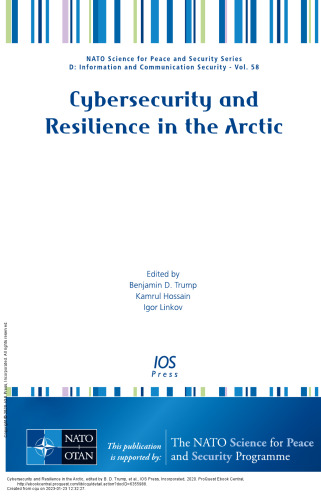
Cybersecurity and Resilience in the Arctic
2020 · PDF

A Systemic Recovery
2022 · PDF

Multi-criteria decision analysis : case studies in engineering and the environment
2021 · PDF

COVID-19: Systemic Risk and Resilience
2021 · PDF

Climate: Global Change and Local Adaptation
2011 · PDF
Synthetic Biology 2020: Frontiers in Risk Analysis and Governance
2020 · PDF