Principles of Equity
Book information
Description
Henry Home / Principles of Equity Front Matter Half Title Page, p. i Frontispiece, p. iii Full Title Page, p. v Copyright Page, p. vi Contents, p. vii Editor's Introduction, p. ix A Note on Legal Sources and Citations, p. xxvii Abbreviations, p. xxxiii Preliminary Discourse being an Investigation of the Moral Laws of Society., p. xxxv Part: Principles of Equity, Vol. I, p. 1 Original Title Page, p. 1 Letter to Lord Mansfield, p. 3 Preface to the Second Edition, p. 5 Preface to the Present [Third] Edition, p. 7 Contents, p. 9 Explanation of Some Scotch Law Terms Used in This Work, p. 15 Introduction, p. 17 Book I. Powers of a Court of Equity derived from the Principle of Justice., p. 39 Part I. Powers of a court of equity to remedy the imperfections of common law with respect to pecuniary interest, by supplying what is defective, and correcting what is wrong., p. 39 Chapter I. Powers of a court of equity to remedy what is imperfect in common law, with respect to the protecting individuals from harm., p. 40 Section I. Harm done by a man in exercising a right or privilege., p. 41 Section II. Harm done by one who has it not in view to exercise any right or privilege., p. 48 Section III. A man tempted or overawed by undue influence to act knowingly against his interest., p. 52 Article I. Where a man, yielding to a temptation, acts knowingly against his interest., p. 52 Article II. Where a man is overawed to act knowingly against his interest., p. 53 Section IV. A man moved to act unknowingly against his interest, by fraud, deceit, or other artificial means., p. 62 Section V. What remedy is applied by a court of equity against the wrongs above stated., p. 67 Chapter II. Powers of a Court of Equity to remedy what is imperfect in common law, with respect to protecting the weak of mind from harming themselves by unequal bargains and irrational deeds., p. 71 Chapter III. Powers of a court of equity to remedy what is imperfect in common law, with respect to the natural duty of benevolence., p. 74 Section I. Connections that make benevolence a duty when not prejudicial to our interest., p. 77 Section II. Connections that make benevolence a duty even against our interest., p. 88 Article I. Connections that intitle a man to have his loss made up out of my gain., p. 88 Article II. Connections that intitle a man who is not a loser, to partake of my gain., p. 103 Article III. Connections that intitle one who is a loser to be indemnified by one who is not a gainer., p. 109 Chapter IV. Powers of a court of equity to remedy what is imperfect in common law with respect to deeds and covenants., p. 117 Section I. Where will is imperfectly expressed in the writing., p. 122 Article I. Where the words leave us uncertain about will., p. 123 Article II. Where the words are short of will., p. 128 Article III. Where the words go beyond will., p. 132 Section II. Implied will., p. 141 Section III. Whether an omission in a deed or covenant can be supplied., p. 144 Section IV. A deed or covenant that tends not to bring about the end for which it was made., p. 154 Section V. Equity with respect to a deed providing for an event that now can never happen., p. 160 Section VI Errors in deeds and covenants., p. 162 Section VII. A deed or covenant being void at common law as ultra vires, can a court of equity afford any relief?, p. 179 Section VIII. Where there is a failure in performance., p. 185 Section IX. Indirect means employed to evade performance., p. 194 Chapter V. Powers of a court of equity to remedy what is imperfect in common law with respect to statutes., p. 195 Section I. Where the will of the legislature is not justly expressed in the statute., p. 207 Article I. Where the words are ambiguous., p. 207 Article II. Where the words fall short of will., p. 208 Article III. Where the words go beyond will., p. 208 Section II. Where the means enacted fall short of the end purposed by the legislature., p. 210 Section III. Where the means enacted reach unwarily beyond the end purposed by the legislature., p. 219 Chapter VI Powers of a court of equity to remedy what is imperfect in common law with respect to matters between debtor and creditor., p. 224 Section I. Injustice of common law with respect to compensation., p. 225 Section II. Injustice of common law with respect to indefinite payment., p. 231 Section III. Injustice of common law with respect to rent levied indefinitely., p. 236 Chapter VII. Powers of a court of equity to remedy what is imperfect in common law with respect to a process., p. 240 Part: Principles of Equity, Vol. II, p. 243 Original Title Page, p. 243 Book I. Powers of a Court of Equity derived from the Principles of Justice., p. 245 Part I. Powers of a court of equity to remedy the imperfections of common law with respect to pecuniary interest., p. 245 Chapter VIII. Powers of a court of equity to remedy what is imperfect in common law with respect to legal execution., p. 245 Section I Where the common law is defective., p. 245 Article I. Subjects that cannot be attached by the executions of common law., p. 246 Article II. Circumstances where even common subjects are withdrawn from these executions., p. 247 Article III. These executions are in some cases imperfect., p. 251 Article IV. They serve only to make debts effectual, and give no aid to other claims., p. 251 Section II. Where the common law with respect to execution is oppressive or unjust., p. 253 Appendix to Chapter VIII., p. 258 Chapter IX. Power of a court of equity to inflict punishment, and to mitigate it., p. 263 Part II. Powers of a court of equity to remedy the imperfection of common law with respect to matters of justice that are not pecuniary., p. 274 Chapter I. How far a covenant or promise in favour of an absent person, is effectual., p. 275 Chapter II. Powers of a court of equity to repress immoral acts that are not pecuniary., p. 287 Book II. Powers of a Court of Equity founded on the principle of Utility, p. 289 Chapter I. Acts in themselves lawful reprobated in equity as having a tendency to corrupt morals., p. 290 Chapter II. Acts and covenants in themselves innocent, prohibited in equity, because of their tendency to disturb society, and to distress its members., p. 292 Chapter III. Regulations of commerce, and of other public concerns, rectified where wrong., p. 295 Chapter IV. Forms of the common law dispensed with in order to abridge law-suits., p. 297 Chapter V. Bona fides as far as regulated by utility., p. 300 Chapter VI. Interposition of a court of equity in favour even of a single person to prevent mischief., p. 304 Chapter VII. Statutes preventive of wrong or mischief extended by a court of equity., p. 305 Conclusion of Book II. Justice and Utility compared., p. 311 Book III., p. 315 Chapter I. What equity rules with respect to rents levied upon an erroneous title of property., p. 315 Chapter II. Powers of a court of equity with respect to a conventional penalty., p. 324 Chapter III. What obligations and legacies transmit to heirs., p. 328 Chapter IV. Arrestment and process of forthcoming., p. 333 Chapter V. Powers of a court of equity with relation to bankrupts., p. 345 Chapter VI. Powers and faculties., p. 379 Chapter VII. Of the power which officers of the law have to act extra territorium., p. 395 Chapter VIII. Jurisdiction of the court of session with respect to foreign matters., p. 401 Section I. Personal actions founded on foreign covenants, deeds, or facts., p. 405 Section II. Foreign covenants and deeds respecting land., p. 409 Section III. Moveables domestic and foreign, and their legal effects., p. 411 Section IV. Debts whether regulated by the law of the creditor's country or that of the debtor., p. 416 Section V. Foreign Evidence., p. 420 Section VI. Effect of a statute, of a decree, of a judicial conveyance, or legal execution, extra territorium., p. 421 Original Index, p. 435 Principles Founded on in This Work, p. 451 Major Variant Readings between the First, Second, and Third Editions, p. 453 Table of Contents of the First Edition (1760), p. 467 Table of Contents of the Second Edition (1767), p. 475 Appendix. Extracts from the First and Second Editions, p. 485 Letter from Kames to Robert Dundas of Arniston, Lord President of the Court of Session, Including a Paper Entitled "Jurisdiction of the Court of Session as a Court of Equity", p. 537 Jurisdiction of the Court of Session as a Court of Equity, p. 539 Glossary, p. 543 Bibliography, p. 565 Index, p. 571 Colophon, p. 604
Similar books

Sketches of the History of Man
2007 · PDF

Sketches of the History of Man
2007 · PDF

Sketches of the History of Man
2007 · PDF

Essays on Principles of Morality and Natural Religion
2005 · PDF

Essays on Principles of Morality and Natural Religion (Natural Law and Enlightenment Classics)
2005 · PDF

Elements of Criticism, Vol. 2 (Natural Law and Enlightenment Classics)
2005 · PDF

Elements of Criticism, Vol. 1 (Natural Law and Enlightenment Classics)
2005 · PDF
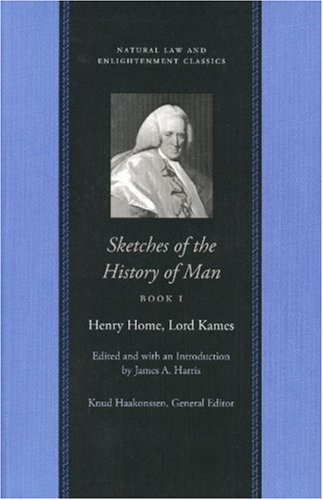
Sketches of the History of Man, Volume 1 (Natural Law and Enlightenment Classics)
2007 · PDF