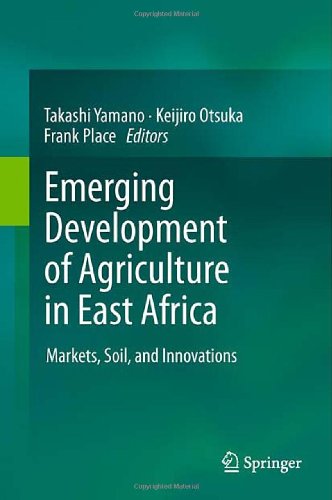
Emerging Development of Agriculture in East Africa: Markets, Soil, and Innovations
Book information
Description
Based on a coordinated panel study of more than 2,400 households in three countries—Kenya, Uganda, and Ethiopia—this book provides unprecedented insight into how agricultural productivity can be improved. Its vast coverage of over 240 different communities offers a wide variety of policy, market and agro-climatic contexts, thus enabling more certain conclusions to be drawn about which strategies are more probably universal or context-specific. Emerging Development of Agriculture in East Africa offers case studies that find promise in many new innovations. Farmers in Uganda have quickly learned the management of NERICA rice (a new upland rice variety), which is being disseminated in a limited way in the region. Also in Uganda, farmers living in more remote areas have improved access to markets due to the expansion of mobile phones. In Kenya, improved milk marketing systems have increased efficiency and led to tangible increases in the adoption of dairy production technologies. And the adoption of intensive dairy production systems in Kenya and Uganda are providing significant amounts of manure and positively impacting yields of maize and banana. Despite the success of these innovations, many of their impacts are limited in terms of depth (size of impact per household) and breadth (number of households). Therefore, each chapter details key constraints to improved impact and the potential policy strategies to overcome them. Many recommendations concern the improvement of markets, which is imperative to increasing agricultural productivity and reducing poverty. Particular emphasis is placed on the role of technology to induce institutional and market change, as was evident in Asia’s Green Revolution. Altogether, the studies in the book suggest that, in addition to improving markets and the output / input price ratio, it is essential to improve technology (e.g. varieties or water management) so that fertilizer and other inputs can earn a higher return. Front Matter....Pages i-xvii Front Matter....Pages 1-1 Purpose, Scope, and Methodology....Pages 3-20 Front Matter....Pages 21-21 The Maize Farm-Market Price Spread in Kenya and Uganda....Pages 23-38 Fertilizer Policies, Price, and Application in East Africa....Pages 39-57 The Impacts of Fertilizer Credit on Crop Production and Income in Ethiopia....Pages 59-72 Emerging Markets in the Post-liberalization Period: Evidence from the Raw Milk Market in Rural Kenya....Pages 73-84 Dynamic Changes in the Uptake of Dairy Technologies in the Kenya Highlands....Pages 85-97 Mobile Phone Coverage and Market Participation: The Case of Banana Marketing in Uganda....Pages 99-113 Front Matter....Pages 115-115 Optimal Fertilizer Use on Maize Production in East Africa....Pages 117-132 Dairy–Banana Integration and Organic Manure Use in Uganda....Pages 133-151 Technology, Soil Fertility, and Poverty: The Case of NERICA Rice in Uganda....Pages 153-167 On the Possibility of a Lowland Rice Green Revolution in Sub-Saharan Africa: Evidence from Eastern Uganda....Pages 169-184 Front Matter....Pages 185-185 Market Access, Soil Fertility, and Income in East Africa....Pages 187-202 Conclusion: Toward the Transformation of Agriculture in East Africa....Pages 203-210 Back Matter....Pages 211-214
Similar books

African Urban Harvest: Agriculture in the Cities of Cameroon, Kenya and Uganda
2010 · PDF

Methods to Analyse Agricultural Commodity Price Volatility
2011 · PDF

Policy Reforms and Agriculture Development in Central Asia
2006 · PDF

African Urban Harvest: Agriculture in the Cities of Cameroon, Kenya and Uganda
2010 · PDF

Methods to Analyse Agricultural Commodity Price Volatility
2011 · PDF
Emerging Development of Agriculture in East Africa: Markets, Soil, and Innovations
2011 · PDF

Applying the Kaizen in Africa: A New Avenue for Industrial Development
2018 · PDF

Land Tenure Reform in Asia and Africa: Assessing Impacts on Poverty and Natural Resource Management
2013 · PDF