Love, Death, and Revolution in Central Europe: Ludwig Feuerbach, Moses Hess, Louise Dittmar, Richard Wagner
Book information
Description
The philosopher of religion and critic of idealism, Ludwig Feuerbach had a far-reaching impact on German radicalism around the time of the Revolution of 1848. This intellectual history explores how Feuerbach’s critique of religion served as a rallying point for radicals, and how they paradoxically sought to create a new, post-religious form of religiosity as part of the revolutionary aim. At issue for the Feuerbachian radicals was the emergence of a humanity emancipated from the constraints of mere institutions, able to express itself freely and harmoniously. Caldwell also touches on Moses Hess, Louise Dittmar, and Richard Wagner in his discussion of the time. This book reconstructs the nature of Feuerbach’s radicalism and shows how it influenced early works of socialism, feminism, and musical modernism.
Similar books
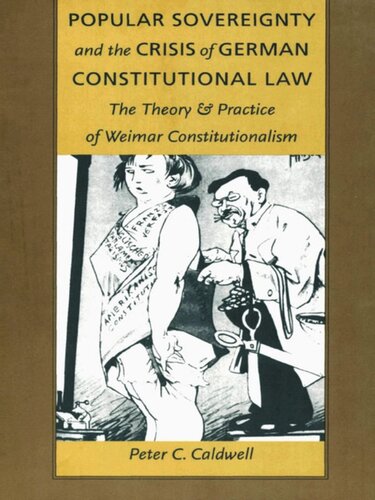
Popular Sovereignty and the Crisis of German Constitutional Law: The Theory and Practice of Weimar Constitutionalism
1997 · PDF

Love, Death, and Revolution in Central Europe: Ludwig Feuerbach, Moses Hess, Louise Dittmar, Richard Wagner
2009 · PDF

German Unification: Expectations and Outcomes
2011 · PDF

Love, Death, and Revolution in Central Europe: Ludwig Feuerbach, Moses Hess, Louise Dittmar, Richard Wagner
2009 · PDF

MySQL® Notes for Professionals book
2018 · PDF

MrExcel 2022: Boosting Excel
2022 · PDF

MrExcel 2022: Boosting Excel
2022 · PDF

Session C11: Ancient Cultural Landscapes in South Europe – their Ecological Setting and Evolution, Session C22: Gardeners from South America, Session S04: Agro-Pastoralism and Early Metallurgy Sessions, Session WS29: The Idea of Enclosure in Recent Iberian Prehistory, Session C88: Rhytmes et causalites des dynamiques de l'anthropisation en Europe entre 6500 ET 500 BC: Hypotheses socio-culturelles et/ou climatiques: Proceedings of the XV UISPP World Congress (Lisbon 4-9 September 2006) / Actes du XV Congrès Mondial (Lisbonne 4-9 Septembre 2006) Vol.36
2010 · PDF