The Medieval Offices of Saint Thomas Aquinas
Book information
Description
AbstractThe book focuses on the relationship between the music and the text in Saint Thomas Aquinas’s med!ieval offces: the *Dies natalis* and the *Translatio*. Our study is a combination of musicological, philological and historical approaches, the aim of which is to grasp the sensory experiences that enveloped the participant in a medieval liturgy. When analysing the offces, we have used traditional methods of musical and textual paleography as well as codicology and philology, comparing both external and internal aspects of our sources.The manuscript sources used in the research are dated mainly to the fourteenth and the beginning of the fifteenth century. Regarding the chants of the older offce, the *Dies natalis* , we can observe that, with a few minor exceptions, they are quite coherent regardless of the location of their employment. The chants of *Translatio* share similar melodies apart from the third great responsory in the manuscripts from Perugia. Thomas’s *Translatio* is a contrafact of Dominic’s *Dies natalis*.Most of the chant melodies carry the texts according to their respective modal nature. Due to the repetitive structure of the modal cycle and the constant change of modes, the emotion of a singer and a listener changes from chant to chant, from mode to mode, as if to underline the importance of not becoming too attached to one modal experience, one emotion. The singing of a rhymed offce with a modal order is a form of obedience: the modal character of a single chant is less relevant than the singer’s willingness to give up one mode and to move on to the next one.The restructuring that Dominic’s offce underwent when it was recast in Thomas’s *Translatio* is reflected in the latter’s strikingly different use of verse form: as the responsories in particular had to incorporate an increased amount of text and a more syllabic style of musical expression, the verse types employed have been changed completely.As the chants of the offces were repeated from time to time, the singers and listeners became thoroughly acquainted with them. This process created a place in the memory where the text could be evoked by simply hearing an echo of the melody. This lends a deeper perspective to offces with shared melodies: in the heart, the mind and the body of a person who knows the liturgy, even a whole chain of liturgies may be recalled through a single melody. For the Dominicans, the liturgy formed an important part of their identity and existence in temporal as well as sacral history.* * *This study focuses on the relationship between the music and the text in Saint Thomas Aquinas’s medieval offices. Singing and listening are central to sensory experience in medieval liturgy. The combination of the melodies and words is strongly emotional, having the capacity to transform the mood of a person and the environment of the church, metaphorically transporting singers and listeners to the spiritual realm of the saint. Liturgical chants had a great potential to convey devotional and even political messages: the different sensorial stimuli of the liturgy made them attainable and understandable to everyone in medieval communities, without making a sharp distinction between religious and secular audiences. In Thomas’s *Dies natalis* and *Translatio* offices, the devotional and political aspects were deliberately taken into consideration by the friars of the Order of Preachers who prepared the offices. In addition to the obvious benefit that it has preserved some thing of aesthetic value, such written music provides some of the best surviving evidence of the veneration of the saint. The book includes the musical notations of the chants. * * *their CD recording: [*Felix Thomas, lumen mundi*](https://sites.utu.fi/ossagloriosa/the-cd-launch-felix-thomas-lumen-mundi-is-coming-soon/) by [Vox Silentii](https://arizona.nml3.naxosmusiclibrary.com/artist/33529) ([for sale on Fuga.fi](https://www.fuga.fi/?sivu=detail&id=VOXSI04))[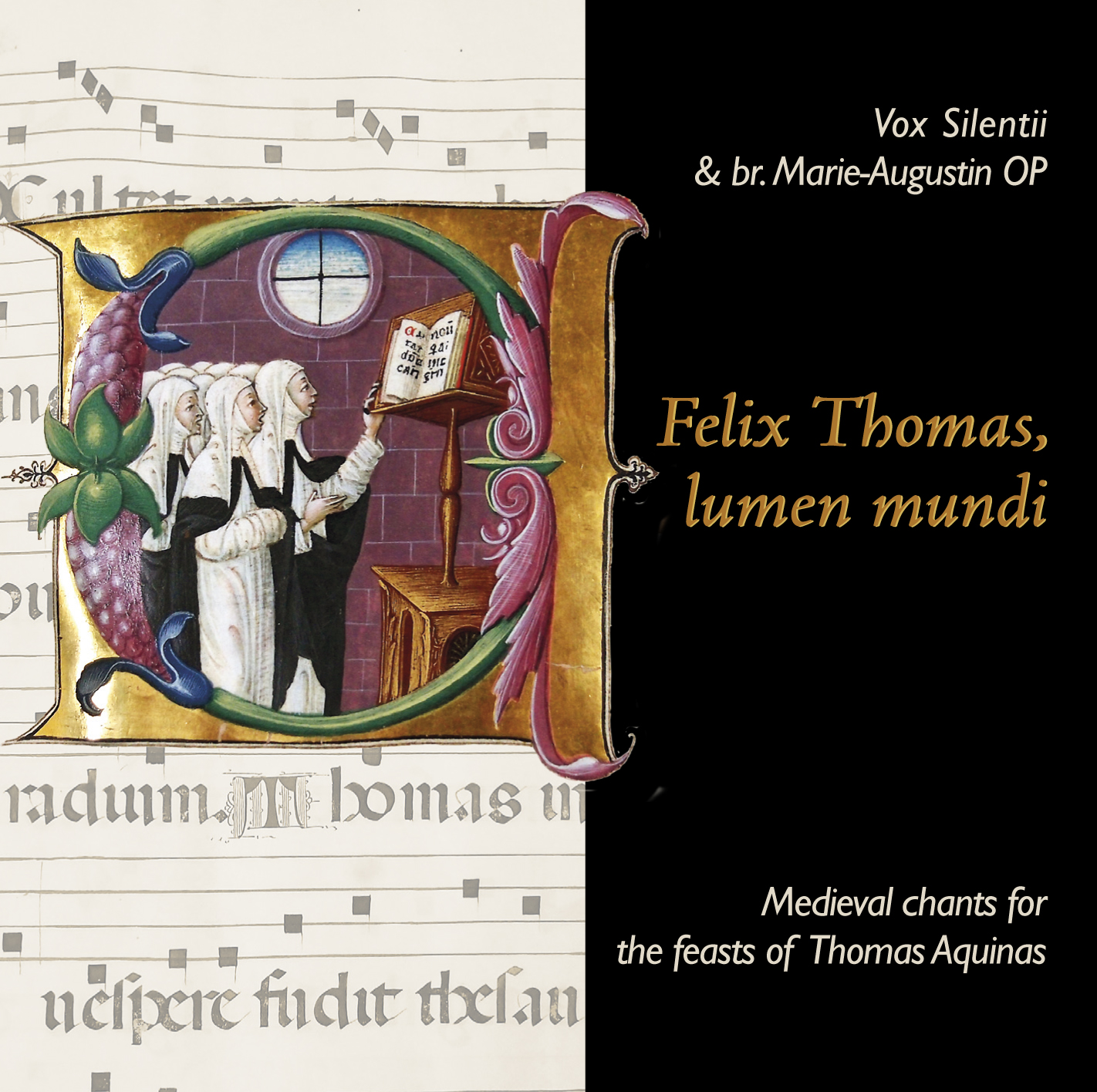](https://sites.utu.fi/ossagloriosa/the-cd-launch-felix-thomas-lumen-mundi-is-coming-soon/) [Opus M3U playlist](https://isidore.co/misc/Res%20pro%20Deo/Greg%20Chant/Felix%20Thomas%20lumen%20mundi/opus_playsist.m3u) (lossy) or [FLAC M3U playlist](https://isidore.co/misc/Res%20pro%20Deo/Greg%20Chant/Felix%20Thomas%20lumen%20mundi/flac_playsist.m3u) (lossless), playable in, e.g., [VLC](https://www.videolan.org/)* * *PDF p. 67 on the *translatio* of St. Thomas matins hymn [*Joseph dupplex doctore*](https://isidore.co/misc/Res%20pro%20Deo/Greg%20Chant/Felix%20Thomas%20lumen%20mundi/Translatio%20feast_%20Matins_%20Joseph%20duplex%20doctoris.opus):, which pairs St. Thomas with Old Testament Joseph!> Joseph dupplex doctore gloria, > Signis velut presignat vatibus, > Mulieris acta victoria, > Ossa sancta legata fratribus, > Tholoseque delata partibus. > [Joseph’s twofold glory > Presaged the Doctor with prophetic signs, > The victory over the woman, > The holy bones left to his brothers > and transferred to Toulouse.]> The passage plays on two episodes of scriptural history and their counterparts in the life of Thomas and the subsequent history of his relics. Joseph’s rebuttal of the advances of Potifar’s wife [ **Gen. 39:7-19** ] is seen as anticipating the episode in Thomas’s youth when he chased a prostitute from his chamber with a whip, while the translation of Thomas’s bones to Toulouse is equated with Moses’ transport of Joseph’s bones from Egypt to the Holy Land [ **Ex. 13:19** ]. Although the latter comparison may seem tenuous to the modern reader, it has the implication that Thomas’s relics were in an enforced exile while the Cistercians of Fossanova possessed them.
Similar books
La liturgie dominicaine (vol. 6): De la Trinité à l'Avent
1923 · PDF
Western Plainchant: A Handbook
1993 · PDF
Liturgical Latin: Its Origins and Character: Three Lectures
1957 · PDF
Rationale divinorum officiorum
1859 · PDF
Mass of the Roman Rite: Its Origins And Development (Missarum Sollemnia)
1950 · PDF
Mass of the Roman Rite: Its Origins And Development (Missarum Sollemnia)
1950 · DJVU
Liturgical Latin: Its Origins and Character: Three Lectures
1957 · PDF
The Dominican Rite: History and Liturgy
2015 · EPUB