Between West And East. People of The Globular Amphora Culture in Eastern Europe: 2950-2350 BC
Book information
Description
Second Edition. — Translated by John Comber and Piotr T. Zebrowski. — Poznan (Poland), 2010. — 352 pp. — (Baltic-Pontic Studies; Volume 8). — ISBN 83-86094-07-9.The societies of the Globular Amphora culture (GAC) in eastern Europe have already been discussed in one of the previous volumes of the Baltic-Pontic Studies (4). The papers included in it presented new Globular Amphora culture assemblages and new information categories (in particular, new radiocarbon dates). This volume gives a full description of source material foundations relating to the presence of GAC populations in eastern Europe, from the Baltic coast in the north to the Black Sea in the south and the Dnieper-Dvina line in the east. The sources were subjected to extensive analytical procedures whose ultimate result is a new presentation of the temporal and spatial parameters of the development of GAC population settlement in eastern Europe. Of special interest is a detailed description of the cultural environments in which the settlement appeared as well the cultural processes in which GAC societies took part. Consequently, this book touches upon a number of controversial issues in the prehistory of the borderland between western and eastern Europe. We intend to continue this line of investigations in one of the next volumes focusing especially on the questions of social transformations characteristic of the 3rd millennium BC in the area of interest to us that need to be dealt anew.Contents:Introduction Space. Settlement of the Globular Amphora Culture on the Territory of Eastern Europe Classification of sources. Characteristics of complexes of Globular Amphora culture traits. Range of complexes of Globular Amphora culture traits. Spatial distinction between complexes of Globular Amphora culture traits. The eastern group and its indicators. Spatial relations of the eastern and centralGlobular Amphora culture groups. Time. Chronology of Settlement of Globular Amphora Culture Populations in Eastern Europe Relative chronology. Absolute chronology. Dating of East European Globular Amphora culture settlement against the absolute chronology of the central and western groups. Neighbours. Cultural Environment of Eastern Europe as the Context of Globular Amphora Culture Populations Endogenous structures. Exogenous structures. Conclusion. Contacts. Relations of the Globular Amphora Culture with Other Societies of Eastern Europe Identifiers of contacts. Forms of contact. The Baltic Coast. Continuity and Change. An Outline of the History of the Globular Amphora Culture Population in Eastern Europe Basic features of socio-economic structures of the Globular Amphora culture people. East-European topogenesis. Participation of eastern group societies in the cultural transformations in the Vistula drainage. Conclusion. The role of the Globular Amphora culture population in the history of eastern European societies. Instead of epilogue Annexe. Catalogue of Globular Amphora culture sources Annexe. List of 14C datings used in the book
Similar books
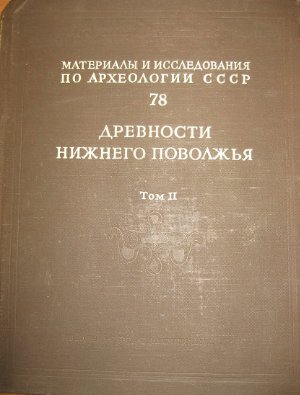
Материалы и исследования по археологии СССР №78. Крупнов Е.И., Смирнов К.Ф. (отв. ред.) Древности Нижнего Поволжья (Итоги работ Сталинградской археологической экспедиции). Том II
DJVU

Усово Озеро. Поселение срубной культуры на Северском Донце

О серпах, колодцах и земледелии бронзового века

К вопросу об использовании металлических серпов и серповидных орудий в степных (скотоводческих) культурах эпохи поздней бронзы Восточной Европы

Технико-технологический анализ керамики Покровского поселения эпохи бронзы

Самарский II курганный могильник - новый некрополь ямной культуры в Башкирском Зауралье

Самарский II курганный могильник ямной культуры в Башкирском Зауралье
