Dynamical Systems V: Bifurcation Theory and Catastrophe Theory
Book information
Description
Bifurcation theory and catastrophe theory are two of the best known areas within the field of dynamical systems. Both are studies of smooth systems, focusing on properties that seem to be manifestly non-smooth. Bifurcation theory is concerned with the sudden changes that occur in a system when one or more parameters are varied. Examples of such are familiar to students of differential equations, from phase portraits. Moreover, understanding the bifurcations of the differential equations that describe real physical systems provides important information about the behavior of the systems. Catastrophe theory became quite famous during the 1970's, mostly because of the sensation caused by the usually less than rigorous applications of its principal ideas to "hot topics", such as the characterization of personalities and the difference between a "genius" and a "maniac". Catastrophe theory is accurately described as singularity theory and its (genuine) applications. The authors of this book, the first printing of which was published as Volume 5 of the Encyclopaedia of Mathematical Sciences, have given a masterly exposition of these two theories, with penetrating insight.
Similar books
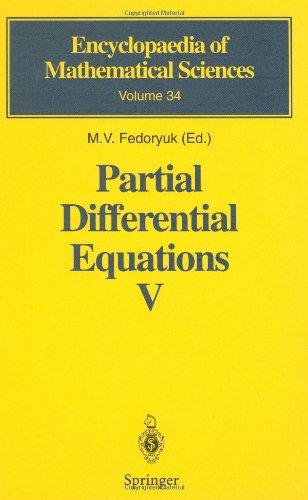
Partial Differential Equations V: Asymptotic Methods for Partial Differential Equations
1999 · DJVU

Fractals and chaos. The Mandelbrot set and beyond
2004 · DJVU

Physics, Nature and Society: a Guide to Order and Complexity in Our World
2014 · PDF
Radio Resource Management in Cellular Systems
2001 · PDF
Counterterrorism and Open Source Intelligence
2011 · PDF
Thermodynamik: Grundlagen und technische Anwendungen – Band 2: Mehrstoffsysteme und chemische Reaktionen
2010 · PDF
Thermodynamik: Von der Mikrophysik zur Makrophysik
2010 · PDF

Ensembles on Configuration Space: Classical, Quantum, and Beyond
2016 · PDF