Style, Method and Philosophy in Wittgenstein
Book information
Description
Wittgenstein said, 'really one should write philosophy only as one writes a poem'. This Element provides a comprehensive explanation of what he possibly meant by the statement, and why the statement is a correct description of Wittgenstein's philosophy. It connects the statement with Wittgenstein's idea of philosophical clarification, the methods he uses in it, and the masters he acknowledges as the sources for his ways of 'moving his thought'. The Element introduces distinctions that are essential for approaching the multilayered complex of Wittgenstein's oeuvre. One is the distinction between writing philosophical clarifications for himself and forming philosophical books for his reader. While poetry was central to both activities, it was mandatory for the second. Indeed, for creating the perfect philosophical book Wittgenstein thought he lacked precisely what some of his masters possessed: poetic genius.
Similar books

Wittgenstein and Democratic Politics: Language, Dialogue and Political Forms of Life
2024 · EPUB

Wittgenstein and Democratic Politics: Language, Dialogue and Political Forms of Life
2024 · PDF

Wittgenstein: The Philosopher and his Works (Publications of the Austrian Ludwig Wittgenstein Society)
2006 · PDF
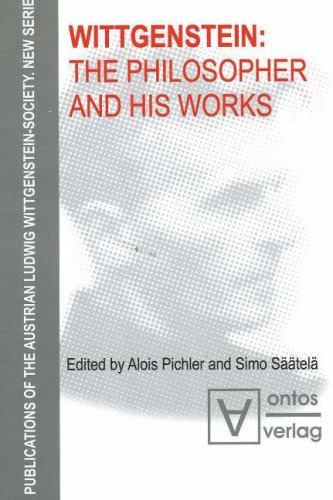
Wittgenstein: the philosopher and his works
2006 · PDF

MySQL® Notes for Professionals book
2018 · PDF

MrExcel 2022: Boosting Excel
2022 · PDF

MrExcel 2022: Boosting Excel
2022 · PDF

Session C11: Ancient Cultural Landscapes in South Europe – their Ecological Setting and Evolution, Session C22: Gardeners from South America, Session S04: Agro-Pastoralism and Early Metallurgy Sessions, Session WS29: The Idea of Enclosure in Recent Iberian Prehistory, Session C88: Rhytmes et causalites des dynamiques de l'anthropisation en Europe entre 6500 ET 500 BC: Hypotheses socio-culturelles et/ou climatiques: Proceedings of the XV UISPP World Congress (Lisbon 4-9 September 2006) / Actes du XV Congrès Mondial (Lisbonne 4-9 Septembre 2006) Vol.36
2010 · PDF