Classical groups and geometric algebra
Book information
Description
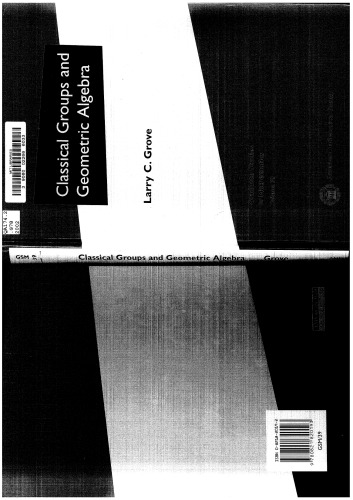
``Classical groups'', named so by Hermann Weyl, are groups of matrices or quotients of matrix groups by small normal subgroups. Thus the story begins, as Weyl suggested, with ``Her All-embracing Majesty'', the general linear group $GL_n(V)$ of all invertible linear transformations of a vector space $V$ over a field $F$. All further groups discussed are either subgroups of $GL_n(V)$ or closely related quotient groups. Most of the classical groups consist of invertible linear transformations that respect a bilinear form having some geometric significance, e.g., a quadratic form, a symplectic form, etc. Accordingly, the author develops the required geometric notions, albeit from an algebraic point of view, as the end results should apply to vector spaces over more-or-less arbitrary fields, finite or infinite. The classical groups have proved to be important in a wide variety of venues, ranging from physics to geometry and far beyond. In recent years, they have played a prominent role in the classification of the finite simple groups. This text provides a single source for the basic facts about the classical groups and also includes the required geometrical background information from the first principles. It is intended for graduate students who have completed standard courses in linear algebra and abstract algebra. The author, L. C. Grove, is a well-known expert who has published extensively in the subject area.
Similar books

Groups and Characters
1997 · PDF

Classical groups and geometric algebra
2002 · DJVU

Groups and Characters
1997 · PDF
Classical Groups and Geometric Algebra
2002 · PDF

Classical Groups and Geometric Algebra
2001 · PDF

Algebra
1983 · PDF

Classical Groups and Geometric Algebra
2001 · DJVU

Algebra
1983 · DJVU