Oceanography. An Invitation to Marine Science
Book information
Description
Front Cover Title Page Copyright Page Dedication Page About the Authors Brief Contents CONTENTS Preface Suggestions for Using This Book Foreword (Enric Sala) 1. The Origin of the Ocean Key Concepts 1.1: Earth Is an Ocean World 1.2: Marine Scientists Use the Logic of Science to Study the Ocean 1.3: Stars Form Seas 1.4: Earth, Ocean, and Atmosphere Accumulated in Layers Sorted by Density 1.5: Life Probably Originated in the Ocean 1.6: What Will Be Earth’s Future? 1.7: Are There Other Ocean Worlds? Questions from Students Terms and Concepts to Remember Study Questions Global Geoscience Watch 2. A History of Marine Science Key Concepts 2.1: Understanding the Ocean Began with Voyaging for Trade and Exploration 2.2: The Age of European Discovery 2.3: Voyaging Combined with Science to Advance Ocean Studies 2.4: The First Scientific Expeditions Were Undertaken by Governments 2.5: Contemporary Oceanography Makes Use of Modern Technology Questions from Students Terms and Concepts to Remember Study Questions Global Geoscience Watch 3. Earth Structure and Plate Tectonics Key Concepts 3.1: Pieces of Earth’s Surface Look Like They Once Fit Together 3.2: Earth’s Interior Is Layered 3.3: The Study of Earthquakes Provides Evidence for Layering 3.4: Earth’s Inner Structure Was Gradually Revealed 3.5: The New Understanding of Earth Evolved Slowly 3.6: Wegener’s Idea Is Transformed 3.7: The Breakthrough: From Seafloor Spreading to Plate Tectonics 3.8: Plates Interact at Plate Boundaries 3.9: A Summary of Plate Interactions 3.10: The Confirmation of Plate Tectonics 3.11: Scientists Still Have Much to Learn about the Tectonic Process Questions from Students Terms and Concepts to Remember Study Questions Global Geoscience Watch 4. Ocean Basins Key Concepts 4.1: The Ocean Floor Is Mapped by Bathymetry 4.2: Ocean-Floor Topography Varies with Location 4.3: Continental Margins May Be Active or Passive 4.4: The Topography of Deep-Ocean Basins Differs from That of the Continental Margin 4.5: The Marine Environment Is Classified in Distinct Zones 4.6: The Grand Tour Questions from Students Terms and Concepts to Remember Study Questions Global Geoscience Watch 5. Sediments Key Concepts 5.1: Ocean Sediments Vary Greatly in Appearance 5.2: Sediments Are Classified by Particle Size 5.3: Sediments May Be Classified by Source 5.4: Neritic Sediments Overlie Continental Margins 5.5: Pelagic Sediments Vary in Composition and Thickness 5.6: Researchers Have Mapped the Distribution of Deep-Ocean Sediments 5.7: Geologists Use Specialized Tools to Study Ocean Sediments 5.8: Sediments Are Historical Records of Ocean Processes 5.9: Marine Sediments Are Economically Important Questions from Students Terms and Concepts to Remember Study Questions Global Geoscience Watch 6. Water and Ocean Structure Key Concepts 6.1: A Note to the Reader 6.2: Familiar, Abundant, and Odd 6.3: The Water Molecule Is Held Together by Chemical Bonds 6.4: Water Has Unusual Thermal Characteristics 6.5: Surface Water Moderates Global Temperature 6.6: The Ocean Is Stratified by Density 6.7: Refraction Can Bend the Paths of Light and Sound through Water 6.8: Light Does Not Travel Far through the Ocean 6.9: Sound Travels Much Farther Than Light through the Ocean Questions from Students Terms and Concepts to Remember Study Questions Global Geoscience Watch 7. Ocean Chemistry Key Concepts 7.1: Water Is a Powerful Solvent 7.2: Seawater Consists of Water and Dissolved Solids 7.3: Gases Dissolve in Seawater 7.4: The Ocean’s Acid–Base Balance Varies with Dissolved Components and Depth Questions from Students Terms and Concepts to Remember Study Questions Global Geoscience Watch 8. Circulation of the Atmosphere Ch 8: Key Concepts 8.1: The Atmosphere and Ocean Interact with Each Other 8.2: The Atmosphere Is Composed Mainly of Nitrogen, Oxygen, and Water Vapor 8.3: The Atmosphere Moves in Response to Uneven Solar Heating and Earth’s Rotation 8.4: Atmospheric Circulation Generates Large-Scale Surface Wind Patterns 8.5: Storms Are Variations in Large-Scale Atmospheric Circulation 8.6: Katrina and Sandy Questions From Students Terms and Concepts to Remember Study Questions Global Geoscience Watch 9. Circulation of the Ocean Key Concepts 9.1: Mass Flow of Ocean Water Is Driven by Wind and Gravity 9.2: Surface Currents Are Driven by the Winds 9.3: Surface Currents Affect Weather and Climate 9.4: Wind Can Cause Vertical Movement of Ocean Water 9.5: El Niño and La Niña Are Exceptions to Normal Wind and Current Flow 9.5: Thermohaline Circulation Affects All the Ocean’s Water Questions from Students Terms and Concepts to Remember Study Questions Global Geoscience Watch 10. Waves Key Concepts 10.1: Ocean Waves Move Energy across the Sea Surface 10.2: Waves Are Classified by Their Physical Characteristics 10.3: The Behavior of Waves Is Influenced by the Depth of Water through Which They Are Moving 10.4: Wind Blowing over the Ocean Generates Waves 10.5: Interference Produces Irregular Wave Motions 10.6: Deep-Water Waves Change to Shallow-Water Waves as They Approach Shore 10.7: Internal Waves Can Form between Ocean Layers of Differing Densities 10.8: “Tidal Waves” Are Probably Not What You Think 10.9: Storm Surges Form beneath Strong Cyclonic Storms 10.10: Water Can Rock in a Confined Basin 10.11: Water Displacement Causes Tsunami and Seismic Sea Waves Questions from Students Terms and Concepts to Remember Study Questions Global Geoscience Watch 11. Tides Key Concepts 11.1: Tides Are the Longest of All Ocean Waves 11.2: Tides Are Forced Waves Formed by Gravity and Inertia 11.3: The Dynamic Theory of Tides Adds Fluid Motion Dynamics to the Equilibrium Theory 11.4: Most Tides Can Be Accurately Predicted 11.5: Tidal Patterns Can Affect Marine Organisms 11.6: Power Can Be Extracted from Tidal Motion Questions from Students Terms and Concepts to Remember Study Questions Global Geoscience Watch 12. Coasts Key Concepts 12.1: Coasts Are Shaped by Marine and Terrestrial Processes 12.2: Erosional Processes Dominate Some Coasts 12.3: Beaches Dominate Depositional Coasts 12.4: Larger-Scale Features Accumulate on Depositional Coasts 12.5: Biological Activity Forms and Modifies Coasts 12.6: Freshwater Meets the Ocean in Estuaries 12.7: The Characteristics of U.S. Coasts 12.8: Humans Interfere in Coastal Processes Questions from Students Terms and Concepts to Remember Study Questions Global Geoscience Watch 13. Life in the Ocean Key Concepts 13.1: Life on Earth Is Notable for Unity and Its Diversity 13.2: The Concept of Evolution Helps Explain the Nature of Life in the Ocean 13.3: Rapid, Violent Change Causes Mass Extinctions 13.4: Oceanic Life Is Classified by Evolutionary Heritage 13.5: The Flow of Energy Allows Living Things to Maintain Complex Organization 13.6: Living Organisms Are Built from a Few Elements 13.7: Elements Cycle between Living Organisms and Their Surroundings 13.8: Environmental Factors Influence the Success of Marine Organisms Questions from Students Terms and Concepts to Remember Study Questions Global Geoscience Watch 14. Primary Producers Key Concepts 14.1: Primary Producers Synthesize Organic Material 14.2: Plankton Drift with Ocean Currents 14.3: Plankton Collection Methods Depend on the Organism’s Size 14.4: Phytoplankton 14.5: Lack of Nutrients and Light Can Limit Primary Productivity 14.6: Production Equals Consumption at the Compensation Depth 14.7: Phytoplankton Productivity Varies with Local Conditions 14.8: Seaweeds and Marine Plants Are Diverse and Efficient Primary Producers 14.9: Primary Productivity Also Occurs Deep in the Water Column, at Hydrothermal Vents, in Seabed Sediments, and in Solid Rock Questions from Students Terms and Concepts to Remember Study Questions Global Geoscience Watch 15. Marine Animals Key Concepts 15.1: Animals Evolved When Food and Oxygen Became Plentiful 15.2: Invertebrates Are the Most Successful and Abundant Animals 15.3: The Worm Phyla Are the Link to Advanced Animals 15.4: Advanced Invertebrates Have Complex Bodies and Internal Systems 15.5: Construction of Complex Chordate Bodies Begins on a Stiffening Scaffold 15.6: Vertebrate Evolution Traces a Long and Diverse History 15.7: Fishes Are Earth’s Most Abundant and Successful Vertebrates 15.8: Fishes Are Successful Because of Unique Adaptations 15.9: Sea Turtles and Marine Crocodiles Are Ocean-Going Reptiles 15.10: Some Marine Birds Are the World’s Most Efficient Flyers 15.11: Marine Mammals Include the Largest Animals Ever to Have Lived Questions from Students Terms and Concepts to Remember Study Questions Global Geoscience Watch 16. Marine Communities Key Concepts 16.1: Marine Organisms Live in Communities 16.2: Communities Consist of Interacting Producers, Consumers, and Decomposers 16.3: Marine Communities Change as Time Passes 16.4: Examples of Shoreline Marine Communities 16.5: Examples of Shallow Benthic and Open-Ocean Marine Communities 16.6: Examples of Deep-Sea Marine Communities 16.7: Organisms in Communities Can Live in Symbiosis Questions from Students Terms and Concepts to Remember Study Questions Global Geoscience Watch 17. Marine Resources Key Concepts 17.1: Marine Resources Are Subject to the Economic Laws of Supply and Demand 17.2: Physical Resources 17.3: Renewable Sources of Marine Energy 17.4: Biological Resources 17.5: Nonextractive Resources Use the Ocean in Place 17.6: The Law of the Sea Governs Marine Resource Allocation Questions from Students Terms and Concepts to Remember Study Questions Global Geoscience Watch 18. The Ocean and the Environment Key Concepts 18.1: An Introduction to Marine Environmental Issues 18.2: Marine Pollutants May Be Natural or Human Generated 18.3: Organisms Cannot Prosper if Their Habitats Are Disturbed 18.4: Marine Protected Areas Are Refuges 18.5: Earth’s Climate Is Changing 18.6: What Can Be Done? Questions from Students Terms and Concepts to Remember Study Questions Global Geoscience Watch Afterword APPENDICES 1: Measurements and Conversions 2: Geologic Time 3: Latitude and Longitude, Time, and Navigation 4: Maps and Charts 5: The Beaufort Scale 6: Taxonomic Classification of Marine Organisms 7: Periodic Table of the Elements 8: Working in Marine Science 9: The World Ocean Seafloor Glossary A B C D E F G H - I J - K - L M N O P R S T U - V W X - Z INDEX A B C D E F - G H I J K - L M N O P Q - R S T U V W Y - Z Plate Techtonics and Volcanic Activity Human Impact on the World Ocean
Similar books

Calculus with Analytical Geometry Fifth Edition Solutions Manual, Volume II
1994 · PDF

Calculus with Analytical Geometry Fifth Edition Solutions Manual, Volume I
1994 · PDF
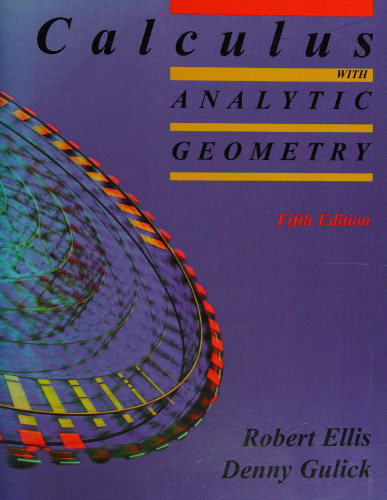
Calculus with Analytical Geometry, Fifth Edition
1998 · PDF

Predicting Storms: The Adventure Begins
2018 · PDF

Predicting Storms: The Adventure Begins, Second Edition
2024 · PDF

Predicting Storms: The Adventure Begins, Third Edition
2024 · PDF

On numerals as signs of primeval unity among mankind
1873 · PDF

Calculus with Analytic Geometry
1990 · PDF