An axiological process ethics
Book information
Description
This book brings together two philosophical perspectives —process philosophy and Hartmanian formal axiology— to argue for a more appealing and persuasive approach to process ethics. The implications for spiritual practice bring fresh meaning to Whitehead’s call to live, live well, live better. “Whitehead’s vision changes the way we think of ethics and values, but it does not include an ethical system. One problem has been that it has focused attention sharply on individual occasions of experience. Joseph Bracken has shown the need to attend to the unity of persons and societies in a fuller way. Edwards builds on that insight and incorporates other contributions into a richly articulated and highly original post-Whiteheadian account of ethics and values”. (John B. Cobb, Jr., Professor Emeritus, Claremont School of Theology) REM B. EDWARDS is Professor Emeritus of the University of Tennessee. The author of 21 books, his areas of specialization are philosophy of religion, American philosophy, medical ethics, and ethical theory, with a special focus on mental health care ethics, ethics and animals, and formal axiology. An Axiological Process Ethics Series Preface CONTENTS PREFACE 1. SOULS AS FIELDS AND ACTUAL ENTITIES Persons in Traditional Philosophy Human and Non-human Souls Bracken on Souls as Fields and Agents Understanding Fields Fields are Invisible, Imperceptible Fields are Objectively Real Fields are Physical, Spatially Extended Fields Endure Fields are Causes, Agents An Expanded Concept of Souls as Fields Souls are Invisible, Imperceptible, Self-perceptible Souls are Objectively Real, Potent Souls are Physical and Psychical Souls are Enduring Actual Entities Souls are Originative Causal Agents Soul Fields, Agency, and Responsibility Souls and Complete Human Beings 2. INTRINSIC VALUES, PERSONS, AND INDIVIDUALS Intrinsically Valuable Actual Entities Self-significance: Valuation of Self or by Self Consciousness Endurance Individuality Uniqueness Replaceability “Who or What Am I?” The Value of Aggregates Worldly Overvaluation of Aggregates Ethical Duties to What? 3. THE GOOD AND THE BEAUTIFUL: ETHICS VERSUS AESTHETICS Is Beauty Intrinsically Good? Beauty Fails the Test Beautiful Aggregates Well-being, Good For, and Intrinsically Good Pleasures and Happiness Satisfactions Creativity Truth, Knowledge, Beliefs, Concepts Self-realization The Purpose of the Universe: Intensities, or Beauty God's Purpose as the Intensification of Feeling God's Purpose as the Creation of Beauty God's Purpose as Creating Intrinsically Valuable Actual Entities Is the Dispute Merely Verbal? 4. ‘GOOD,’ AND WHAT AND HOW WE VALUE Defining “Good” The Form of the Good Defining “Better,” “Best,” and “Ought” Three Dimensions of Goodness: Systemic, Extrinsic, and Intrinsic Moore's Principle of Isolation The Hierarchy of Value Value Combinations and Confusions Valuations, Or How We value Valuing Good Things in Different Dimensions 5. DEGREES, ETHICS, AND VIRTUE Degrees of Intrinsic Worth, Marginal Cases, and Animals Abortion Terminal Cases Unrelievable Suffering Animals Intrinsic, Moral, and Spiritual Goodnes Three Dimensions of Ethics and Virtue Systemic Ethics and Systemic Virtues Extrinsic Ethics and Extrinsic Virtues Intrinsic Ethics and Intrinsic Virtues Major Obstacles to Virtuous Living Ethical and Spiritual Values and Evaluations Works Cited About the Author
Similar books

Formal Axiology And Its Critics
1995 · PDF

Freedom to Live: The Robert Hartman Story
1994 · PDF

The knowledge of good: critique of axiological reason
2002 · PDF

Formal axiology and its critics
1995 · PDF
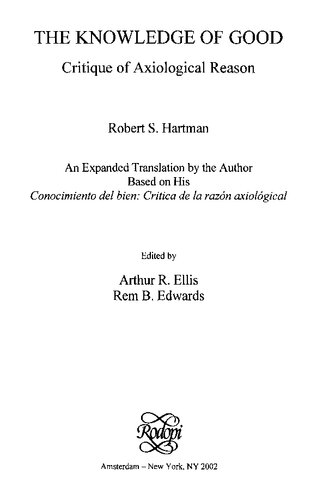
The knowledge of good: critique of axiological reason
2002 · PDF

Formal axiology and its critics
1995 · PDF

The knowledge of good: critique of axiological reason
2002 · PDF

MySQL® Notes for Professionals book
2018 · PDF