Social Construction of Law: Potential and Limits (Elgar Studies in Legal Theory)
Book information
Description
This illuminating book explores the theme of social constructionism in legal theory. It questions just how much freedom and power social groups really have to construct and reconstruct law. Michael Giudice takes a nuanced approach to analyse what is true and what is false in the view that law is socially constructed. He draws on accounts of European Union law as well as Indigenous legal orders in North America to demonstrate the contingency of particular concepts of law. Utilising evidence from a range of social and natural sciences, he also considers how law may have a naturally necessary core. The book concludes that while law would not exist without beliefs, intentions, and practices, it must always exist as a social rule, declaration, or directive; much, but not all, of law is socially constructed. This book will be a valuable resource for academics and students of law and philosophy as well as researchers interested in the intersections between analytical legal theory, socio-legal studies, and empirical legal studies.
Similar books

The Normativity of Law
2024 · PDF

The Methodology of Legal Theory: Volume I
2010 · EPUB
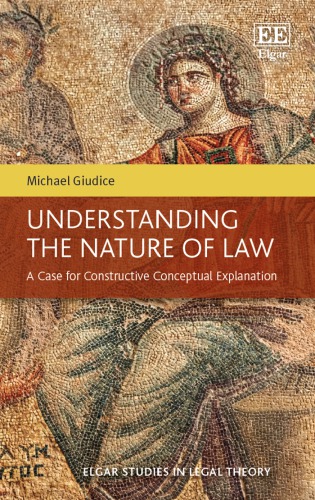
Understanding the Nature of Law: A Case for Constructive Conceptual Explanation
2015 · PDF

Legality's Borders: An Essay in General Jurisprudence
2010 · PDF

MySQL® Notes for Professionals book
2018 · PDF

MrExcel 2022: Boosting Excel
2022 · PDF

MrExcel 2022: Boosting Excel
2022 · PDF

Session C11: Ancient Cultural Landscapes in South Europe – their Ecological Setting and Evolution, Session C22: Gardeners from South America, Session S04: Agro-Pastoralism and Early Metallurgy Sessions, Session WS29: The Idea of Enclosure in Recent Iberian Prehistory, Session C88: Rhytmes et causalites des dynamiques de l'anthropisation en Europe entre 6500 ET 500 BC: Hypotheses socio-culturelles et/ou climatiques: Proceedings of the XV UISPP World Congress (Lisbon 4-9 September 2006) / Actes du XV Congrès Mondial (Lisbonne 4-9 Septembre 2006) Vol.36
2010 · PDF