The Ethics of Democracy: A Contemporary Reading of Hegel’s Philosophy of Right
Book information
Description
The legal regulations and formal rules of democracy alone are not enough to hold a society together and govern its processes. Yet the irreducible ethical pluralism that characterizes contemporary society seems to make it impossible to impose a single system of values as a source of social cohesion and identity reference. In this book, Lucio Cortella argues that Hegel's theory of ethical life can provide such a grounding and makes the case through an analysis of Hegel's central political work, the Philosophy of Right. Although Hegel did not support democratic political ends and wrote in a historical and cultural context far removed from the current liberal-democratic scene, Cortella maintains that the Hegelian theory of ethical life, with its emphasis on securing a framework conducive to human freedom, nevertheless offers a convincing response to the problem of the ethical uprootedness of contemporary democracy. Contents Translator’s Introduction Preface to the English Translation Preface to the Original Italian Edition: Does Democracy Need Ethics? Introduction. Morality and Ethical Life: Key Concepts in Hegel’s Conception of the Political Chapter 1. Freedom and the Absolute 1.1. Freedom and Ontology 1.2. Freedom and Self-transparency 1.3. Freedom and Negativity 1.4. Freedom and Finitude 1.5. Freedom and Relation 1.6. Freedom and Objectivity 1.7. Freedom and Self-consciousness Chapter 2. The Age of Universal Freedom 2.1. “Person” and the Universality of Right 2.2. Freedom as Autonomy of the Subject 2.3. Freedom of Civil Society 2.3.1. Civil Society as State of Nature 2.3.2. Abstract Freedom Becomes Reality 2.3.3. Primacy of Freedom Over Nature 2.3.4. Overcoming Individualism 2.3.5. Civil Society as “the External State” 2.3.6. The Realm of Appearance 2.3.7. From Subjective Freedom to Relational Freedom: Family, Civil Society, Corporation Chapter 3. Actualization of Ethical Life: The Sphere of the State 3.1. Characteristics of Hegelian Ethical Life 3.1.1. Unity of Freedom and Nature 3.1.2. Unity of Freedom and History 3.1.3. Reconciliation of Universality and Ethos 3.1.4. Ethos as “Second Nature” 3.1.5. Healing the Diremption of Modernity 3.1.6. Practical Unity of Subject and Object 3.2. Ethical Life as Primacy of the Object 3.2.1. Reconciliation of Individual and Universal 3.2.2. The Originariness of Order 3.2.3. A Subjectivity Deficit 3.3. Contingency of the Ethical 3.3.1. Failure of Ethical Life 3.3.2. Nationalistic Closure of the Universality of Sittlichkeit and the Defeat of Freedom 3.3.3. From Objective Spirit to Absolute Spirit Chapter 4. Elements of a Postidealist Ethical Life: A Democratization of Hegel’s Political Philosophy 4.1. Logico-ontological Presuppositions of Hegelian Ethical Life 4.1.1. From Ethical Life to the Philosophy of History 4.1.2. From Philosophy of History to Logic 4.1.3. Two Competing Conceptions of the Idea of Freedom 4.2. Ethical Life and Logic of Recognition 4.2.1. Logic of Recognition 4.2.2. Ethical Life and Otherness 4.2.3. Normative Background of Recognition and Spheres of Ethical Life 4.3. Democracy as Ethos 4.3.1. Fundamental Characteristics of a Democratic Ethical Life 4.3.2. A Democratization of Hegel Notes Bibliography Index
Similar books
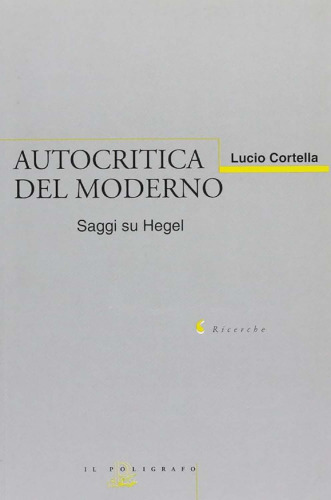
Autocritica del moderno. Saggi su Hegel
2002 · PDF

Autocritica del moderno
2002 · PDF

La filosofia contemporanea. Dal paradigma soggettivista a quello linguistico
2020 · EPUB

The Ethics of Democracy: A Contemporary Reading of Hegel's Philosophy of Right
2015 · PDF

L'«ethos» del riconoscimento
2023 · EPUB

L'«ethos» del riconoscimento
2023 · EPUB

Una dialettica nella finitezza
2006 · PDF

MySQL® Notes for Professionals book
2018 · PDF