An introduction to modeling and simulation of particulate flows
Book information
Description
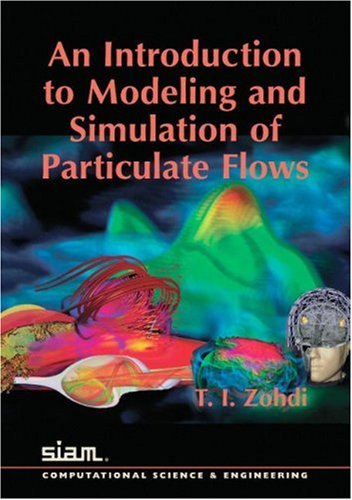
The relatively recent increase in computational power available for mathematical modeling and simulation raises the possibility that modern numerical methods can play a significant role in the analysis of complex particulate flows. This introductory monograph focuses on basic models and physically based computational solution strategies for the direct and rapid simulation of flowing particulate media. Its emphasis is primarily on fluidized dry particulate flows in which there is no significant interstitial fluid, although fully coupled fluid-particle systems are discussed as well. An introduction to basic computational methods for ascertaining optical responses of particulate systems also is included. The successful analysis of a wide range of applications requires the simulation of flowing particulate media that simultaneously involves near-field interaction and contact between particles in a thermally sensitive environment. These systems naturally occur in astrophysics and geophysics; powder processing pharmaceutical industries; bio-, micro- and nanotechnologies; and applications arising from the study of spray processes involving aerosols, sputtering, and epitaxy. Audience An Introduction to Modeling and Simulation of Particulate Flows is written for computational scientists, numerical analysts, and applied mathematicians and will be of interest to civil and mechanical engineers and materials scientists. It is also suitable for first-year graduate students in the applied sciences, engineering, and applied mathematics who have an interest in the computational analysis of complex particulate flows. Contents List of Figures; Preface; Chapter 1: Fundamentals; Chapter 2: Modeling of particulate flows; Chapter 3: Iterative solution schemes; Chapter 4: Representative numerical simulations; Chapter 5: Inverse problems/parameter identification; Chapter 6: Extensions to swarm-like systems; Chapter 7: Advanced particulate flow models; Chapter 8: Coupled particle/fluid interaction; Chapter 9: Simple optical scattering methods in particulate media; Chapter 10: Closing remarks; Appendix A. Basic (continuum) fluid mechanics; Appendix B. Scattering; Bibliography; Index
Similar books

An Introduction to Modeling and Simulation of Particulate Flows
2007 · DJVU
An introduction to modeling and simulation of particulate flows
2007 · DJVU

An Introduction to Modeling and Simulation of Particulate Flows
2007 · DJVU

MySQL® Notes for Professionals book
2018 · PDF

MrExcel 2022: Boosting Excel
2022 · PDF

MrExcel 2022: Boosting Excel
2022 · PDF

Session C11: Ancient Cultural Landscapes in South Europe – their Ecological Setting and Evolution, Session C22: Gardeners from South America, Session S04: Agro-Pastoralism and Early Metallurgy Sessions, Session WS29: The Idea of Enclosure in Recent Iberian Prehistory, Session C88: Rhytmes et causalites des dynamiques de l'anthropisation en Europe entre 6500 ET 500 BC: Hypotheses socio-culturelles et/ou climatiques: Proceedings of the XV UISPP World Congress (Lisbon 4-9 September 2006) / Actes du XV Congrès Mondial (Lisbonne 4-9 Septembre 2006) Vol.36
2010 · PDF

THE BRITISH ARMY IN INDIA: ITS PRESERVATION BY AN APPROPRIATE CLOTHING, HOUSING, LOCATING, RECREATIVE EMPLOYMENT, AND HOPEFUL ENCOURAGEMENT OF THE TROOPS. with AN APPENDIX ON INDIA : THE CLIMATE OP ITS HILLS ; THE DEVELOPMENT OF ITS RESODRCBS, INDUSTRY, AND ARTS ; THE ADMINISTRATION OF JUSTICE ; THE BLACK ACT ; THE PROGRESS OF CHRISTIANITY ; THE TRAFFIC IN OPIUM ; THE VALUE OF INDIA ; PERMANENT CAUSES OF DISAFFECTION, AND OF THE RECENT REBELLION ; THE TRADITIONARY POLICY; MISGOVERNMENT BY NATIVE RULERS ; ANNEXATIONS OF THEIR TERRITORY, ETC.
1858 · PDF