Tessellations. Mathematics, Art and Recreation
Book information
Description
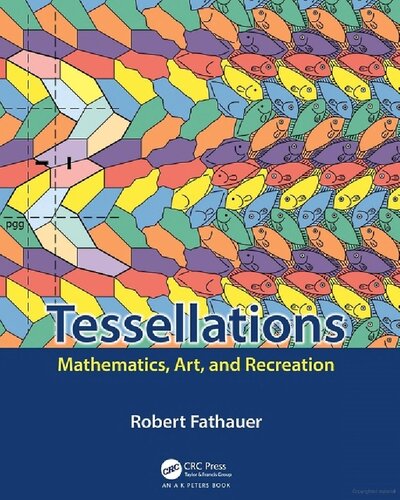
Tessellations: Mathematics, Art and Recreation aims to present a comprehensive introduction to tessellations (tiling) at a level accessible to non-specialists. Additionally, it covers techniques, tips, and templates to facilitate the creation of mathematical art based on tessellations. Inclusion of special topics like spiral tilings and tessellation metamorphoses allows the reader to explore beautiful and entertaining math and art. The book has a particular focus on ‘Escheresque’ designs, in which the individual tiles are recognizable real-world motifs. These are extremely popular with students and math hobbyists but are typically very challenging to execute. Techniques demonstrated in the book are aimed at making these designs more achievable. Going beyond planar designs, the book contains numerous nets of polyhedra and templates for applying Escheresque designs to them. Activities and worksheets are spread throughout the book, and examples of real-world tessellations are also provided. Key features: Introduces the mathematics of tessellations, including symmetry Covers polygonal, aperiodic, and non-Euclidean tilings Contains tutorial content on designing and drawing Escheresque tessellations Highlights numerous examples of tessellations in the real world Activities for individuals or classes Filled with templates to aid in creating Escheresque tessellations Treats special topics like tiling rosettes, fractal tessellations, and decoration of tiles Contents Preface Intro to Tessellations Historical Examples of Tessellations Tessellations in the World around us Escheresque Tessellations Tessellations & recreational Mathematics Tessellations & Mathematics Education Recognizing Tessellations Historical Tessellations Geometric Tessellations Tiles Angles Vertices & Edge-to-Edge Tessellations Regular Polygons & regular Tessellations Regular-Polygon Vertices Prototiles Semi-regular Tessellations Other Types of Polygons General triangle & quadrilateral Tessellations Dual & Laves Tessellations Pentagon & Hexagon Tessellations Stellation of regular Polygons & Star Polygons Star Polygon Tessellations Regular Polygon Tessellations that are not Edge-to-Edge Squared Squares Modifying Tessellations to create new Tessellations Circle Packings & Tessellations Basic Properties of Tiles Edge-to-Edge Tessellations Classifying Tessellations by their Vertices Symmetry & Transformations in Tessellations Symmetry in Objects Transformations Symmetry in Tessellations Frieze Groups Wallpaper Groups Heesch Types & Orbifold Notation Coloring of Tessellations & Symmetry Symmetry in Objects Transformations Translational Symmetry in Tessellations Rotational Symmetry in Tessellations Glide Refection Symmetry in Tessellations Tessellations in Nature Modeling of natural Tessellations Crystals Lattices Cracking & Crazing Divisions in Plants & Animals Coloration in Animals Voronoi Tessellations Modeling natural Tessellations using geometric Tessellations Quantitative Analysis of natural Tessellations Decorative & Utilitarian Tessellations Tiling Building Blocks & Coverings Permeable Barriers Other Divisions Fiber Arts Games & Puzzles Islamic Art & Architecture Spherical Tessellations Building with Tessellations Polyforms & Reptiles Properties of Polyforms Tessellations of Polyforms The Translation & Conway Criteria Other Recreations using Polyforms Heesch Number Reptiles Discovering & classifying Polyforms Rosettes & Spirals Rhombus Rosettes Other Rosettes Logarithmic spiral Tessellations Archimedean spiral Tessellations Exploring spiral Tessellations Matching Rules, Aperiodic Tiles & Substitution Tilings Matching Rules & Tiling Periodicity in Tessellations Penrose Tiles Other aperiodic Sets & Substitution Tilings Socolar-Taylor aperiodic monotile Escheresque Tessellations based on aperiodic Tiles Penrose Tiles & the Golden Number Fractal Tiles & Fractal Tilings Tessellations of fractal Tiles Fractal Tessellations 2-fold f-Tilings based on Segments of regular Polygons f-Tilings based on kite-, dart- & v-shaped Prototiles f-Tilings based on Polyforms Miscellaneous f-Tilings Prototiles for fractal Tilings Non-Euclidean Tessellations Hyperbolic Tessellations Spherical Tessellations Non- Euclidean Tessellations of regular Polygons Escheresque Tessellations Drawing Tessellations by Hand Using general computer Graphics Programs Using Tessellations computer Program Mixing Techniques Tip 1 The outline of the tile should suggest the motif Tip 2 The tiles should make orientational sense Tip 3 Choose motifs that go together Tip 4 Different motifs should be commensurately scaled Tip 5 Use source material to get the details right Tip 6 Stylize the design Tip 7 Choose style that fts your taste & abilities Tip 8 Choose colors that suit your taste & bring out the tiles Finding Motifs for Tile Shape Refining Tile Shape using Translation Refining Tile Shape using glide Refection Locating & using Source Material for Real-Life Motifs Special Techniques to solve Design Problems Distorting the entire Tessellations Breaking Symmetries Splitting Tile into smaller Tiles Splitting & moving Vertices Reshaping Tile by splitting & moving Vertices Escheresque Tessellations based on Squares Creating Tessellation by Hand Tessellation with translational Symmetry only Tessellation with 2- & 4-fold rotational Symmetry Tessellation with glide Refection Symmetry Tessellation with simple Refection & glide Refection Symmetry Tessellation with glide Refection Symmetry in 2 orthogonal Directions Tessellation with 2-fold rotational & glide Refection Symmetry Tessellation with 2 Motifs & glide Refection Symmetry Tessellation with 2 different Tiles & Refection Symmetry in 1 Direction Tessellation with 2 different Tiles & Refection Symmetry in 2 orthogonal Directions Escheresque Tessellation with translational Symmetry Escheresque Tessellation with rotational Symmetry Escheresque Tessellation with glide Refection Symmetry Escheresque Tessellations based on Isosceles Right Triangle & Kite-shaped Tiles Right-Triangle Tessellation with 2-fold rotational Symmetry Right-Triangle Tessellation with 2- & 4-fold rotational Symmetry Right-Triangle Tessellation with 2- & 4-fold rotational & Refection Symmetry Kite Tessellation with glide Refection Symmetry Kite Tessellation with 2 Motifs & glide Refection Symmetry Tessellation based on Right-Triangle Tiles Tessellation based on Kite-shaped Tiles Escheresque Tessellations based on Equilateral Triangle Tiles Tessellation with 6-fold rotational Symmetry Tessellation with rotational & glide Refection Symmetry Tessellation with 2-fold rotational Symmetry only Tessellation with translational Symmetry only Equilateral Triangle-based Tessellation with rotational Symmetry Equilateral Triangle-based Tessellation with glide Refection Symmetry Escheresque Tessellations based on 60°-120° Rhombus Tiles Tessellation with translational Symmetry only Tessellation with refection Symmetry Tessellation with 3-fold rotational Symmetry Tessellation with glide Refection Symmetry Rhombus Tessellation with rotational & glide Refection Symmetry Tessellation with kaleidoscopic Symmetry Tessellation with bilaterally Symmetry Tiles Tessellation with kaleidoscopic Symmetry Escheresque Tessellations based on Hexagonal Tiles Tessellation with 3-fold rotational Symmetry Tessellation with 6-fold rotational Symmetry Tessellation based on Hexagons & Hexagrams Tessellation based on hexagonal Tiles Hexagon-based Tessellation with 2-, 3- & 6-fold rotational Symmetry Decorating Tiles to create Knots & other Designs Role of Combinatorics Tessellations to create Knots & Links Iterated & fractal Knots & Links with fractal Tilings Other Types of decorative Graphics Symmetrical Designs by decorating Tessellations Tessellation Metamorphoses & Dissections Geometric Metamorphoses Positive & negative Space Techniques for Transitioning btw Escheresque Tessellation Motifs Tessellation Dissections Draw Tessellation Metamorphosis Intro to Polyhedra Basic Properties of Polyhedra Polyhedra in Art & Architecture Polyhedra in Nature Tiling 3D Space Slicing 3-Honeycombs to reveal Plane Tessellations Identifying & characterizing Polyhedra in Nature Identifying Polyhedra in Art & Architecture Adapting Plane Tessellations to Polyhedra Nets of Polyhedra Restrictions on Plane Tessellations for Use on Polyhedra Distorting Plane Tessellations to fit Polyhedra Designing & drawing Tessellations for Polyhedra using the Templates Coloring of Tessellations on Polyhedra Tips on building the Models Representing Solids using Nets Transformations to apply Tessellation Motif to Net Background on the Platonic Solids Tessellating Platonic Solids Tessellation templates for the Platonic solids Activity 22.1. Attributes of the Platonic solids and Euler’s formula Activity 22.2. Drawing the Platonic solids Tessellating Archimedean Solids Background on Archimedean Solids Tessellation Templates for Archimedean Solids Surface Area of Archimedean Solids Volume of truncated Cube Tessellating other Polyhedra Other popular Polyhedra Tessellation Templates Cross-Sections of Polyhedra Tessellating other Surfaces Other Surfaces to tessellate Tessellation Templates for other Surfaces Surface Area & Volume of Cylinders & Cones Refs Glossary Index
Similar books
Tessellations: Mathematics, Art, and Recreation
2020 · PDF

Tessellations: Mathematics, Art, and Recreation
2021 · PDF

Tessellations. Mathematics, Art and Recreation
2021 · PDF

Origami Deluxe Book & Gift Set
2007 · PDF

MySQL® Notes for Professionals book
2018 · PDF

MrExcel 2022: Boosting Excel
2022 · PDF

MrExcel 2022: Boosting Excel
2022 · PDF

Session C11: Ancient Cultural Landscapes in South Europe – their Ecological Setting and Evolution, Session C22: Gardeners from South America, Session S04: Agro-Pastoralism and Early Metallurgy Sessions, Session WS29: The Idea of Enclosure in Recent Iberian Prehistory, Session C88: Rhytmes et causalites des dynamiques de l'anthropisation en Europe entre 6500 ET 500 BC: Hypotheses socio-culturelles et/ou climatiques: Proceedings of the XV UISPP World Congress (Lisbon 4-9 September 2006) / Actes du XV Congrès Mondial (Lisbonne 4-9 Septembre 2006) Vol.36
2010 · PDF