Insect behavior
Book information
Description
For thirty years, Insect Behavior served as students’ sole overview of a field of study that is growing exponentially. Considerably updated and expanded, this second edition still retains its constructive balance between modern developments and historical insights, between new examples and old, between empirical work and theory, and between pertinent conclusions and the dynamic field and laboratory experiences from which such discoveries arise. Twenty-six case studies, 45 new color plates and 173 figures (over 40% of them new) add richness to the well-written, accessible text. Correct format and impagination. Preface to the Second Edition Contents Case Studies 1 The History and Scope of Insect Behavior 1.1 Introduction 1.1.1 What Is Insect Behavior? 1.1.2 Insect Behavior's Biological Context 1.1.3 Historical Foundations 1.1.4 The Watershed Years 1.1.5 The Rise of Ethology 1.2 Conceptual Frameworks 1.2.1 Evolution by Natural Selection 1.2.2 Genetics and Behavior 1.2.3 The Comparative Approach 1.2.4 Conceptual Pitfalls 1.3 Phylogenys Role 1.3.1 Microevolution and Macroevolution 1.3.2 Phylogenetic Systematics and Cladistics 1.3.3 Behavior and Speciation 1.4 Questions and Perspectives 1.4.1 Proximate and Ultimate Analyses 1.4.2 Types of Approach Case Study 1.1: Foraging Onset in the Honey Bee, Apis mellifera 2 Programming and Integrating Behavior 2.1 Introduction 2.2 Nerve-Based Coordination 2.2.1 The Insect Nervous System 2.2.2 Simple Reflexes and Repeated Motor Patterns Case Study 2.1: Escape Behavior in the Cockroach, Periplaneta 2.2.3 Ethological Explanations 2.3 Life in a Stimulus-Rich World 2.3.1 Sensory Tuning and Filtering 2.4 Case Study 2.2: How Noctuid Moths Hear Bats 2.3.2 Memory and Learning Case Study 2.3: Learning in the Parasitoid Wasp,Hyssopus 2.3.3 Insect Intelligence 2.4 Hormone-Based Coordination 2.4.1 Clocks and Reiterative Rhythms 2.4.2 Gated Rhythms Case Study 2.4: Initiation of Adult Behavior in Saturniid Moths 3 Spatial Adjustment 3.1 Introduction 3.2 Locomotion 3.2.1 Terrestrial and Aquatic Locomotion 3.2.2 Aerial Locomotion 3.3 Orientation 3.3.1 Locomotory Responses 3.3.2 Posture and Position 3.3.3 Orientation to Radiant Energy 3.3.4 Magnetic Field Orientation 3.3.5 Orientation to the Evidence of Others' Presence 3.4 Thermoregulation 3.4.1 Dormancy and Thermotolerance 3.4.2 Regulation of Heat Gain 3.4.3 Heat Production 3.5 Migration 3.5.1 Seasonal Migration Case Study 3.1: Migration in the Milkweed Bug, Oncopeltus 3.5.2 Migration Under Ephemeral Conditions 3.5.3 Dispersal and Navigation 4 Foraging and Feeding 4.1 Introduction 4.1.1 Food Recognition and Acceptance 4.1.2 Regulation of Feeding 4.2 Foraging Strategies 4.2.1 Herbivory 4.2.2 Active Search 4.2.3 Trapping and Ambush 4.2.4 Parasites and Parasitoids 4.2.5 Theft and Kleptoparasitism 4.2.6 Insect Agriculture 4.2.7 Nest Symbionts: Becoming a House Pet Case Study 4.1: Myrmecophily in the Rove Beetle, Atemeles 4.3 Coevolution and the Arms Race 4.3.1 Attack, Defense, and Counterattack 4.3.2 Employing Mercenaries for Protection 4.4 Case Study 4.2: Coevolution of Acacias and Their Ants, Pseudomyrmex 4.3.3 The Tommy Tucker Syndrome: Food in Return for Services 4.4 Case Study 4.3: Mutualism Between Fig Trees and the Wasp, Blastophaga 4.4 Feeding as a Communal Activity 4.4.1 Simple Groups and Feeding Aggregations 4.5 Case Study 4.4: Group Feeding and Cannibalism in the Willow Leaf Beetle, Plagiodera 4.4.2 Social Feeding Behaviors 5 Defense: A Survival Catalogue 5.1 Introduction 5.2 Defense Messages 5.3 Passive Messages 5.3.1 Crypsis: 'I'm Not Here'' Case Study 5.1: Melanism in the Peppered Moth, Biston betularia 5.3.2 Systemic Defenses: 'I'm Noxious'' 5.3.3 Mimicry: 'I'm Someone Else'' 5.3.4 Aposematic Defenses: 'I'm Dangerous'' 5.4 Active Messages 5.4.1 Attack: 'I'm Turning the Tables'' 5.4.2 Startle: 'I'm Not What You Thought'' 5.4.3 Group Actions: 'We're in This Together'' 6 Chemical Communication 6.1 Introduction 6.2 Mechanisms of Chemical Communication 6.2.1 Odor Creation and Reception 6.2.2 Communication Through Chemistry Case Study 6.1: Identification of the Mate Attractant of the Silkworm Moth, Bombyx mori 6.3 The Functions of Chemical Communication 6.3.1 Finding and Choosing Mates 6.3.2 Assembly, Aggregation, and Recruitment 6.4 Case Study 6.2: Aggregation in a Bark Beetle, Dendroctonus 6.3.3 Alarm and Alert 6.3.4 Host-Marking 6.4 Case Study 6.3: Host-Searching by an Ichneumonid Wasp, Pleolophus 6.3.5 Recognition 6.4 The Information Content of Pheromones 6.4.1 Physiological Adjustments: The Q/K Ratio 6.4.2 Pheromones as Language: Syntax and Lexicon 6.4.3 Exploitation and Code-Breaking 6.4.4 The Chemical Channel and Other Signal Modes 6.5 Chemical Communication and Insect Control 7 Visual Communication 7.1 Introduction 7.2 Bioluminescence 7.2.1 The Physiology of Insect Light Production 7.2.2 Bioluminescence as a Communication Method 7.3 Light Reception 7.3.1 Receptors and Form Perception 7.3.2 Visual Acuity and Flicker Vision 7.3.3 Polarized Light Perception 7.3.4 Color Vision 7.4 Functions of Visual Communication 7.4.1 Aggregation and Dispersion 7.4.2 Alarm 7.4.3 Sexual Signals 7.5 Case Study 7.1: Visual Communication in the Silver-Washed Fritillary, Argynnis paphia 7.4.4 Multimodal Signaling 8 Mechanocommunication 8.1 Introduction 8.2 Producing and Sending Signals 8.2.1 Sound Creation 8.2.2 Distance and Substrate 8.3 Receiving Signals 8.3.1 Vibration Case Study 8.1: Vibrotaxis in the Thorn Bug, Umbonia crassicornis 8.3.2 Hearing 8.3.3 Communication by Touch 8.4 The Acoustic Channel 8.4.1 Parameters of Insect Song 8.4.2 Song Synchronies 8.4.3 Active Acoustics 8.4.4 Sound as a Communication Method 8.5 Functions of Insect Communicative Sounds 8.5.1 Protest, Alarm, and Aggression Case Study 8.2: Aggressive Singing in Two Crickets, Acheta and Gryllus 8.5.2 Aposematic Sounds and Acoustic Mimicry 8.5.3 Sexual Signals 8.6 Case Study 8.3: Sexual Attraction in the Mosquito, Aedes aegypti 8.5.4 Social Sounds Case Study 8.4: Communicatory Interaction in the Honey Bee, Apis mellifera 9 Reproductive Behavior 9.1 Introduction 9.2 Courtship and Mating 9.2.1 The Physiology of Mating Behavior 9.2.2 Reproduction Modes 9.2.3 Complexity and Plasticity Case Study 9.1: Courtship in the Crane Fly, Tipula oleracea 9.2.4 Pollination and Male Reproductive Behavior 9.3 Courtship and Conflict 9.3.1 Dimorphism, Sexual Selection, and Mate Choice Case Study 9.2: Female Choices in the Stalk-Eyed Fly, Cyrtodiopsis 9.3.2 Intrasexual Competition 9.3.3 Territoriality and Dominance 9.3.4 Nuptial Gifts Case Study 9.3: Nuptial Gifting in the Arctiid Moth, Cosmosoma 9.4 Mating Systems and Parental Investment 9.5 Oviposition Behavior 9.5.1 Selecting a Site or Host 9.5.2 Reproductive Rates and Energy Allocation 10 Parental Behaviors and Social Life 10.1 Introduction 10.2 Social Organization 10.2.1 Aggregations and Simple Groups 10.2.2 Parent-Offspring Interactions Case Study 10.1: Reversed Sex Roles in the Giant Water Bug, Abedus 10.2.3 Solitary and Communal Nesters 10.3 The Insect Social Register 10.3.1 The Ants Case Study 10.2: Cyclical Foraging in Army Ants, Eciton 10.3.2 The Eusocial Wasps 10.3.3 The Bees 10.3.4 The Termites 10.3.5 Lesser Known Candidates 10.4 Implications and Correlates of Social Life Case Study 10.3: Egg-Carrying in the Golden Egg Bug, Phyllomorpha 10.4.1 The Ecology of Parental Care Case Study 10.4: Parental Care in the Stink Bug, Antiteuchus tripterus 10.4.2 Paradoxes of Insect Sociality 10.4.3 Interspecific Social Interactions Credits Plates Index
Similar books

Insect behavior. A sourcebook of laboratory and field exercises
1982 · PDF
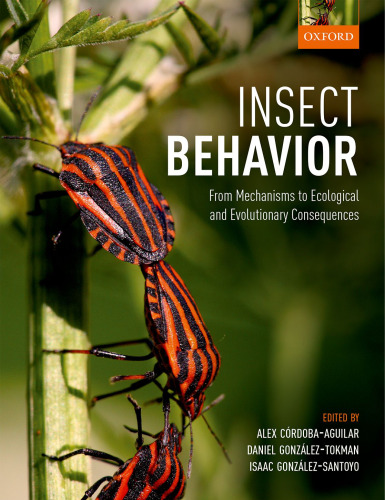
Insect behavior. From mechanisms to ecological and evolutionary consequences
2018 · PDF

Successful Scientific Writing: A Step-by-Step Guide for the Biological and Medical Sciences
2014 · PDF

Successful Scientific Writing: A Step-by-Step Guide for the Biological and Medical Sciences
2007 · PDF

Insect Behavior: 2nd Edition
2010 · PDF

Insect Behavior: 2nd Edition
2010 · PDF

Successful Scientific Writing: A Step-by-Step Guide for the Biological and Medical Sciences
2007 · PDF

Insect Behavior: 2nd Edition
2010 · PDF