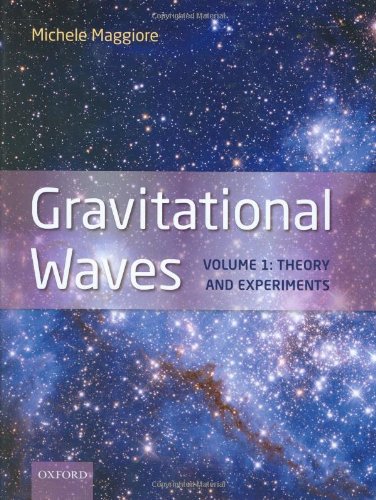
Gravitational Waves, Volume 1: Theory and Experiments
Book information
Description
This book deals with all aspects of gravitational-wave physics, both theoretical and experimental. This first volume deals with gravitational wave (GW) theory and experiments. Part I discusses the theory of GWs, re-deriving afresh and in a coherent way all the results presented. Both the geometrical and the field-theoretical approach to general relativity are discussed. The generation of GWs is discussed first in linearized theory (including the general multipole expansion) and then within the post-Newtonian formalism. Many important calculations (inspiral of compact binaries, GW emission by rotating or precessing bodies, infall into black holes, etc.) are presented. The observation of GWs emission from the change in the orbital period of binary pulsar, such as the Hulse-Taylor pulsar and the double pulsar, is also explained, and the pulsar timing formula is derived. Part II discusses the principles of GW experiments, going into the detail of the functioning of both interferometers and resonant-mass detectors. One chapter is devoted to the data analysis techniques relevant for GW experiments. Contents Preface Notation Part I: Gravitational-wave theory 1 The geometric approach to GWs 1.1 Expansion around flat space 1.2 The transverse-traceless gauge 1.3 Interaction of GWs with test masses 1.3.1 Geodesic equation and geodesic deviation 1.3.2 Local inertial frames and freely falling frames 1.3.3 TT frame and proper detector frame 1.4 1.4.1 Separation of GWs from the background 1.4.2 How GWs curve the background 1.4.3 The energy–momentum tensor of GWs 1.5 1.5.1 Geometric optics in curved space 1.5.2 Absorption and scattering of GWs 1.6 1.1. Linearization of the Riemann tensor in curved space 1.2. Gauge transformation of h_μν and R_μνρσ^(1) Further reading 2 The field-theoretical approach to GWs 2.1 Linearized gravity as a classical field theory 2.1.1 Noether’s theorem 2.1.2 The energy–momentum tensor of GWs 2.1.3 The angular momentum of GWs 2.2 Gravitons 2.2.1 Why a spin-2 field? 2.2.2 The Pauli–Fierz action 2.2.3 From gravitons to gravity 2.2.4 2.3 Massive gravitons 2.3.1 Phenomenological bounds 2.3.2 Field theory of massive gravitons 2.4 2.1. The helicity of gravitons 2.2. Angular momentum and parity of graviton states Further reading 3 3.1 3.2 3.3 3.3.1 3.3.2 3.3.3 3.3.4 3.3.5 3.4 3.5 3.5.1 3.5.2 3.6 3.1. Quadrupole radiation from an oscillating mass 3.2. Quadrupole radiation from a mass in circular orbit 3.3. Mass octupole and current quadrupole radiation from a mass in circular orbit 3.4. Decomposition of S^kl,m into irreducible representations of SO(3) 3.5. Computation of Further reading 4 4.1 4.1.1 4.1.2 4.1.3 4.1.4 4.2 4.2.1 4.2.2 4.3 4.3.1 4.3.2 4.4 4.4.1 4.4.2 4.5 4.1. Fourier transform of the chirp signal 4.2. Fourier decomposition of elliptic Keplerian motion Further reading 5 5.1 5.1.1 5.1.2 5.1.3 5.1.4 5.1.5 5.1.6 5.1.7 5.2 5.3 5.3.1 5.3.2 5.3.3 5.3.4 5.3.5 5.4 5.5 5.6 5.6.1 5.6.2 5.6.3 5.6.4 Further reading 6 6.1 6.2 6.2.1 6.2.2 6.2.3 6.3 Further reading Part II: Gravitational-wave experiments 7 7.1 7.2 7.3 7.4 7.4.1 7.4.2 7.4.3 7.5 7.5.1 7.5.2 7.5.3 7.6 7.6.1 7.6.2 7.6.3 7.7 7.7.1 7.7.2 7.8 7.8.1 7.8.2 7.8.3 Further reading 8 8.1 8.1.1 8.1.2 8.1.3 8.2 8.2.1 8.2.2 8.3 8.3.1 8.3.2 8.3.3 8.3.4 8.3.5 8.4 8.4.1 8.4.2 Further reading 9 9.1 9.1.1 9.1.2 9.2 9.2.1 9.2.2 9.2.3 9.3 9.3.1 9.3.2 9.3.3 9.3.4 9.4 9.4.1 9.4.2 9.4.3 9.4.4 9.5 9.5.1 9.5.2 Bibliography Index
Similar books

A Modern Introduction to Classical Electrodynamics
2023 · PDF

A Modern Introduction to Classical Electrodynamics
2023 · PDF

Gravitational Waves: Volume 2: Astrophysics and Cosmology
2018 · PDF

Gravitational Waves, Volume 1: Theory and Experiments
2008 · DJVU

Gravitational wave experiments and early universe cosmology
2000 · PDF

A Modern Introduction to Quantum Field Theory
2005 · PDF

A Modern Introduction to Quantum Field Theory
2004 · PDF
Gravitational Waves: Volume 1: Theory and Experiments
2007 · PDF