Athens from 1456 to 1920: The Town Under Ottoman Rule and the 19th-century Capital City
Book information
Description
Few people are aware that shortly after 1456, when Athens yielded without fighting to the bitter end, she had become one of the bigger Balkan towns within the Ottoman Empire. The limited area confined within the boundaries of the late Roman fortification walls soon developed into a town of thirty-six mahalles. A thorough analysis of the town/country relationship within the Ottoman feudal system of production in general, and as related to Athens in particular, reveals the dynamic conditions of urban development. Athens shared many of the characteristics of prosperity based on specific modes of appropriation of surpluses and patterns of division of labour between town and countryside. Strange though it might seem, it was only after the middle of the 17th century, when land-tenure conditions changed and Athens was heading towards decline, that an Ottoman character as such could be detected in its built environment, although Christians still strongly outnumbered Muslim citizens. That being so, the presence at that time in Athens of representatives of the European Enlightenment, hypnotized by the myth of its artistic and cultural treasures, did not affect the general conditions of development. In the 1830s, Athens, by that time a provincial town of secondary importance, was ordered to stride from feudalism to capitalism, to transform itself into a modern capital city of a new-born state. The shift from a small town under Ottoman rule to the modern city of the Hellenic Kingdom implied the quick transformation of belonging to a community (understood in terms of sharing common cultural characteristics) to a sense of being a member of a society (understood as an institution, as an externality demanding obedience). The amorphous masses of the medieval quarters that had arranged themselves so that unity within variety was established, where each particular architectural entity retained its meaning in so far as it was experienced as part of the whole urban fabric, had to give way to the early 19th-century planning environment, conceived more or less as a series of autonomous architectural identities understood only within a specific urban complex. It was not easy for Athens to cross the line in 1834. The rejection of the first plan should not be naively understood as an urban restructuring triggering the virulent dissent of those Athenian landowners who detected threats to their vested interests. A violent break with the past was necessary so that new compositional stratagems could be implemented. But ever since Athens became a capital city, the pendulum of its history swung dramatically between tradition and modernism, not least because nationalism kept propagating an idealistic vision of an historical continuum that ran from the glorious ancient past down to the euphoria of the modern Greek state. Although Athens did make steady steps towards becoming a modern , European-like city, comprehensive planning and centralized control of public works, as they had been essayed in central and western European cities in the second half of the 19th century, were totally incompatible with the build-as-you-please practice foisted on the capital city of Greece. Architectural and urban analysis of Athens between 1456 and 1920 discloses the metamorphosis of a town to a city, experienced as an invigorating adventure through the meandering routes of history. This is what this book is about.
Similar books

Athens from 1456 to 1920: The Town under Ottoman Rule and the 19th-Century Capital City
2014 · PDF

Athens from 1920 to 1940: A true and just account of how History was enveloped by a modern City and the Place became an Event
2016 · PDF
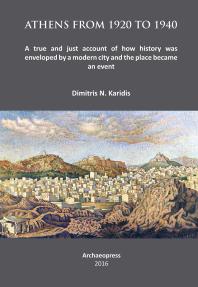
Athens from 1920 To 1940: A True and Just Account of How History Was Enveloped by a Modern City and the Place Became an Event
2016 · PDF

Schinkel ‘in Athens’: Meta-Narratives of 19th-Century City Planning
2022 · PDF

MySQL® Notes for Professionals book
2018 · PDF

MrExcel 2022: Boosting Excel
2022 · PDF

MrExcel 2022: Boosting Excel
2022 · PDF

Session C11: Ancient Cultural Landscapes in South Europe – their Ecological Setting and Evolution, Session C22: Gardeners from South America, Session S04: Agro-Pastoralism and Early Metallurgy Sessions, Session WS29: The Idea of Enclosure in Recent Iberian Prehistory, Session C88: Rhytmes et causalites des dynamiques de l'anthropisation en Europe entre 6500 ET 500 BC: Hypotheses socio-culturelles et/ou climatiques: Proceedings of the XV UISPP World Congress (Lisbon 4-9 September 2006) / Actes du XV Congrès Mondial (Lisbonne 4-9 Septembre 2006) Vol.36
2010 · PDF