Kafka’s Stereoscopes: The Political Function of a Literary Style
Book information
Description
In 1911, Franz Kafka encountered the Kaiser Panorama: a stereoscopic peep show offering an illusion of three-dimensional depth. After the experience, he began to emulate the apparatus in his literary sketches, developing a style we might call "stereoscopic," juxtaposing, like the optical stereoscope, two images of the same object seen from slightly different perspectives. Isak Winkel Holm argues that Kafka's stereoscopic style is crucial to an understanding of the relation between literature and politics in Kafka's work. At the level of content, the stereoscopic style offers a representation of the basic order of a specific community. At the level of form, the stereoscopic style is structured as the juxtaposition of two dissimilar images of the same community. At the level of function, finally, the style provokes a reconsideration, and perhaps even a reconfiguration, of the social order itself. With insights from literary studies, philosophical aesthetics and political theory, Kafka's Stereoscopes offers a detailed but highly readable argument for the relevance of Kafka's literary works in today's political reality. Cover page Series page Title page Copyright page Dedication Contents Figures Acknowledgments Abbreviations Introduction Kafka and the Political: In the Kaiserpanorama Telling him at the same time . . . The Configuration of Communal Life Three Theses Literature’s Creative and Beneficent Force Part I One We Don’t Want to Accept Him Living Together What is the Meaning Anyhow? Now It Is 6 Admittance to the Law State of Nature/State of Exception The Pawn of a Pawn The Problem of Group Formation Two They Are Not Human Beings When Six O’clock Comes, However A Swarm of Terms of Abuse Social Imaginaries Pre-Process The Intellectual Assertion of Existence Three Simultaneously Also Nothing No Real Connections True, but Truer Still Aesthetic Reflection Closing in on Schizophrenia Constructive Destruction Bourgeoisification of Nothingness Four Storming the Border Bulwarks of Silence That We Are What Difficult Things These Are Miracles in the Street A Common Bite Reflective Reconfiguration The Political Moment in “The Judgment” The Clocks Are Not in Unison Part II Five A Construction of Chance and Laws Cutting Up the Plot Loosened, Shredded, Wafting About Him Confused Jargon Six A Weakness of Imagination “China Complex” The Preconditions for the Work Stereoscopic China An Obscure Concept Subject to No Current Law We Cannot Go Forward Part III Seven A Matter of Justice Karl on the Balcony I Karl at the Head Cashier’s Office The Stereoscopic Passport With Only the Slightest Pressure The Stereoscopic Head Cashier’s Office A Higher Forum Karl on the Balcony II Eight I Speak for Them, Not for Myself The “Most Risky” Moment Far Too Corporeally Court and Apartment Building Political Assembly Private Organization The Stereoscopic Inquiry An Essential Disturbance The Man from the Country Nine As If the Whole of Existence Were Transformed The Arrival of a Land Surveyor Apparent Village Worker Unbotmässig The Stereoscopic Village The Tower Serrating the Blue Sky An End or a Beginning Conclusion Worthy of the Law: “On the Question of the Laws” The Character of the Laws On Three Questions of the Laws A Sigh of Relief Bibliography Index
Similar books

Stormløb mod grænsen: det politiske hos Franz Kafka
2015 · EPUB

Kierkegaard and Climate Catastrophe: Learning to Live on a Damaged Planet
2022 · PDF

Kierkegaard and Climate Catastrophe: Learning to Live on a Damaged Planet
2022 · EPUB
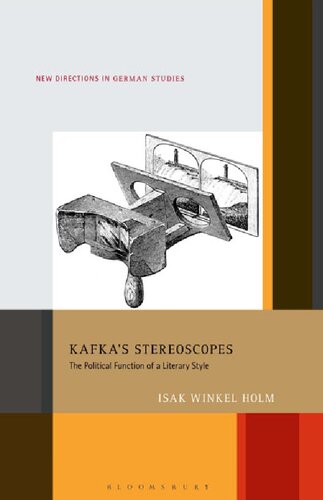
Kafka’s Stereoscopes: The Political Function of a Literary Style
2020 · PDF

MySQL® Notes for Professionals book
2018 · PDF

MrExcel 2022: Boosting Excel
2022 · PDF

MrExcel 2022: Boosting Excel
2022 · PDF

Session C11: Ancient Cultural Landscapes in South Europe – their Ecological Setting and Evolution, Session C22: Gardeners from South America, Session S04: Agro-Pastoralism and Early Metallurgy Sessions, Session WS29: The Idea of Enclosure in Recent Iberian Prehistory, Session C88: Rhytmes et causalites des dynamiques de l'anthropisation en Europe entre 6500 ET 500 BC: Hypotheses socio-culturelles et/ou climatiques: Proceedings of the XV UISPP World Congress (Lisbon 4-9 September 2006) / Actes du XV Congrès Mondial (Lisbonne 4-9 Septembre 2006) Vol.36
2010 · PDF