The Four Pillars of Geometry
Book information
Description
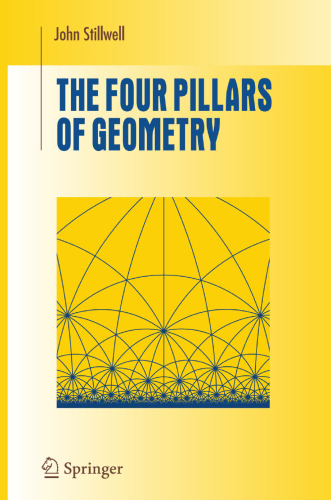
Many people think there is only one “right” way to teach geometry. For two millennia, the “right” way was Euclid’s way, and it is still good in many respects. But in the 1950s the cry “Down with triangles!” was heard in France and new geometry books appeared, packed with linear algebra but with no diagrams. Was this the new “right” way, or was the “right” way something else again, perhaps transformation groups? In this book, I wish to show that geometry can be developed in four fundamentally different ways, and that all should be used if the subject is to be shown in all its splendor. Euclid-style construction and axiomatics seem the best way to start, but linear algebra smooths the later stages by replacing some tortuous arguments by simple calculations. And how can one avoid projective geometry? It not only explains why objects look the way they do; it also explains why geometry is entangled with algebra. Finally, one needs to know that there is not one geometry, but many, and transformation groups are the best way to distinguish between them. Two chapters are devoted to each approach: The ?rst is concrete and introductory, whereas the second is more abstract. Thus, the ?rst chapter on Euclid is about straightedge and compass constructions; the second is about axioms and theorems. The ?rst chapter on linear algebra is about coordinates; the second is about vector spaces and the inner product.
Similar books
The Four Pillars of Geometry
2005 · PDF

Algebraic Number Theory for Beginners: Following a Path From Euclid to Noether
2022 · PDF

Sources of Hyperbolic Geometry
1996 · DJVU

The Real Numbers: An Introduction to Set Theory and Analysis
2013 · EPUB

The Real Numbers: An Introduction to Set Theory and Analysis
2013 · PDF

Numbers and Geometry
1997 · PDF

Yearning for the Impossible: The Surprising Truths of Mathematics, Second Edition (AK Peters/CRC Recreational Mathematics Series)
2018 · PDF

The Story of Proof: Logic and the History of Mathematics
2022 · PDF