On Pythagoreanism
Book information
Description
The purpose of the conference “On Pythagoreanism”, held in Brasilia in 2011, was to bring together leading scholars from all over the world to define the status quaestionis for the ever-increasing interest and research on Pythagoreanism in the 21st century. The papers included in this volume exemplify the variety of topics and approaches now being used to understand the polyhedral image of one of the most fascinating and long-lasting intellectual phenomena in Western history. Cornelli’s paper opens the volume by charting the course of Pythagorean studies over the past two centuries. The remaining contributions range chronologically from Pythagoras and the early Pythagoreans of the archaic period (6th-5th centuries BCE) through the classical, hellenistic and late antique periods, to the eighteenth century. Thematically they treat the connections of Pythagoreanism with Orphism and religion, with mathematics, metaphysics and epistemology and with politics and the Pythagorean way of life. Introduction 1 Historiography Pythagoreanism as an historiographical category: historical and methodological notes Approaching Pythagoras of Samos: Ritual, Natural Philosophy and Politics 2 Pythagoras and Early Pythagorean traditions When Pythagoras was still Living in Samos (Heraclitus, frg. 129) The Pythagorean Akousmata and Early Pythagoreanism Pythagoras Homericus: Performance as Hermeneutic Horizon to Interpret Pythagorean Tradition Orphics and Pythagoreans: the Greek perspective On the origin of the Orphic-Pythagorean notion of the immortality of the soul 3 Fifth and Fourth Century Pythagoreanism Philolaus on Number Archytas and the duplication of the cube 4 Reception by Plato, Aristotle and the Early Academy Plato and the Pythagoreans Philolaus and Plato on method, measure and pleasure Epicharmus and the plagiarism of Plato Pythagorean Number Doctrine in the Academy Early Pythagoreans in Aristotle’s account 5 Hellenistic and Late Antique traditions The Pythagorean Hypomnemata reported by Alexander Polyhistor in Diogenes Laertius (8.25–33): a proposal for reading Eudorus of Alexandria and the ‘Pythagorean’ pseudepigrapha Pythagoreanism in late antique Philosophy, after Proclus 6 Pythagorean heritage in Renaissance and modern times Ficino’s Pythagoras A modern approximation to Pythagoreanism: Boscovich’s “point atomism” Curricula Index of Topics Index locorum Index nominum
Similar books

Plato’s Styles and Characters: Between Literature and Philosophy
2016 · PDF

Plato's Phaedo: Selected Papers from the Eleventh Symposium Platonicum
2019 · PDF

Brill's Companion to the Reception of Pythagoras and Pythagoreanism in the Middle Ages and the Renaissance
2021 · PDF
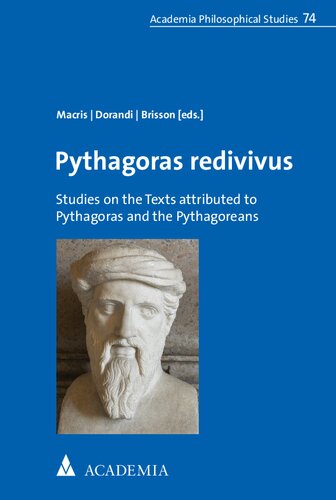
Pythagoras Redivivus: Studies on the Texts Attributed to Pythagoras and the Pythagoreans
2021 · PDF

MySQL® Notes for Professionals book
2018 · PDF

MrExcel 2022: Boosting Excel
2022 · PDF

MrExcel 2022: Boosting Excel
2022 · PDF

Session C11: Ancient Cultural Landscapes in South Europe – their Ecological Setting and Evolution, Session C22: Gardeners from South America, Session S04: Agro-Pastoralism and Early Metallurgy Sessions, Session WS29: The Idea of Enclosure in Recent Iberian Prehistory, Session C88: Rhytmes et causalites des dynamiques de l'anthropisation en Europe entre 6500 ET 500 BC: Hypotheses socio-culturelles et/ou climatiques: Proceedings of the XV UISPP World Congress (Lisbon 4-9 September 2006) / Actes du XV Congrès Mondial (Lisbonne 4-9 Septembre 2006) Vol.36
2010 · PDF