“Mystically Espoused to Christ, the Son of God (c. 604 §1)”: The Basis for Proposing Juridic Principles to Guide the Development of Norms for the Ordo virginum
Book information
Description
good treatment of why [the Holy Office in 1927 forbade public vows of virginity for women living in the world](https://christianity.stackexchange.com/a/71400/1787): "Explanations for the 1927 Denial" (PDF pp. 129-33)by the president of the [USACV ](https://consecratedvirgins.org/)(conservative *Novus Ordo* [Cdl. Burke](http://www.catholic-hierarchy.org/bishop/bburke.html) [was the "Episcopal Moderator of the Consecrated Virgins in the United States"](https://www.ewtn.com/catholicism/library/consecration-of-a-virgin-9170), *c.* 1995-2008; cf. his [May 31, 2020, message to consecrated virgins](https://youtu.be/jIUXMPLyA-I))[St. Thomas's explanation for why the Church doesn't consecrate violated virgins](https://christianity.stackexchange.com/a/82876/1787) helps explain why an intact virgin is a more perfect virgin than a violated one ([ *Super Sent.* lib. 4 d. 38 q. 1 a. 5 ad 4](https://aquinas.cc/la/en/%7ESent.IV.D38.Q1.A5.Obj1.12); transl. [Stegman](https://isidore.co/calibre#panel=book_details&book_id=7937) p. 53, PDF p. 71):> Those women who are corrupted through violence, if they do not consent in any way, do not lose the glory of virginity in the sight of God. But since it is extremely difficult that in such pleasure some impulse of enjoyment does not surge forth, therefore the Church, which cannot judge interior matters, does not veil a woman among virgins when she has been externally corrupted. For which reason Pope Leo says: *Those servants of God who have lost the integrity of their chastity by barbaric oppression will be more greatly praiseworthy in their humility and modesty, if they do not dare to unite themselves with uncontaminated virgins.*> illæ quæ per violentiam corrumpuntur, si nullo modo consentiant, virginitatis gloriam quo ad Deum non perdunt. Sed quia valde est difficile quod in tali delectatione aliquis placentiæ motus non insurgat, ideo Ecclesia quæ de interioribus judicare non potest, cum exterius corrupta sit, eam inter virgines non velat; unde Leo Papa dicit: *illæ famulæ Dei quæ integritatem pudoris oppressione barbarica perdiderunt, laudabiliores erunt in humilitate et verecundia, si se incontaminatis non audeant copulare virginibus*.* * *The 1970 revision of the rite of consecration to a life of virginity roused an ancient practice that had fallen into disuse over the centuries: the consecration of virgins who lived in the world, rather than in the enclosure of a monastery. Canon 604 of the 1983 Code of Canon Law juridically recognizes this restored *Ordo* *virginum* as “similar to” (accedit) other forms of consecrated life, defining members of the *Ordo* as those “who are mystically betrothed to Christ, the Son of God” through their consecration to God by the diocesan bishop.Drawing from analogous ecclesial law for both marriage and for institutes of consecrated life and societies of apostolic life, and in response to the expansion of the *Ordo* *virginum* throughout the world since 1970, this study proposes juridic principles that may be applied in the development of norms to govern the *Ordo*. Chapter one probes the theological underpinning of mystical espousal to Christ by examining the mystery of virginal nuptial love in the Most Holy Trinity, in the Blessed Virgin Mary, and in God’s bond with created man, revealed in both the Old and New Testaments. Chapters two and three study ecclesial law and liturgy in the development of the *Ordo* *virginum* as a stable way of life, from the earliest days of the Church to today. Employing a canon-by-canon analysis, chapter four considers analogous application of marriage law in the 1983 code to the mystical espousal to Christ that characterizes the *Ordo* *virginum* , and chapter five follows by considering an analogous application of the law on consecrated life to the *Ordo*.The study concludes by proposing thirty-four principles to guide the development of norms for the *Ordo* *virginum* in the following areas: juridical/theological identity; validity of consecration; governance; admission and formation of candidates; obligations and rights of members; apostolate; and separation of members from the *Ordo* *virginum*. The theological-juridical approach of this canonical study contributes to the Church’s appreciation and safeguarding of the vocation of consecrated virginity as “among the most excellent gifts bequeathed by Our Lord to His Bride, the Church.”
Similar books

De Unico Vocationis Modo
1990 · PDF

The One Bride: The Church and Consecrated Virginity
1965 · PDF

The Validity of Virginal Marriage: A Doctoral Dissertation Presented in the Theological Faculty of the Pontifical Gregorian University
1938 · PDF

The One Bride: The Church and Consecrated Virginity
1965 · PDF

St. John Chrysostom's "De virginitate" and "De non iterando coniugio": Translation and Commentary
1980 · PDF

The Validity of Virginal Marriage: A Doctoral Dissertation Presented in the Theological Faculty of the Pontifical Gregorian University
1938 · PDF

On God and Man: The Theological Poetry of St. Gregory of Nazianzus
2001 · PDF
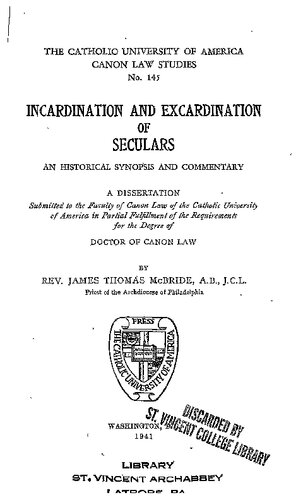
Incardination and Excardination of Seculars
1941 · PDF