The Other Germany
Book information
Description
After the success of their jointly published 1939 book Escape to Life, Erika and Klaus Mann swiftly began working on a follow-up project, which was issued by the New York publisher Modern Age Books in early 1940 under the title The Other Germany. Complementing their numerous lectures – educational talks about Germany, which they held across the USA – the siblings used their programmatically titled book to pursue the goal of convincing the Anglophone public of the existence of an “other Germany” beyond the Nazi regime. In their judgement, the fact that the majority of their fellow countrymen consorted with the dictatorship is more an expression of despair than of ideological conformity: “In all truth and justice we maintain that the overwhelming majority of the German people are bitterly disillusioned with Hitler. This majority urgently desire to be rid of him.” The basic assumption that the German people suffered political paternalism by a despicable regime – whether due to their naiveté, helplessness or despondent resignation – was publicly shared, at least initially, by numerous intellectuals who emigrated after 1933. According to their understanding, they themselves represented the true, real German culture, against which Nazism has sinned. As a slogan, “The Other Germany” thus meant a confrontational challenge and self-assurance in equal measure. The book of the same name by the Mann siblings, however, did not meet with a big audience: Only one print run was published and even after the War, it was never translated into German. Nach dem Erfolg ihres 1939 gemeinsam veröffentlichten Buches Escape to Life begannen Erika und Klaus Mann rasch mit den Arbeiten zu einem Nachfolge-Projekt, das unter dem Titel The other Germany Anfang 1940 im New Yorker Verlag Modern Age erschien. Ergänzend zu den zahlreichen „Lectures“ – aufklärerischen Vortragsreihen über Deutschland, die sie quer durch die USA führten – verfolgten die Geschwister mit der programmatisch betitelten Publikation den Zweck, die englischsprachige Öffentlichkeit von der Existenz eines „other Germany“ („anderen Deutschlands“) jenseits des NS-Regimes zu überzeugen. Den Umstand, dass sich die Mehrzahl der eigenen Landsleute mit der Diktatur arrangierte, werteten sie eher als Ausdruck von Mutlosigkeit statt von ideologischer Konformität: Die Mehrzahl der Deutschen, schrieben die Manns, sei von Hitler enttäuscht und wolle ihn loswerden („In all truth and justice we maintain that the overwhelming majority of the German people are bitterly disillusioned with Hitler. This majority urgently desire to be rid of him.”) Die Grundannahme der politischen Bevormundung der deutschen Bevölkerung durch ein verachtenswertes Regime – aus Naivität, Hilflosigkeit oder mutloser Resignation – wurde zumindest anfangs von zahlreichen nach 1933 emigrierten Intellektuellen öffentlich geteilt. Sie selbst repräsentierten nach eigenem Verständnis die wahre, eigentliche deutsche Kultur, an der sich der Nationalsozialismus versündigt habe. Als Schlagwort bedeutete „Das andere Deutschland“ somit gleichermaßen Kampfansage und Selbstvergewisserung. Dem gleichnamigen Buch der Geschwister Mann war indes kein großes Publikum beschieden: Es erschien nur in einer Auflage und wurde auch nach dem Krieg nie ins Deutsche übersetzt. Title Copyright Foreword Contents PROLOGUE: In the United States 1 Looking Backward 2 The German Republic 3 How Was It Possible? or Good-by to Berlin 4 Are the Germans Happy In the Third Reich? 5 Three Weeks of Personal History 6 After the Catastrophe Epilogue in the U. S.
Similar books

Rundherum : Abenteuer einer Weltreise
2018 · EPUB

Abenteuer einer Weltreise
2018 · EPUB

Das Buch von der Riviera
2018 · EPUB
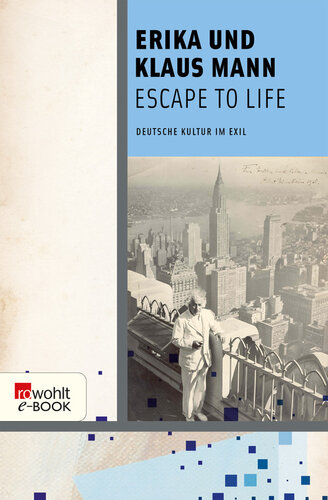
Escape to Life : Deutsche Literatur im Exil
2009 · EPUB

MySQL® Notes for Professionals book
2018 · PDF

MrExcel 2022: Boosting Excel
2022 · PDF

MrExcel 2022: Boosting Excel
2022 · PDF

Session C11: Ancient Cultural Landscapes in South Europe – their Ecological Setting and Evolution, Session C22: Gardeners from South America, Session S04: Agro-Pastoralism and Early Metallurgy Sessions, Session WS29: The Idea of Enclosure in Recent Iberian Prehistory, Session C88: Rhytmes et causalites des dynamiques de l'anthropisation en Europe entre 6500 ET 500 BC: Hypotheses socio-culturelles et/ou climatiques: Proceedings of the XV UISPP World Congress (Lisbon 4-9 September 2006) / Actes du XV Congrès Mondial (Lisbonne 4-9 Septembre 2006) Vol.36
2010 · PDF