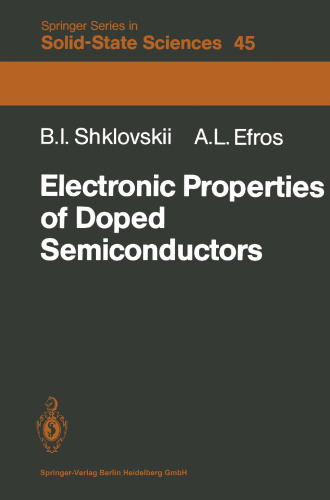
Electronic Properties of Doped Semiconductors
Book information
Description
First-generation semiconductors could not be properly termed "doped- they were simply very impure. Uncontrolled impurities hindered the discovery of physical laws, baffling researchers and evoking pessimism and derision in advocates of the burgeoning "pure" physical disciplines. The eventual banish ment of the "dirt" heralded a new era in semiconductor physics, an era that had "purity" as its motto. It was this era that yielded the successes of the 1950s and brought about a new technology of "semiconductor electronics". Experiments with pure crystals provided a powerful stimulus to the develop ment of semiconductor theory. New methods and theories were developed and tested: the effective-mass method for complex bands, the theory of impurity states, and the theory of kinetic phenomena. These developments constitute what is now known as semiconductor phys ics. In the last fifteen years, however, there has been a noticeable shift towards impure semiconductors - a shift which came about because it is precisely the impurities that are essential to a number of major semiconductor devices. Technology needs impure semiconductors, which unlike the first-generation items, are termed "doped" rather than "impure" to indicate that the impurity levels can now be controlled to a certain extent.
Similar books

Opticals Effects in Liquid Crystals
1991 · PDF
Electronic Properties of Doped Semiconductors
1984 · PDF

Handbook of Nano-Optics and Nanophotonics
2013 · PDF

Semiconductor physics
2014 · PDF

Femtosekundenlaser: Einführung in die Technologie der ultrakurzen Lichtimpulse
2016 · PDF

Licht in der Welt der Nanotechnologie : Ein verständlicher Einstieg in die Grundlagen und Anwendungen
2016 · PDF

Handbook of Solar Energy: Theory, Analysis and Applications
2016 · PDF

A Practical Guide to Lightcurve Photometry and Analysis
2016 · PDF